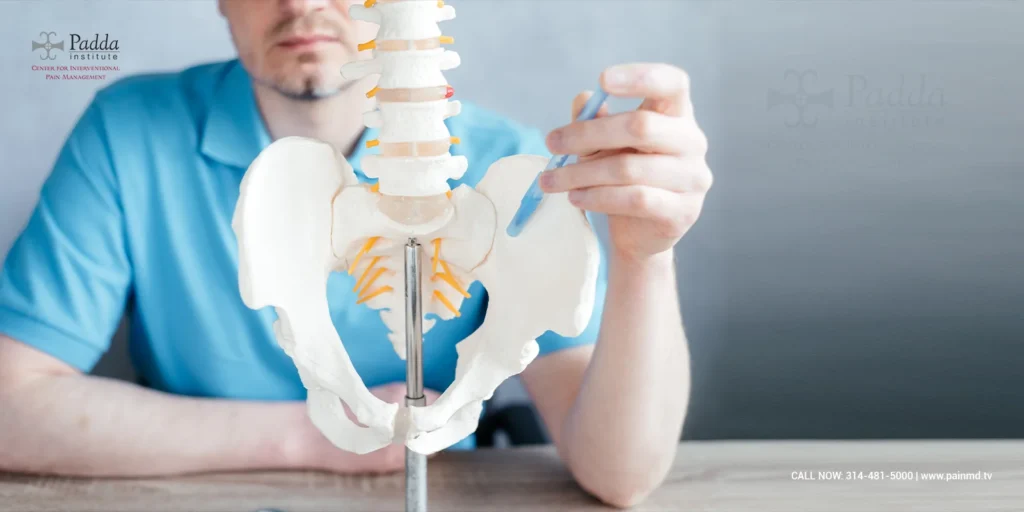
Summary: Low back pain is pretty common. Most people have lower back pain from sciatica, a bulging disk or a worn-out spinal disk. But in some cases, low back pain may come from sacroiliac joint problems. Sacroiliac joint pain is hard to diagnose. Its signs look like low back pain from other causes. Pain specialists ask people with low back pain to keep a journal. That is because pain from a bulging disk and pain from the sacroiliac joint differ in small ways. A timely diagnosis helps doctors treat the problem better.
Low back pain is among the most common causes of chronic pain. It often hits women of childbearing age. So it first strikes people at quite a young age. Low back pain causes constant pain, stiffness, and trouble walking. The pain often spreads to the legs. It causes pain and even numbness there.
The most common cause of back pain is a herniated disk or a worn disk. But in a small number of cases, this pain may come from changes in the sacroiliac joint. The problem is that doctors are more likely to look for the more common causes. So they may often miss the real cause of back pain.
Imaging makes this worse. Doctors order scans, but most people show low back changes like a worn disc or a bulging disc. So doctors are quick to blame the spinal disc for the patient’s low back pain.
When the real cause of low back pain is missed, treatment falls short. Of course, painkillers like opioids help, because they mute any kind of pain. But when doctors miss the real cause, they cannot give full relief. Patients often end up on painkillers for a long time.
Sacroiliac joint pain may occur due to many reasons like pregnancy, arthritis, infection, and other issues. People who had motor vehicle accidents are also more likely to have low back pain from the sacroiliac joint.
If the problem is never diagnosed, treatment falls short. For example, doctors would often recommend local steroid injections to shrink the bulging disk. The shot may help reduce the bulge. But if the pain comes from the sacroiliac joint, these shots fail to give any lasting relief. In many cases, patients may feel no benefit at all after them.
Why do doctors so often miss pain from the sacroiliac joint? This joint barely moves. Strong ligaments hold it in place. So it is less likely to be affected.
For low back pain, doctors often suggest physical therapy. But most of this therapy targets the lower spine, not the sacroiliac joint. It works on the core muscles instead. That may help a bit, but it also fails to give full relief.
How Can You Tell if Low Back Pain Is From the Sacroiliac (SI) Joint?
Telling the two apart can be hard. Low back pain and sacroiliac joint pain may cause similar symptoms. Still, there are some small differences.
With lower back pain from a bulging disc or sciatica, the pain runs down the leg. It often reaches the lower leg and causes severe pain and numbness. The pain is also centered in the lower back. With the sacroiliac joint, the pain sits a bit lower, and you can point to the spot. The pain may also spread to the leg. But it does not reach the lower leg and usually stays above the knee.
A bulging disc also causes more leg weakness than sacroiliac pain does. With low back pain, some people may even lose bowel or bladder control. MRI is a useful tool for finding the cause of low back pain, but it is not perfect. Many people with sacroiliac joint pain may also have changes in the lower back, like a bulging disc or a worn disc.
In most cases, experienced doctors can tell the two apart. But patients must describe their pain clearly. That is why pain specialists ask people with low back pain to keep a journal. Write down the type of pain, what sets it off, when it happens, what it feels like, and more. All of this helps your doctor sort out the cause of your low back pain.
Padda Institute of Pain Management not only offers Sciatica Nerve Pain Treatment but also dedicated treatments for lower back pain due to spine injuries, sacroiliac joints, etc.
Frequently asked questions
What causes sacroiliac joint pain?
Sacroiliac joint pain can come from pregnancy, arthritis, infection and other problems that affect the joint where the spine meets the pelvis. People who have been in a motor vehicle accident are also more likely to have low back pain that starts in the sacroiliac joint rather than in a spinal disc.
Does SI joint pain go below the knee?
Usually not. Sacroiliac joint pain sits a little lower than typical low back pain, and you can often point to the exact spot. It may spread into the leg, but it usually stays above the knee. Pain from a bulging disc or sciatica tends to travel into the lower leg, with numbness and more noticeable leg weakness.
Why is sacroiliac joint pain so often missed?
Doctors look for the common causes first, and imaging shows disc bulges or disc wear in most adults, so the disc gets the blame. The SI joint is held firmly in place by strong ligaments and moves very little, so it is easy to overlook. When it is missed, disc injections and core-strengthening therapy give little or no lasting relief.
What should I write in a back pain journal?
Write down the type of pain, what sets it off, when it happens and what it feels like, along with where it spreads. These small details are what help an experienced physician tell sacroiliac joint pain apart from pain caused by a bulging disc or sciatica, which leads to a faster, more accurate diagnosis and better treatment.
Dr. Gurpreet Singh Padda, MD, MBA, MHP