
Summary: Opioids are often used to manage persistent cancer pain. But the new study finds too little data to show that they work. There appear to be very few RCTs proving they work for cancer pain. Most studies on the topic are either small or old.
Opioids have long been the backbone of cancer pain care. But this new study shows a surprising lack of placebo-controlled trials to back them up. The gap is most striking for widely used opioid painkillers such as morphine, methadone, buprenorphine, fentanyl, hydromorphone, oxycodone, and tramadol. The largest placebo-controlled trial here tested tapentadol. It showed a higher response rate than placebo, but the size of the effect was unclear. Studies of codeine suggest some benefit for mild-to-severe cancer pain. But those studies were mostly small and did not match how the drug is used in real clinics.
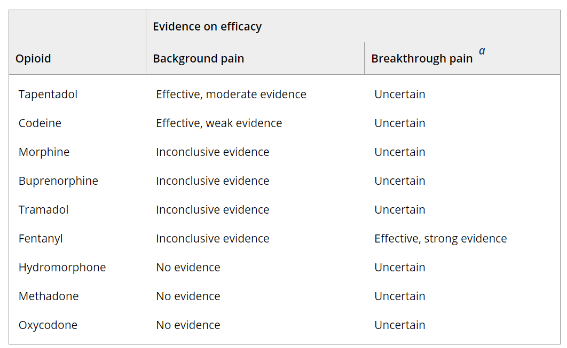
A summary of the evidence (Table 1 below) shows that each opioid has a different level of proof. Moderate evidence supports tapentadol for background pain. Fentanyl has strong evidence for breakthrough pain. But for many other common opioids, the evidence is unclear or missing. That makes it hard to write treatment guidelines. It is harder still because cancer pain comes in many types and stages. Chronic cancer pain also needs a different approach than end-of-life care.
Table 1 Summary of evidence on the efficacy of opioid analgesics compared with placebo.
Morphine is often recommended first for moderate-to-severe cancer pain because it is good value and seen as helpful. But it can be hard to use in patients with liver or kidney damage, because those organs break it down and clear it. Outside of end-of-life care, trials comparing morphine with placebo show mixed results. More studies are needed to pin down its role and how well it works.
This latest study also points to non-opioid options and add-on therapies for cancer pain. NSAIDs, such as aspirin, piroxicam, ketorolac, and diclofenac, have shown efficacy comparable to opioids for moderate-to-severe cancer pain. So these non-opioid options could be useful. They could matter most for patients who want to avoid opioids. They could also help patients who want to cut opioid doses because of the risk of tolerance and dependency. But most of these studies are old and small. More research is needed to confirm the findings.
Prescribing opioids for cancer pain means weighing the harms. These include opioid use disorder, hyperalgesia (a state where the drug makes you more sensitive to pain), tolerance, and dependency.
There is also growing concern that opioids, especially morphine, may weaken the immune system. But current studies have design flaws, such as confounding bias (when a hidden factor skews the result). The association between opioid use and risks like infection or tumor growth is still uncertain. That is why experts are calling for larger, well-designed clinical studies.
We also need to understand cancer pain better and sort it into subtypes. That would let doctors fit opioid therapy to each patient. Nonpharmacologic treatments (care without drugs) deserve a closer look too. They could be used alone or with painkillers as pain management strategies. More research is also needed on therapies that ease opioid side effects, such as anti-nausea drugs and laxatives. That would improve patient care and results.
Are opioids effective for cancer pain?
The new study shows a significant gap in the evidence that common opioid painkillers work for cancer pain. We badly need more rigorous trials with clearly defined groups of patients. Those trials would let doctors make better decisions.
Frequently asked questions
What is the best opioid for treating cancer pain?
No single opioid has strong proof across the board. In this review, tapentadol had moderate evidence for background pain. Fentanyl had strong evidence for breakthrough pain. Morphine is often recommended first because it costs less. Yet its trials against placebo outside end-of-life care conflict. It is also harder to use when the liver or kidneys are impaired.
What is the best painkiller for cancer patients?
It depends on the type and stage of the pain, and the evidence is thinner than most people assume. NSAIDs such as aspirin, piroxicam, ketorolac and diclofenac matched opioids for moderate-to-severe cancer pain in the studies reviewed. So they are worth weighing for patients who want to avoid opioids or lower the dose. Still, those studies were small and old.
What are the risks of taking opioids for cancer pain?
The known risks are opioid use disorder, tolerance, dependency and hyperalgesia. Hyperalgesia is a state where the drug makes you more sensitive to pain. Researchers are also studying whether opioids, morphine in particular, weaken the immune system. If so, they could raise the risk of infection or tumor growth. That link is still unproven. Side effects often call for extra medicines, such as anti-nausea drugs and laxatives.
Source:
Abdel Shaheed, C., Hayes, C., Maher, C. G., Ballantyne, J. C., Underwood, M., McLachlan, A. J., Martin, J. H., Narayan, S. W., & Sidhom, M. A. (2024). Opioid analgesics for nociceptive cancer pain: A comprehensive review. CA: A Cancer Journal for Clinicians, 74(3), 286–313. https://doi.org/10.3322/caac.21823
Dr. Gurpreet Singh Padda, MD, MBA, MHP


