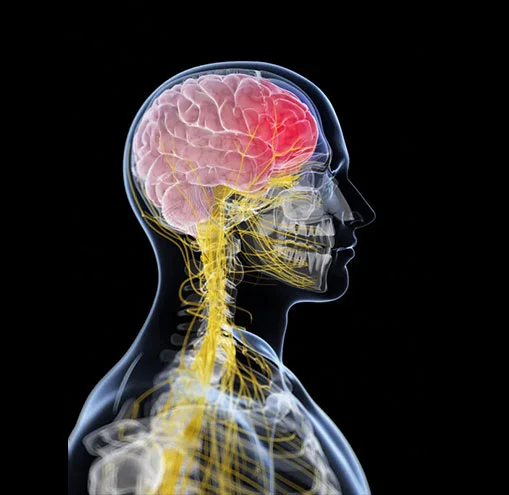
Headache goes back to ancient times. At the dawn of civilization, early headache cures tried to drive out the “demons and evil spirits” that people thought caused headaches. Skulls from as early as the Neolithic period, back to 7000 BC, have man-made holes in them (called trephination). These were likely made for medical reasons, which may have included treating headache. Skulls with trepanation have also been found in Peru, dating back to the thirteenth century. The early Greeks wrote of headache as a serious medical problem. Hippocrates (400 BC) may have been the first to describe the symptoms of migraine.
In his books, Hippocrates wrote about what seems to be the visual aura that can come before a migraine. The word “migraine” itself comes from the Greek word hemicrania (half of the head). Over the centuries, famous people such as Plato, Thomas Willis, Erasmus Darwin (Charles Darwin’s grandfather), and others added to what we know about headache. In more recent times, Dr Harold Wolff played a key role in sorting headaches into types and in how we treat them. In 1948 he published the first edition of his classic book, Wolff’s Headache. Dr Wolff then brought in key scientific ideas that made the study of headache modern. Since then, headache research has exploded, and we understand the condition much better. Science now shows more clearly how some headaches, such as migraine, work inside the body.
This has also led to new drugs made just for migraine, special pain care methods, and in the end, better ways to treat it. Migraines have hit people for centuries and have shaped world history. Many famous people have had severe headaches. Julius Caesar, Napoleon, Ulysses S. Grant and Robert E. Lee all had migraines. So did great painters Vincent Van Gogh, Georges Seurat and Claude Monet. So did famous authors Virginia Woolf, Cervantes (best known for Don Quixote) and Lewis Carroll (Alice’s Adventures in Wonderland). Thomas Jefferson spent six weeks in bed with a migraine. Then, in a burst of hard work, he wrote the Declaration of Independence.
There is even evidence to suggest that at least some of Alice’s Adventures came from the visual auras of Carroll’s own migraines. As Cheshire Cat observed, “One pill makes you smaller; one pill makes you larger, the pills mother gives you do nothing at all”. Writings indicate that Thomas Jefferson’s headaches were so severe that they often kept him from getting through the day.
As he wrote to Martha Jefferson on February 18, 1784, “Having to my habitual ill health….lately added an attack of my periodical headache; I am obliged to avoid reading, writing, and almost thinking”. In March 1807, while still President, Jefferson wrote “…Indeed, I have but little moment in the morning in which I can either read, write, or think, being obliged to be shut up in a dark room from early in the forenoon till night, with a periodical headache”.
Headache patients are one of the largest groups seen in a neurology practice. More people see a doctor for headache than for any other single problem. Headache, and migraine most of all, may be thought of as part of being human. Yet it is still missed, misnamed and mistreated. For some people, a headache is a nuisance that comes now and then. For others, it is the sign of a disabling long-term disease. For that second group, headache breaks up the day and drags down their lives. How often headaches strike, how bad they get and what they do to a life varies widely. The causes of headache are different from person to person.