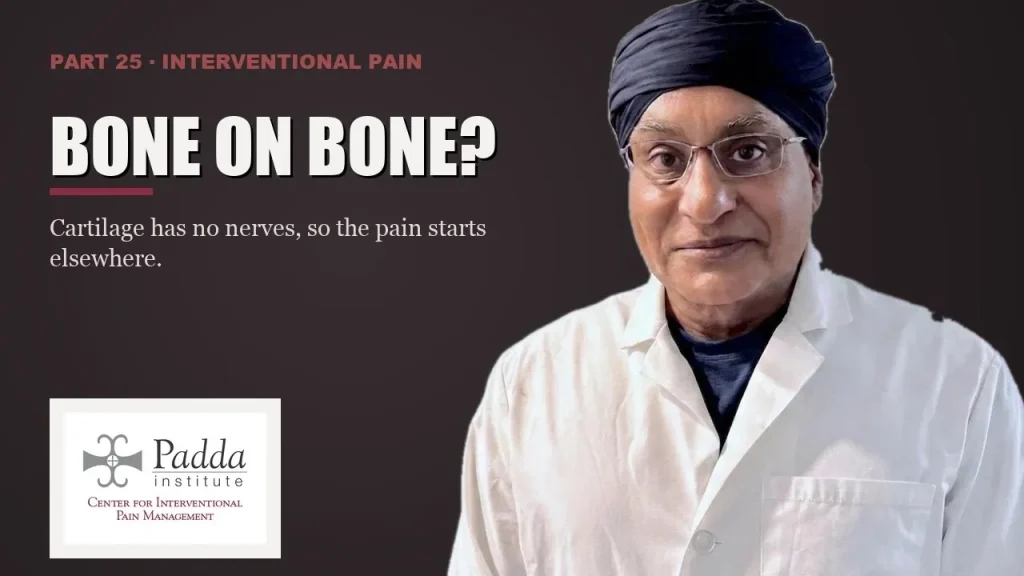
What this video covers
- Why cartilage has no nerves, and where knee arthritis pain is really made
- What the genicular nerves are. How a diagnostic block helps predict who is likely to respond to ablation. Why a single positive block can still be a false positive
- How radiofrequency ablation blocks pain signals without cutting bone or making the knee unstable. Why the long-term effect of shutting off the nerve supply to (denervating) a weight-bearing joint is still unsettled
- What the controlled trials actually measured: 12 weeks in the sham-controlled trial, 12 to 24 weeks in the pooled analysis. Why the often-quoted three to twelve months of relief is clinical habit, not a trial result
- The material risks: bleeding or injury to the genicular artery, infection, a numb patch of skin over the knee, painful dysesthesia or neuroma, thermal and grounding-pad burns, a short pain flare, radiation from fluoroscopy, and rare reports of osteonecrosis or fracture near the ablation site. Plus the honest limits. Roughly 4 in 10 carefully selected patients do not reach 50 percent relief. The treated nerves regrow, so the procedure is often repeated. And ablation does not slow the arthritis itself
- What the pooled placebo-controlled data show about viscosupplementation. Its own risks of acute inflammatory or pseudoseptic flare and joint infection. Why the AAOS 2021 and ACR 2019 osteoarthritis guidelines advise against its routine use
- MEDICAL DISCLAIMER: This content is for educational purposes only and is not medical advice. It does not substitute for professional diagnosis or treatment. Always consult a licensed healthcare provider regarding your condition. Viewing this video does not establish a doctor-patient relationship.
Knee arthritis pain does not come from the cartilage, which has no nerves. It is made in the tissues around it that do have nerves: the inflamed synovium, the subchondral bone, the joint capsule and periosteum, and the fat pad. The small genicular nerves carry that signal out of the knee.
You count stairs now. Thirteen down to the garage. Somewhere around the fourth step, the inside of the knee gives that hot, grinding catch. Your hand is on the railing before you decided to reach. Then there is the part nobody warned you about: it aches while you lie still. Arthritis was supposed to hurt when you moved. No one said it would wake you at two in the morning. You were handed an X-ray and the words bone on bone. You got a steroid shot that lasted six weeks, then four, then two. Then some gel injections, and a visit in three months. That is a calendar, not a plan. This article explains where knee arthritis pain is really made. It covers what the small nerves called the genicular nerves do. And it shows what the controlled evidence does — and does not — support.
What causes knee arthritis pain if cartilage has no nerves?
Start with the fact that changes everything else: articular cartilage has no nerve supply. None. The smooth surface that looks worn on your X-ray has no pain fibers. So it cannot, by itself, make a pain signal.
So where is the pain made? In the tissues around the cartilage that do have nerves:
- The synovium, the joint’s lining, inflamed and thickened.
- The subchondral bone beneath the cartilage plate. It is packed with nerves, reshapes itself under load, and is prone to tiny fractures.
- The joint capsule and the periosteum, the sensitive membrane covering bone.
- The infrapatellar fat pad.
This is why knee osteoarthritis is best seen as a whole-joint disease and not a cartilage disease. It is also why radiographic severity tracks pain only loosely. People with dramatic X-rays can have mild pain. People with mild X-rays can be in serious trouble. (Established.)
On top of that comes a chemical change. Nerve growth factor rises in the arthritic knee. It makes the nerve endings in those tissues more sensitive, until ordinary load starts reading as injury. That is peripheral sensitization — the volume knob on the joint’s own nerves turned up.
Why does knee arthritis hurt on the stairs and at night?
The stair pain and the night pain come from two different places. That is why treating one rarely fixes the other.
The stairs are mechanical. Body weight is multiplied across that joint with every step. Going down stairs is where you feel that math most. In a sensitized joint, ordinary load reads as injury. So the catch on the fourth step is real tissue reporting real strain.
The two-in-the-morning ache is not. Keep that sensitized signal going long enough, and the spinal cord’s dorsal horn starts to amplify it on its own — central sensitization. The nerve traffic keeps firing after the joint has gone still. That explains the symptom that confuses patients most. Pain at rest, pain in bed, pain that has stopped waiting for you to move. It is not weak character, and it is not “arthritis behaving strangely.” It is a nervous system that has listened to an inflamed joint for years. It has changed how it listens.
What are the genicular nerves?
The front of the knee capsule gets its feeling from a set of small sensory branches called the genicular nerves. They are pure messengers. They carry feeling. They do not move the leg.
Three are the usual targets in interventional practice:
- Superior medial, at the junction of the femoral shaft with the medial epicondyle.
- Superior lateral, at the junction of the femoral shaft with the lateral epicondyle.
- Inferior medial, at the junction of the tibial shaft with the medial epicondyle.
The inferior lateral genicular nerve is left alone on purpose. The common peroneal nerve — which lifts the foot — runs too close to it. A foot drop is not an acceptable price for a knee.
One more fact of anatomy shapes the technique. These nerves travel alongside the genicular arteries. That is why the needle is placed under live imaging — fluoroscopy, ultrasound with color Doppler, or both. It is not guessed by feel.
Is your knee pain really coming from arthritis in the knee?
None of this faults the doctors who prescribed your anti-inflammatories or gave you a steroid injection. Symptom-control drugs and a well-timed steroid shot into the joint do something real. They lower inflammation and buy function. What they do not do is answer the question of which structure is generating your pain.
The usual failure is skipping straight to treatment without ever proving the knee is the source. Several conditions cause knee pain that does not come from the genicular pathway at all:
- Hip osteoarthritis sends pain into the inner knee while the knee exam is completely normal. Turning the hip inward brings the pain on.
- L3 or L4 radiculopathy sends pain from the spine into the front of the thigh.
- Pes anserine bursitis is tender below the joint line, not inside the joint.
- Subchondral insufficiency fracture and osteonecrosis are MRI diagnoses, not X-ray diagnoses.
- Crystal arthropathy — gout or pseudogout — acts differently and is treated differently.
- A locked meniscus is a mechanical, surgical problem. Silencing the nerves that report it is a serious mistake.
- A hot, swollen joint is septic until proven otherwise.
An exam, standing X-rays, lab work, and MRI when needed exist to clear that list before anything is injected. This part is not optional. It is the part a fifteen-minute visit tends to lose.
The first procedure is a question, not a treatment
A diagnostic genicular nerve block places a small volume of local anesthetic on those sensory branches under imaging. Then you go out, use the knee, and write down what happens, hour by hour.
If those nerves are carrying your pain, it falls sharply — and briefly. If it does not fall, there are two possible reasons, and they are not the same finding. Either the pain is made somewhere other than that pathway. Or the anesthetic never reached the branch it was aimed at. That difference has to be settled before anyone makes a lesion.
Two honest qualifiers belong here. A block can be falsely positive, and it can be falsely negative. The volume is kept small precisely so the anesthetic cannot spread onto nearby structures and fake a positive. And an unclear result gets repeated, not explained away.
Understand what the block does and does not do: it helps predict who is likely to respond to ablation. It does not prove anything.
Practical safety point: no sedation is used, and most patients drive themselves home and return to normal activity within two to four hours. The anesthetic can leave the leg temporarily weak. If it does, arrange a ride and do not drive until the strength returns.
What ablation does — and what the trials actually measured
Genicular radiofrequency ablation follows a clear block. Electrodes are placed at the same targets under fluoroscopy. Before any lesion is made, a low-level current is used to test: sensory testing confirms the tip is on the branch carrying your pain, and motor testing confirms it is not on anything that moves the leg. Only then is tissue heated. The nerve fibers go through Wallerian degeneration — an orderly breakdown of the fiber past the lesion — and stop sending signals.
No bone is cut. No ligament is divided. The knee is no less stable. But the lesion sits against periosteum, and heat is delivered next to bone. That is why the rare bone problems named below are real, not theoretical. The full detail — how the targets are chosen, what the day looks like, what recovery involves — is on the genicular radiofrequency ablation treatment page.
Now the math, stated plainly.
The sham-controlled trial. Choi and colleagues published a double-blind, sham-controlled randomized trial in Pain in 2011. Thirty-eight elderly patients were randomized. All had knee osteoarthritis pain lasting beyond three months. All had failed conservative care. All had a positive diagnostic genicular block. In the treated arm, 10 of 17 analyzed patients — 59 percent — reached at least 50 percent relief at 12 weeks. No sham patient did. Then weigh that number by its size: 38 randomized, 17 analyzed in the treated arm, and 12 weeks is where that trial ended. It says nothing about six months or a year. (Controlled evidence — but a single small trial, and only out to 12 weeks.)
The pooled analysis. A 2026 systematic review and meta-analysis by Barreto and colleagues in Pain Medicine pooled eight sham-controlled trials. They covered 627 adults with knee osteoarthritis who were ineligible for joint replacement. At 12 weeks, treated groups averaged 1.65 points better on a 0-to-10 pain scale than sham (95% CI −2.57 to −0.74) and about 11.4 points better on WOMAC function (95% CI −18.83 to −3.91). Those are averages of a difference, not a promise to you. And the honest caveat belongs in the same breath: heterogeneity was very high (I² = 83 percent for pain and 91 percent for function). That means the trials barely agree with each other. Long-term data are sparse. (Established but low-certainty; do not read it as more than it is.)
A detail worth knowing before you consent. In a subgroup look within that pooled review, the best technique was conventional monopolar radiofrequency, not the cooled system that carries the regulatory clearance. Ask which device and which technique is planned for you.
What the trials do not say. The commonly quoted three to twelve months of relief is clinical convention, not a trial result — something seen in practice, not a controlled finding. Individual results vary. Nerves grow back, so repeat treatment is normal. Roughly four in ten carefully selected patients never reach 50 percent relief. Ablation does not slow the arthritis. And the long-term effect of shutting off the nerve supply to (denervating) a weight-bearing joint is still unsettled. (Contested and unresolved — presented as such deliberately.)
Gel shots: what the pooled placebo-controlled data show
Viscosupplementation — hyaluronic acid injected into the joint and described as lubrication — deserves a plain answer. That is because most patients are given a warmer one.
In 2022, Pereira and colleagues pooled 15 large placebo-controlled trials in the BMJ. They covered more than 6,000 patients. Pain reduction against placebo was about 2 millimeters on a 100-millimeter scale (SMD −0.08; 95% CI −0.15 to −0.02). That is smaller than the review’s prespecified minimal clinically important difference. It is far below any bar the field sees as meaningful to a patient. Serious adverse events were more common in the treated groups: relative risk 1.49 (95% CI 1.12 to 1.98). Hyaluronic acid carries its own harms, including acute inflammatory or pseudoseptic flare and joint infection.
The American Academy of Orthopaedic Surgeons (2021) and the American College of Rheumatology (2019) both advise against its routine use in knee osteoarthritis. (Established guideline position.)
Saying this costs practices money, including this one. It is still the honest read of the data.
What helps knee arthritis pain without a needle?
Two things deserve most of your effort, and neither involves a needle.
Quadriceps and hip abductor strengthening. A weak quadriceps lets the joint soak up load the muscle should have taken. Rebuilding it changes how force crosses the knee on every step.
Weight management. Body weight is multiplied across that joint with each stride. So change here has leverage nothing else matches.
Diet plans, omega-3-derived specialized pro-resolving mediators, and red and near-infrared light are used at this practice around these procedures. For knee osteoarthritis, the mechanisms come mostly from lab and animal work, and the human trials are small. These are adjunctive and emerging, and never the reason a procedure worked. Individual results vary.
An honest picture of a good outcome
What follows is a composite — a picture built from many patients with this condition, not one person’s chart.
Someone in their late sixties. Arthritis in both knees, worse on the right. A heart history and body weight that made a surgeon unwilling to operate. Two steroid injections, each lasting less than the one before. Gel injections, no change. Hip and low back exams normal, no extra fluid in the knee, no fever. A diagnostic block dropped the pain from seven to two for about four hours, with the expected temporary leg weakness — someone else drove home. Then cooled radiofrequency ablation.
The first ten days were worse. A pain flare, ice, a phone call on day six asking whether this had been a mistake. Relief settled in over about three weeks. Not zero pain — roughly half. Enough to take back the stairs, sleep on that side, and load the quadriceps in therapy. The numb patch of skin above the kneecap is permanent. Around six months the pain began returning as the nerves regrew. The ablation was repeated after a second talk about the same modest numbers.
Six months was chosen for that composite on purpose. Some people get longer. Some get much less. The sham-controlled evidence stops at 12 to 24 weeks. So nobody — including your physician — can tell you in advance which you will be. That is the shape of a truly good result: partial, time-limited, repeatable. Individual results vary.
Risks, and who should not have this
This is not for you if you have an active joint or skin infection, a locked meniscus, or untreated inflammatory arthritis. The same goes for a bleeding risk or blood thinner that cannot safely be paused.
The material risks of genicular block and ablation: bleeding or injury to a genicular artery, infection, a numb patch of skin over the knee, painful dysesthesia or neuroma formation, thermal and grounding-pad burns, a pain flare lasting days, radiation exposure from fluoroscopy, temporary leg weakness and fall risk after the block, no meaningful benefit in roughly 4 of 10 selected patients, and rare reports of osteonecrosis or periarticular fracture near the treated site.
Frequently asked questions
My X-ray says bone on bone. Why does my knee ache when I am not even moving it?
Because the tissue that looks worn on the film is not the tissue that hurts. Articular cartilage has no nerve supply. So the pain is made in the structures around it that do have nerves — inflamed synovium, reshaping subchondral bone, capsule, periosteum and fat pad. Ache at rest and pain that wakes you at night usually reflect sensitization. Nerve growth factor turns up the sensitivity of the joint’s own nerve endings. Over time the spinal cord amplifies that signal on its own. That is also why X-ray severity tracks pain only loosely, in both directions.
What is a genicular nerve block, and does a good result prove the nerves are the problem?
It is a small volume of local anesthetic placed on the sensory branches of the front of the knee capsule under imaging. Then you spend hours recording your pain while you use the knee normally. It helps predict who is likely to respond to ablation — but it does not prove anything. A block can be falsely positive and it can be falsely negative. An unclear result should be repeated, not explained away. No sedation is used, and most patients drive themselves home. If the anesthetic leaves the leg temporarily weak, arrange a ride and do not drive until it wears off. Individual results vary.
For how ablation follows a positive genicular block, read Genicular Nerve Ablation: Treating Knee Pain Without Treating the Joint.
How long does genicular radiofrequency ablation last, and can it be repeated?
The often-quoted three to twelve months is clinical habit, not a trial result. It is something seen in practice, not a controlled finding. What the controlled evidence actually measured is shorter. The sham-controlled trial by Choi and colleagues ended at 12 weeks. There, 10 of 17 analyzed patients in the treated arm — 59 percent — reached at least 50 percent relief, and no sham patient did. The pooled analysis reports a 1.65-point average edge over sham at 12 weeks, with very high heterogeneity and sparse long-term data. Because the treated nerves grow back, the procedure is often repeated. Roughly four in ten carefully selected patients do not reach 50 percent relief. And ablation does not slow the arthritis itself. Individual results vary.
For why repeated procedures can buy less time each round, read Nothing Failed: Why Each Injection Buys Less Time Than the One Before.
Do gel shots — hyaluronic acid injections — help knee arthritis?
The pooled placebo-controlled evidence says the benefit is very small and the risk is not zero. A 2022 BMJ meta-analysis pooled 15 large placebo-controlled trials in more than 6,000 patients. It found pain dropped about 2 millimeters on a 100-millimeter scale versus placebo. That is smaller than the prespecified minimal clinically important difference. It also found a higher rate of serious adverse events (relative risk 1.49). Hyaluronic acid can also cause an acute inflammatory or pseudoseptic flare and, rarely, joint infection. The AAOS in 2021 and the ACR in 2019 both advise against routine use.
I take a blood thinner and several other medications. Does that rule me out?
Not automatically, but every one of them has to be listed before scheduling. Blood thinners and anti-platelet drugs may need to be paused. That decision belongs jointly to the doctor who prescribed them and the doctor doing the procedure. A bleeding risk that cannot safely be managed is a real reason not to proceed. Bring a complete medication list, including over-the-counter drugs and supplements, to the evaluation. Do not start, stop, or change any medication without consulting your physician.
How can I tell if my knee pain is really from arthritis?
Not from the X-ray alone. Several conditions cause knee pain that does not come from the knee joint. Hip arthritis can send pain into the inner knee while the knee exam is normal. A pinched L3 or L4 nerve root sends pain into the front of the thigh. Pes anserine bursitis is tender below the joint line. An exam, standing X-rays, lab work and an MRI when needed clear that list before anything is injected.
What are the treatment options for an arthritic knee?
They build in steps. Anti-inflammatory medicine and a well-timed steroid injection lower inflammation and buy function. When the pain keeps coming back, a diagnostic genicular nerve block tests whether those small nerves carry it. If the block works, radiofrequency ablation can quiet them for a time. It is often repeated as the nerves regrow. Strengthening and weight management carry weight at every step.
What can I do myself to ease knee arthritis pain?
Two things carry the most weight, and neither involves a needle. Strengthen the quadriceps and hip abductors. A weak quadriceps lets the joint soak up load the muscle should take. Rebuilding it changes how force crosses the knee on every step. And manage your weight. That is because body weight is multiplied across the joint with each stride, so change there has leverage nothing else matches.
Where is this evaluated, and how do I get seen?
Padda Institute Center for Interventional Pain Management is at 4477 Woodson Rd, Suite 100, St. Louis, MO 63134, right next to St. Louis Lambert International Airport, with a second location at 12174 Natural Bridge Rd, St. Louis, MO 63044. The practice serves the St. Louis region across Missouri and Illinois. Call (314) 481-5000 or text (314) 886-5902, Monday through Friday, 8:00 AM to 5:00 PM. Bring your films and the dates of every injection you have had. Come ready to hear that the knee may not be the source. That answer is a service, not a dead end.
Addresses, hours and directions are listed on our Locations page.
Key takeaways
- Cartilage has no nerves. So knee arthritis pain is made in the synovium, subchondral bone, capsule, periosteum and fat pad. That is why the X-ray and the pain so often disagree.
- Ache at rest and pain that wakes you at night reflect sensitization, peripheral and then central, not a knee “behaving strangely.”
- The genicular nerves carry that signal from the front of the capsule. A diagnostic block tests the pathway but only predicts response. It does not prove the diagnosis.
- The controlled evidence for ablation is real but modest and short-term. In one small sham-controlled trial, 10 of 17 analyzed patients, 59 percent, reached at least 50 percent relief at 12 weeks. The pooled edge was 1.65 points at 12 weeks, with very high heterogeneity. Roughly 4 in 10 selected patients got no meaningful benefit.
- Pooled placebo-controlled data show viscosupplementation gives benefit below the minimal clinically important difference, with more serious adverse events. AAOS 2021 and ACR 2019 advise against routine use.
This article is educational and is not a substitute for evaluation, diagnosis, or treatment by a physician. Individual results vary. Do not start, stop, or change any medication without consulting your physician. To have the source of your knee pain identified before another injection is scheduled, call (314) 481-5000 or text (314) 886-5902.
References
- Choi WJ, Hwang SJ, Song JG, Leem JG, Kang YU, Park PH, Shin JW. Radiofrequency treatment relieves chronic knee osteoarthritis pain: a double-blind randomized controlled trial. Pain. 2011;152(3):481-487. PMID 21055873. PubMed
- Barreto RB, Barreto AJ, do Nascimento ALM, Carvalho DMB, Queiroz B. Efficacy and safety of genicular nerve ablation techniques for knee osteoarthritis: a systematic review and meta-analysis of sham-controlled randomized trials. Pain Med. 2026;27(4):449-461. PMID 41063397. PubMed
- Pereira TV, Jüni P, Saadat P, Xing D, Yao L, Bobos P, Agarwal A, Hincapié CA, da Costa BR. Viscosupplementation for knee osteoarthritis: systematic review and meta-analysis. BMJ. 2022;378:e069722. PMID 36333100. PubMed
Get the diagnosis before you accept the procedure
Bring your imaging and your history to the Padda Institute Center for Interventional Pain Management in St. Louis. We will tell you which structure is actually generating your pain — and what the evidence does and does not support.
Or call or text us.
Medically reviewed by Dr. Gurpreet Singh Padda, MD, MBA, MHP — Board Certified in Anesthesiology, Pain Medicine, Interventional Pain Management, Addiction Medicine, and Obesity Medicine. Last reviewed July 2026.
Dr. Gurpreet Singh Padda, MD, MBA, MHP