


Main Banner

Piriformis Syndrome Treatment in St. Louis

Buttock pain that radiates down the leg from compression of the sciatic nerve by the piriformis muscle, routinely mistaken for a lumbar disc.

What the piriformis does

The piriformis is a flat muscle deep in the buttock, running from the sacrum to the top of the femur. It rotates the hip outward. The sciatic nerve passes directly beneath it, and in a minority of people through it. When the muscle is tight, hypertrophied, or in spasm after an injury or a long period of sitting, it can compress the nerve where the two cross.

Why it is mistaken for a disc

The result is buttock pain that travels down the back of the thigh, often with tingling, and it is frequently worse with sitting. That is nearly indistinguishable in description from lumbar radiculopathy. MRI of the lumbar spine in a patient over forty will usually show some disc degeneration, so a scan finds something plausible and the real source is never questioned. Cluneal nerve entrapment and sacroiliac joint dysfunction complete the set of conditions that all present in the same region.

How the diagnosis is made

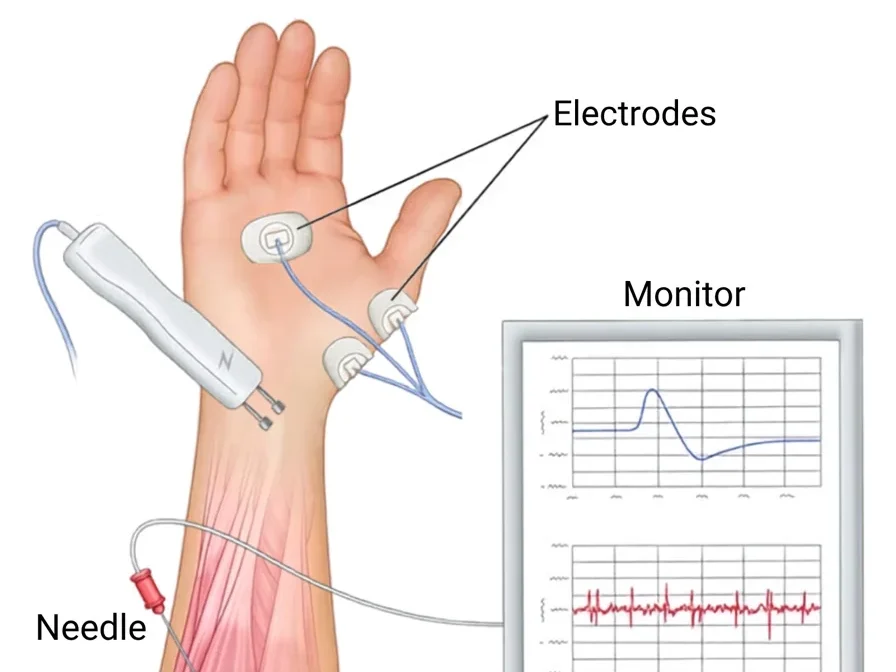
Examination is the starting point: tenderness deep in the buttock over the muscle belly, and reproduction of the pain on maneuvers that stretch or contract the piriformis against resistance. Because no imaging study confirms it, the diagnosis is secured the same way as the others in this differential, with a targeted injection. Local anesthetic is placed into the piriformis under ultrasound guidance, and a clear response points to the muscle rather than the spine. Electrodiagnostic testing is used when a lumbar root lesion has to be excluded rather than assumed.

Treatment

Most patients improve without anything invasive: targeted stretching, correcting the movement pattern or seating posture that provokes it, and time. Where that stalls, an image-guided injection of local anesthetic with a steroid relieves the spasm and lets rehabilitation progress. In stubborn cases botulinum toxin into the muscle produces a longer relaxation than steroid does. Surgical release is rarely required and is a last resort.

Anatomical variation is part of the problem

In most people the sciatic nerve passes beneath an intact piriformis muscle. In a minority it does not. Beaton and Anson described a set of variant relationships in which the nerve, or one of its divisions, passes through the muscle belly or above it rather than below. The common arrangement accounts for the large majority of anatomies, but the variants are frequent enough to matter, and someone whose peroneal division runs through the muscle has a structurally different risk from someone whose nerve passes cleanly beneath it.

This variation is one reason the condition remains contested. Studies disagree on prevalence partly because they are describing anatomically different populations, and because no imaging study reliably identifies which arrangement a given patient has.

Why the diagnosis stays clinical

There is no confirmatory test. MRI is used to exclude a lumbar cause rather than to establish the piriformis. Electrodiagnostic studies are usually normal, because intermittent mechanical compression during specific positions does not necessarily produce the sustained conduction change that testing detects. Provocation maneuvers that place the muscle under stretch and load, of which the FAIR position is the best known, raise suspicion but are not specific.

That leaves the response to a targeted injection as the most informative single piece of evidence, which is the same logic applied to the sacroiliac joint and to cluneal entrapment. It is also why we are careful about the label. Deep buttock pain has several plausible sources that present almost identically, and the honest position is that piriformis syndrome is a diagnosis of pattern and response rather than one a scan can hand you.

Frequently Asked Questions

Sciatica describes the symptom, not the cause. Piriformis syndrome is one cause of it. A lumbar disc pressing on a nerve root is another. They are treated very differently, which is why the distinction matters.

Not reliably. MRI is used to rule out a spinal cause rather than to confirm the piriformis. Diagnosis rests on examination and the response to a targeted injection.

Many patients improve over weeks with stretching and activity change. Where an injection is used, it usually buys the window needed for rehabilitation to hold.

Request an Appointment

Same-day and emergency appointments are available. Call (314) 481-5000 or request a time below.

Related Treatments and Conditions

Other procedures and conditions our St. Louis pain specialists treat.
Sciatica Nerve Pain Treatment

Sciatica mainly refers to the pain that radiates along the sciatic nerve. The sciatic nerve branches from the lower back, the hips, and the..

Hip Joint Injection

The hip joint is a large joint where the leg joins the pelvis, functioning as a ball and socket joint. The top of the thigh bone (the femur)…
Electrodiagnostics

Electrodiagnostics (EDX) testing is used to evaluate the integrity and function of the peripheral nervous (most cranial nerves..