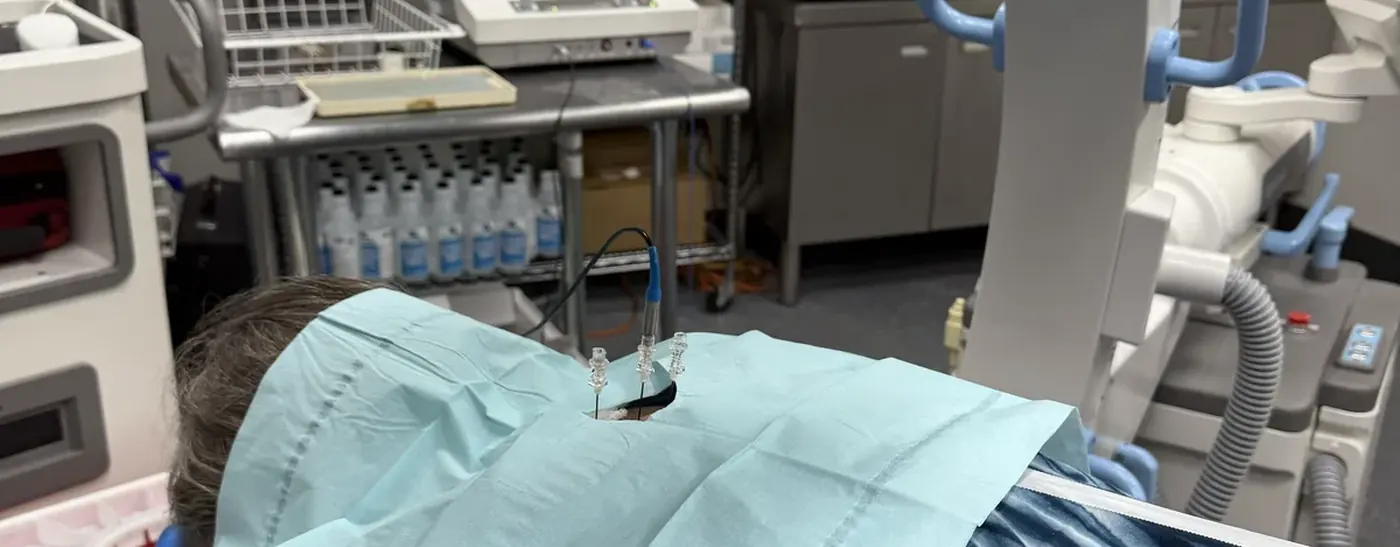


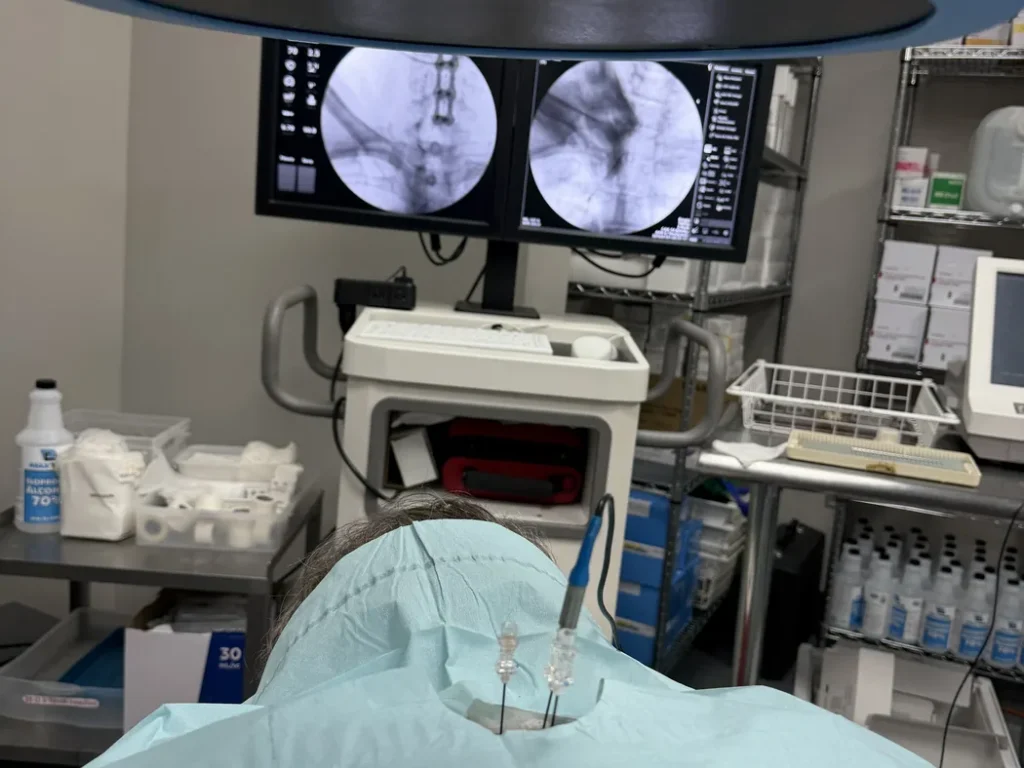
Needle positioning confirmed on live fluoroscopy before radiofrequency lesioning at Padda Institute, St. Louis

Image-guided injections · St. Louis

Ultrasound-Guided and Fluoroscopic Procedures in St. Louis

Ultrasound-guided and fluoroscopic procedures are how we place every injection: under live image guidance. The target decides which imaging we use. That choice changes what the procedure can tell us.

Prefer not to fill in a form?

Same-day and emergency appointments are available.

Why does image guidance matter for injections?

Landmark-based injection means placing a needle by feel and anatomy alone. It misses more often than most patients think. When an injection is both a treatment and a test, a miss does not just fail to help. It gives a false answer, and the whole workup heads the wrong way. Guidance is what makes the result worth trusting.

What is an ultrasound-guided injection?

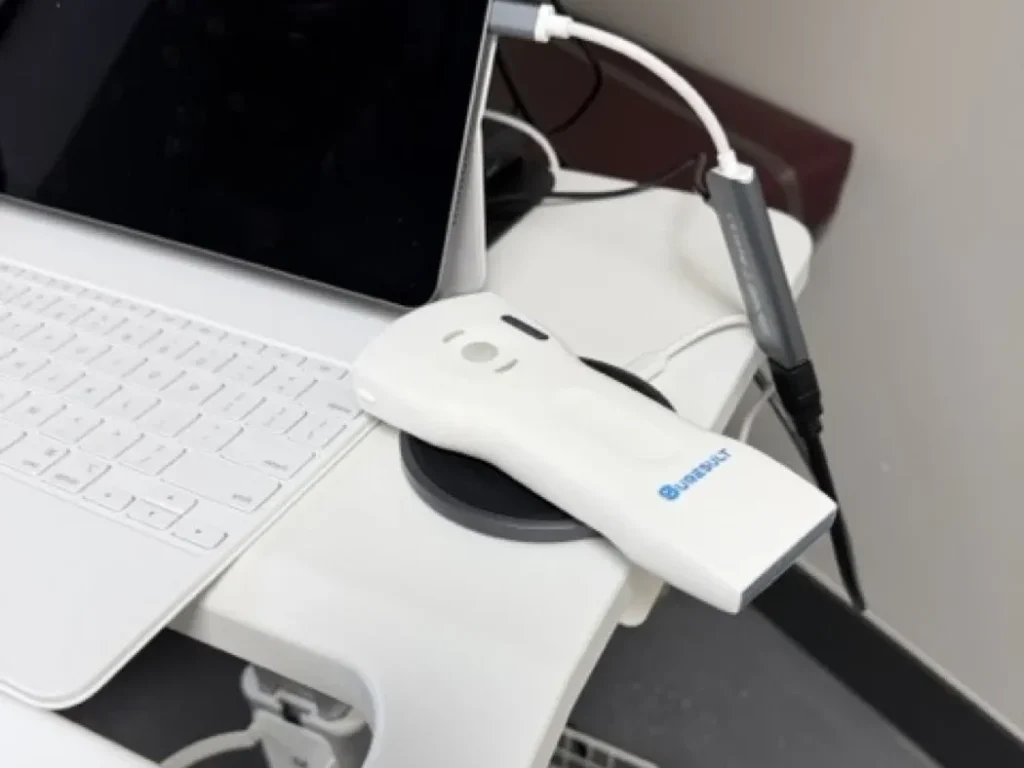
Ultrasound shows soft tissue live, with no radiation. So we can check a muscle, ligament, tendon or joint while it moves. We can load it and put it in the exact spot that brings on the pain. A tendon can look fine at rest. Its problem may show only when the joint moves. This live check gives an answer right in the room. We see the needle, the nerve and the fluid as it spreads. It is essential for hydrodissection and for peripheral nerve stimulation.

What is a fluoroscopy-guided injection?

Fluoroscopy is live X-ray. It shows bone. With contrast dye, it shows exactly where the fluid goes. For spine work, this is the standard. Before any drug goes in, the dye confirms the needle is in the right place. That means the epidural space, the facet joint, or the correct nerve root. It also shows when scar tissue blocks normal spread. Epidural steroid injections, facet joint injections and discography all depend on it.

Ultrasound or fluoroscopy: which is right for my injection?

The target decides. Soft tissue, nerves in the limbs and joints near the skin favor ultrasound. Deep spine parts, bone and anything that needs contrast dye favor fluoroscopy. Some procedures use both. We have both on site. So we pick the imaging to fit the problem. We never force the problem to fit the machine.

Are image-guided injections more accurate than blind injections?

The case for image guidance is not just theory. Studies comparing landmark-based injection with image-guided injection find the same thing again and again. A real proportion of blind injections miss the target. How often depends on the joint and on the experience of the doctor. The knee is fairly forgiving. The hip, the shoulder and the small joints of the spine are not.

The cost is worse than a wasted visit. When an injection is also a test, a miss gives a false negative. The chart says the patient did not respond. The true pain source gets crossed off the list. Then the workup moves on in the wrong direction. So image guidance protects the diagnosis just as much as it delivers the drug.

Two modalities, different physics

Ultrasound and fluoroscopy answer different questions because they see tissue in different ways. Ultrasound reads how sound echoes differ between tissues. So it shows soft tissue, nerves, tendons and blood vessels. It does this live, with no radiation. That is what makes a moving exam possible. We can check a tendon while the joint moves through the range that brings on the pain. No still image can do that.

Fluoroscopy sends X-rays through the body, so it shows bone. With contrast dye that shows up on X-ray, it shows exactly where the fluid goes. Ultrasound cannot do that. Some jobs need us to see the dye pattern. That includes confirming spread in the epidural space and proving the needle is inside a facet joint. It also includes spotting scar tissue that blocks the flow. We keep the radiation dose low with short pulses and a narrow beam. We do not skip the X-ray, because for spine work nothing else gives that proof.

See the Lesion Cycle

The radiofrequency generator mid-lesion at 80 °C. Silent, 3 seconds, loops.

What Our Patients Say

Individual results vary. These are unpaid patient testimonials shared with permission and are not a guarantee of outcome. See all patient stories.

Frequently Asked Questions

Ultrasound uses no radiation at all. Fluoroscopy uses short, pulsed bursts. Used well, it usually cuts the total procedure time and the number of needle passes.

Yes. With ultrasound, patients often watch the screen during the exam. We will show you what we see.

Barely, if at all. Hitting the target on the first pass usually makes up for the setup time. It also makes the result far more reliable.

A regular, or landmark, injection is placed by feel and anatomy alone. A real share of those injections miss the target. The knee is fairly forgiving. The hip, the shoulder and the small joints of the spine are not. Ultrasound shows the needle, the nerve and the spreading fluid live on the screen. So the drug goes where it was meant to go.

Spine procedures. Epidural steroid injections, facet joint injections and discography all depend on fluoroscopy, because contrast dye shows exactly where the fluid goes. Before any drug goes in, it confirms the needle is in the right spot. That means the epidural space, inside the facet joint or at the correct nerve root. It also shows when scar tissue blocks the drug from spreading.

It does more than fail to help. Many injections are also a test. If the needle misses, your chart says you did not respond. The real source of your pain gets ruled out. Then the workup heads the wrong way. That is why every injection we perform is placed under image guidance. It protects your diagnosis as much as it delivers the drug.

For problems that only show up when the body moves. A shoulder tendon that pinches only as the arm lifts, a hip tendon that snaps over bone, or a nerve at the elbow that slides out of its groove all look normal on a still MRI. Dynamic ultrasound watches the joint, tendon or nerve through the motion that brings on the pain, so the diagnosis and the injection target come from the same live picture. Learn more: how often a blind needle misses.

Request an Appointment

Same-day and emergency appointments are available. Call (314) 481-5000 or request a time below.

Prefer not to fill in a form?

Same-day and emergency appointments are available.

Related Treatments and Conditions

Other procedures and conditions our St. Louis pain specialists treat.
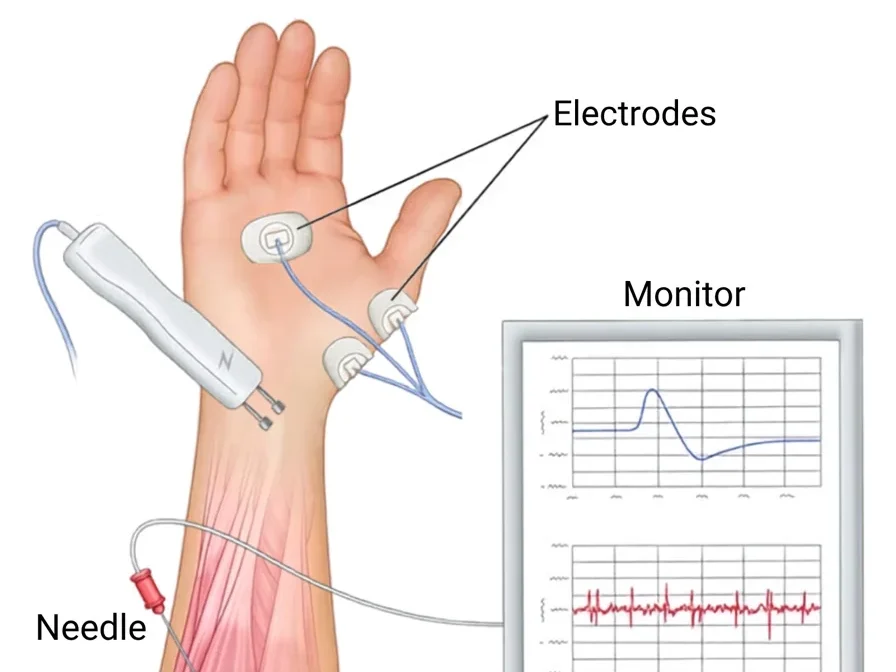
Electrodiagnostics

Electrodiagnostics (EDX) testing checks the health and function of the peripheral nervous (most cranial nerves..

Hip Joint Injection

The hip joint is a large joint where the leg joins the pelvis. It works as a ball and socket. The top of the thigh bone (the femur)…
Discogram

The disks are soft, cushion-like pads that separate the hard bones of your spine. A disk may be painful when it bulges, herniates..

Schedule NowCall (314) 481-5000