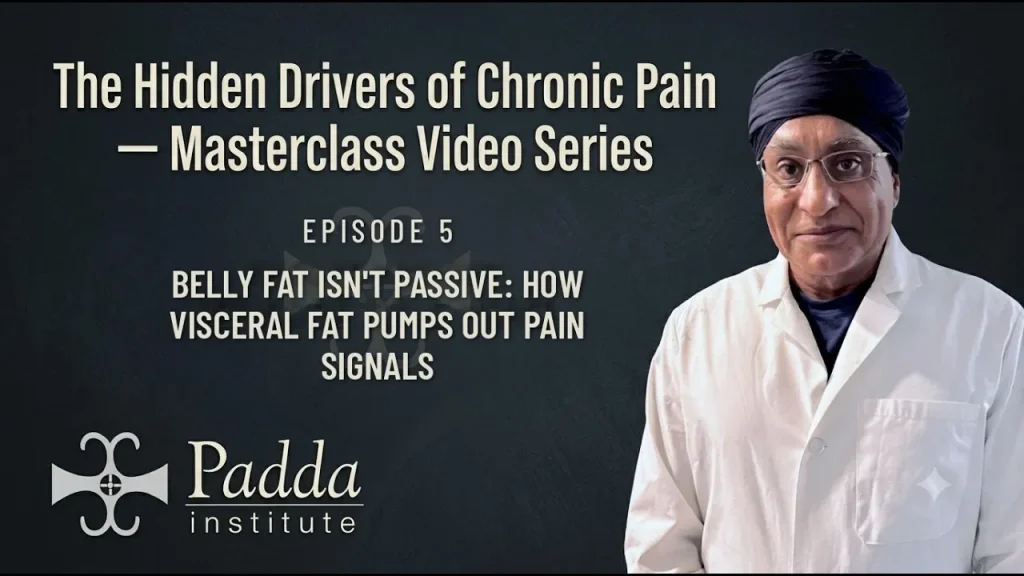
Visceral fat, the deep fat packed around your organs, is an endocrine organ (tissue that sends hormone-like signals into the blood). It pumps TNF-alpha and interleukin-6 (IL-6) into your bloodstream day and night. That constant inflammation sensitizes your nervous system and lowers your pain threshold everywhere at once. It is biology, not willpower, and it responds to metabolic work.
If you carry extra weight, you may have been made to feel that your pain is your fault. You may have been told more discipline would make it go away. This is not about willpower or how you look. It is about biology. Some of the fat in your body does not sit there quietly. Visceral fat, the deep fat packed around your organs, acts like a gland. It pumps inflammatory chemicals into your bloodstream day and night and primes your whole body to feel pain. This article explains that mechanism. And because it is a mechanism, it explains how it can be changed.
What is visceral fat?
The fat just under your skin, the kind you can pinch, is called subcutaneous fat, and it is not the main concern here. The fat that matters for this story is visceral fat, the deep fat packed in and around your organs: your liver, your intestines, deep in your belly. For a long time, medicine treated all fat as passive storage, an idle warehouse for extra calories. That turned out to be completely wrong. Visceral fat is an endocrine organ: it makes signaling molecules and releases them into your bloodstream. The problem is what it chooses to make.
What does visceral fat release into your blood?
What visceral fat overproduces is inflammation. It pumps out inflammatory messenger molecules, chemicals like TNF-alpha and interleukin-6 (IL-6). This is not fringe science. It is the foundation. The original work showed that fat tissue is a direct source of TNF-alpha. It showed that this is a key link between carrying excess fat, chronic inflammation, and insulin resistance. It was first shown in animal models, then confirmed directly in human obesity. Now picture those molecules pouring into your bloodstream not once, but nonstop, every hour of every day. They create a constant low-grade hum of inflammation through your entire body.
Why does visceral fat make pain feel like it's everywhere?
That kind of body-wide inflammation does one specific thing to pain. It sensitizes your nervous system and lowers your pain threshold everywhere at once. When the source of inflammation is one injured spot, the pain is local. But when the source is spread through your whole bloodstream, the sensitization goes everywhere the blood goes. The pain stops being “my knee” and becomes “all of me.” That is also why two people can have identical imaging, the same wear on the same joint, and completely different pain. The person carrying inflammatory visceral fat has a nervous system that is already primed. To be honest about the evidence: the biology of visceral fat releasing these molecules is rock solid. The link to a person’s specific widespread pain is, in the human research, a strong and consistent association.
How do you lose visceral fat?
This is not a verdict on your discipline. Visceral fat is a metabolically active tissue that pumps inflammatory chemicals into your system. It is a biological problem with biological solutions. At the Padda Institute, we target visceral fat directly through the metabolic approach this whole series is built on. We lower the insulin load and correct the diet that drives fat storage in the first place. The good news is that visceral fat responds strongly to this kind of metabolic work. It tends to be among the first fat to come off when you fix the root drivers. Not through crash dieting, but by dealing with the metabolism underneath it. As that visceral fat shrinks, its output of TNF-alpha and IL-6 falls with it. The constant inflammatory background quiets. And pain that had spread everywhere finally has somewhere to recede to.
Frequently asked questions
Is belly fat really connected to chronic pain?
Yes, deep belly fat can be. Visceral fat is an endocrine organ that releases inflammatory molecules like TNF-alpha and IL-6 into your blood. That body-wide inflammation can sensitize your nervous system and lower your pain threshold everywhere. The biology is well established. The link to a specific person's widespread pain is a strong, consistent association. Individual results vary.
For how the leptin that fat releases keeps inflammation switched on, read Leptin Resistance: The Hidden Reason Your Pain Runs Hotter Than Your Scans.
Why do two people with the same scan have different pain?
Because imaging alone does not set pain. A person carrying inflammatory visceral fat has a nervous system that is already primed by inflammation in the blood. So identical wear on the same joint can produce very different pain. The metabolic approach aims to quiet that primed background.
Will losing weight or changing my diet reduce this inflammation?
Visceral fat responds strongly to metabolic work. It tends to come off early when the root drivers are dealt with. As it shrinks, its TNF-alpha and IL-6 output falls. The focus is on the metabolism underneath, not crash dieting. Do not start, stop, or change any medication without consulting your physician. Individual results vary.
For how visceral fat works as immune tissue, read Fat Is an Immune Organ. That Is Why It Hurts.
How do I know if my belly fat is visceral or subcutaneous?
Subcutaneous fat sits just under your skin. It is the kind you can pinch, and it is not the main concern for pain. Visceral fat is deeper, packed in and around your organs, your liver and your intestines, deep in your belly. That deep fat is the one that acts like a gland, pumping inflammatory chemicals into your bloodstream.
Is visceral fat dangerous?
Yes. Visceral fat is an endocrine organ that releases TNF-alpha and interleukin-6 into your bloodstream every hour of every day. Fat tissue is a direct source of TNF-alpha. That is a key link between excess fat, chronic inflammation and insulin resistance. That constant low-grade inflammation also sensitizes your nervous system and lowers your pain threshold throughout your body.
What burns the most visceral fat?
Fixing the metabolism underneath it. The Padda Institute targets visceral fat by lowering the insulin load and correcting the diet that drives fat storage in the first place. Not through crash dieting. Visceral fat responds strongly to this metabolic work and tends to be among the first fat to come off. Its TNF-alpha and IL-6 output falls as it shrinks.
Is my pain my fault because I carry extra weight?
No. This is biology, not willpower or how you look. Visceral fat is a metabolically active tissue that pumps inflammatory chemicals into your system. It is a biological problem with biological solutions. Because it is a mechanism, it can be changed. As visceral fat shrinks, the inflammatory background quiets, and pain that had spread everywhere has somewhere to recede to.
Where are you located and how do I book?
Padda Institute Center for Interventional Pain Management, 4477 Woodson Rd, Suite 100, St. Louis, MO 63134. Book at painmd.tv/appointment/ or call (314) 481-5000.
Key takeaways
- Visceral fat is an active endocrine organ, not passive storage. It releases TNF-alpha and IL-6.
- The fat-to-inflammation biology is rock solid. The tie to a person's widespread pain is a strong human association.
- Body-wide inflammation sensitizes the nervous system everywhere. That is why pain can feel body-wide.
- Next step: target visceral fat with a metabolic approach at the Padda Institute to lower the inflammatory load.
This article is educational and is not a substitute for evaluation, diagnosis, or treatment by a physician. Individual results vary. Do not start, stop, or change any medication without consulting your physician.
Find the source of your pain — not just the signal
Padda Institute Center for Interventional Pain Management builds a customized, root-cause plan for each patient. Interventional care and metabolic medicine, under one roof in St. Louis.
Or call or text us — 4477 Woodson Rd, Suite 100, St. Louis, MO 63134.
Msg & data rates may apply. Reply STOP to opt out, HELP for help. Text is not a secure channel — please don’t send medical or personal health information by text, and don’t use text for emergencies.
Medically reviewed by Dr. Gurpreet Singh Padda, MD, MBA, MHP — Board Certified in Anesthesiology, Pain Medicine, Interventional Pain Management, Addiction Medicine, and Obesity Medicine. Last reviewed July 2026.
Dr. Gurpreet Singh Padda, MD, MBA, MHP