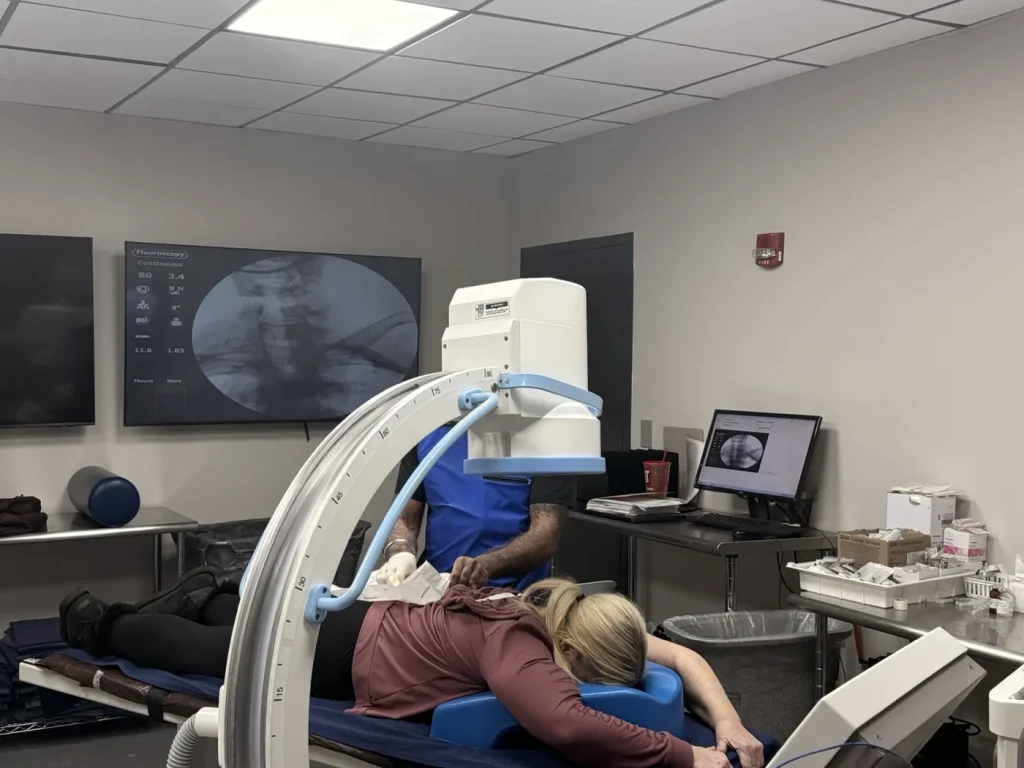
If treatment after treatment has not helped, the specialist you need is one who can prove where the pain comes from before deciding what to do about it. That is what interventional pain management means. First, image-guided testing finds the pain generator. Then treatment aims at that generator. This is not a fine point about credentials. It is the difference between being tested and being cycled.
Chronic pain is common, so this choice reaches a lot of people. In 2021, an estimated 20.9% of US adults had chronic pain. And 6.9% — roughly one in fourteen — had high-impact chronic pain that limited daily life or work.1
Not every “pain doctor” does the same work
The title covers several different jobs. Some doctors treat pain mostly with medication. Some run physical rehab. Some do image-guided tests and procedures. All of these are real jobs. But they are not the same job when past care has already failed.
Ask one simple question at a first visit: how will you find out where this pain is coming from? If the answer is a scan and a prescription, that is the same plan that has not worked so far.
What separates diagnosis from labeling
Testing, not inference
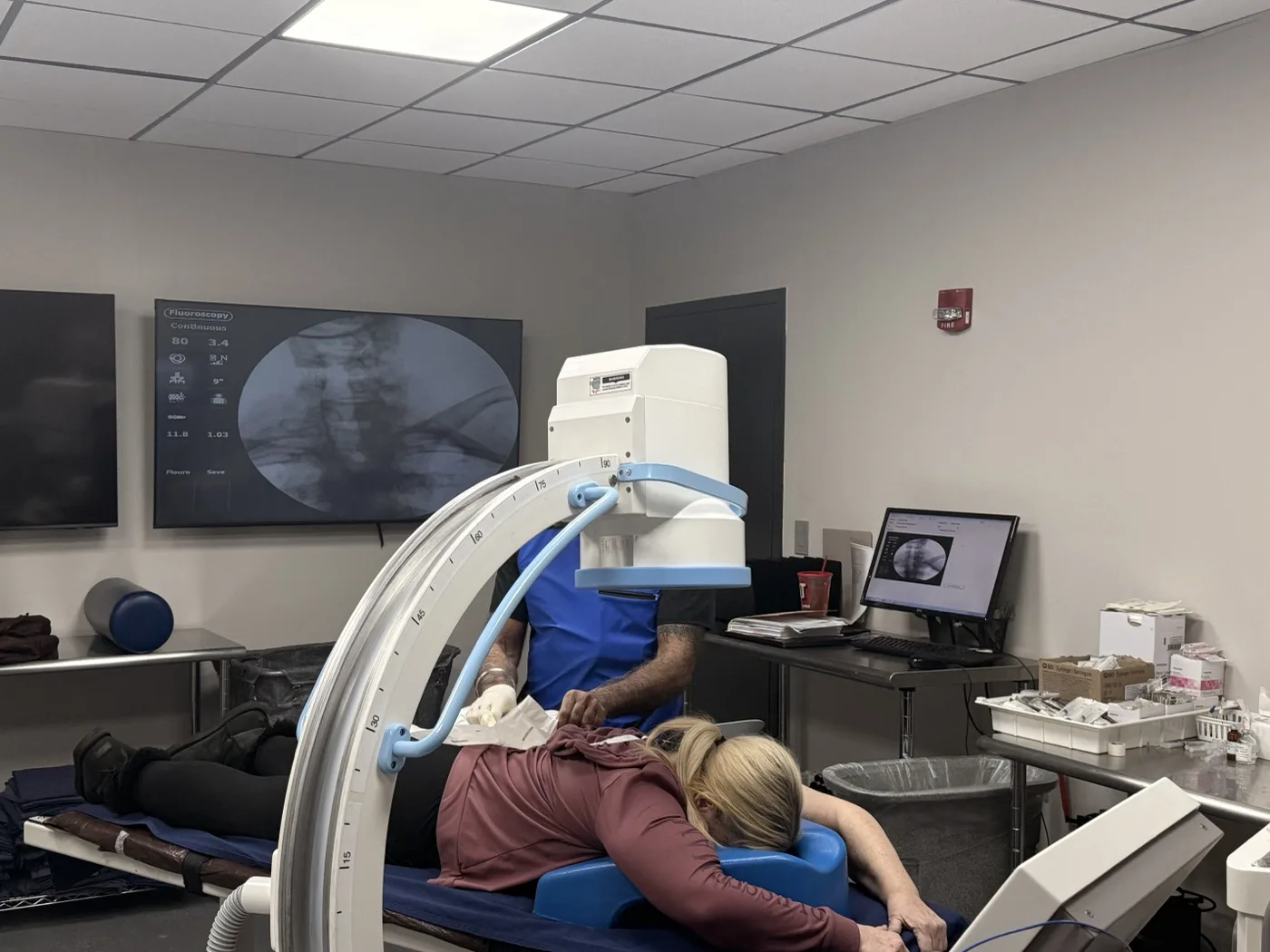
Imaging shows structure. It does not prove that something seen on a scan is causing your pain. Wear-and-tear changes are common in people with no pain at all. A diagnostic block works another way. Numb one specific structure, then see if the pain it is blamed for goes away. That is a test with a result, not a guess.
Dr. Padda explains what scans can and cannot prove in what imaging can and cannot show about pain. He covers the case where the MRI is normal but the pain is real in deep low back pain with a normal MRI.
Procedural capability
A doctor who can test can usually also treat what the test finds. That includes facet joint injections. It also includes radiofrequency ablation once a test block confirms the source. It also includes nerve blocks, and provocative discography when the disc is in question.
A model that accounts for the whole system
Pain that has lasted through several rounds of treatment is often no longer just a local problem. Central sensitization (a nervous system turned up too high), poor sleep, metabolic drivers and avoiding movement all keep pain going. They keep it going after the first injury has healed. A specialist who only thinks about structure will keep hunting for something to fix. And he will keep coming up short.
Normal imaging does not mean nothing is wrong
This is the most common reason patients arrive discouraged. A scan came back normal, and the talk ended there.
Pain can last through processes a scan does not photograph. These include changed pain processing in the brain and spinal cord, poor muscle control, small-fiber nerve damage, or a structure that only hurts under load. A normal scan is a reason to test another way. It is not a reason to decide the pain is not real.
Metabolic and nerve-related drivers
Nerves depend on blood supply and blood sugar control. Diabetes, blood vessel disease and inflammation change how nerves behave and how well they heal. That is why a metabolic check belongs in a pain work-up, not in a separate silo. The reasoning is laid out in diabetes and neuropathy.
“Neuropathy” itself is a category rather than a diagnosis — the useful question is always which nerve, and driven by what.
When the diagnosis is CRPS
Complex regional pain syndrome is still widely called reflex sympathetic dystrophy, or RSD. It is where a structure-only approach fails fastest. The nervous system amplifies the pain; it is not just a local injury. It usually needs layered treatment, not a single procedure.
Options include sympathetic blocks, functional restoration, and ketamine. The practice gives ketamine by IV infusion and also under the tongue and on the skin. Experts still debate whether ketamine works mainly in the brain or at the injury site. The honest answer: the mechanism is not fully known, but an effect can be seen in selected patients. Details are on the CRPS and RSD treatment page.
Behavioral care belongs inside the treatment, not after it
A sensitized nervous system does not settle with injections alone. Acceptance and Commitment Therapy is offered in-house at Padda Institute. A licensed behavioral clinician trained in pain delivers it, side by side with interventional care. It is not a referral after the procedures run out. The goal is restored function and flexible behavior. It is not to convince anyone that their pain is imaginary.
What about medication?
If you already take opioids, ask how a practice plans to help you need less without throwing you into withdrawal. Treating the source of the pain is what makes a taper bearable. The practice’s approach, including how it works with referring doctors and pharmacists, is under opioid stewardship.

Being evaluated in St. Louis
Padda Institute Center for Interventional Pain Management is led by Dr. Gurpreet Singh Padda, MD, MBA, MHP. It serves the St. Louis region across Missouri and Illinois. The main clinic is at 4477 Woodson Road, Suite 100, St. Louis, MO 63134, next to St. Louis Lambert International Airport. A second location is at 12174 Natural Bridge Rd, St. Louis, MO 63044.
Call (314) 481-5000 or text (314) 886-5902, Monday through Friday, 8:00 AM to 5:00 PM. You can see the full range of pain treatments, read about the pain management doctors in St. Louis, find both offices on the locations page, or request an appointment.
More on how these choices are made is on the practice’s YouTube channel, @paddainstitute.
Frequently asked questions
Which type of specialist should I see when other pain treatments have failed?
An interventional pain doctor who does image-guided testing. That way the source of the pain is found before more treatment is chosen. The doctors and their approach are on the pain management doctors in St. Louis page.
Can a pain specialist help if my MRI is normal?
Yes. A normal scan rules out some structural causes. But it cannot rule out pain from changed pain processing, poor muscle control, or structures that only hurt under load. See deep low back pain with a normal MRI.
What should a first visit actually involve?
A history, an exam, a review of past imaging, and a plan to find the pain generator. That plan is often a diagnostic block. Imaging alone does not prove the cause, as explained in what imaging can and cannot show.
I am already on opioids. Will a pain specialist simply stop them?
No. The aim is to treat the source of the pain so you need less medication. Any reduction is done so you do not go into withdrawal. See opioid stewardship.
Is CRPS treated differently from other chronic pain?
Yes. CRPS, also called RSD, involves pain amplified by the nervous system. It usually needs layered treatment, including sympathetic blocks, functional restoration and sometimes ketamine. See CRPS and RSD treatment.
Do you serve patients from Illinois?
Yes. The practice serves the St. Louis region across Missouri and Illinois. Dr. Padda is licensed in both states. Both offices are listed on the locations page.
What evidence should I look for when comparing chronic pain treatments?
Check who was studied before what was found. Most trials enroll patients with one clean diagnosis and leave out people with diabetes, obesity, long-term opioid use or more than one pain source, which describes most people who reach a pain clinic. Then ask three questions: was success measured as function (walking, sleep, work) or only as a pain score; how long did the benefit last; and was the treatment compared with a real alternative or with nothing. Where trials are thin, the mechanism and your own measured response carry more weight, so ask what the clinic will measure in you to decide whether treatment is working. Learn more: how ketamine may help chronic pain, and where the evidence stops.
Sources
- Rikard SM, Strahan AE, Schmit KM, Guy GP. Chronic Pain Among Adults — United States, 2019–2021. MMWR Morbidity and Mortality Weekly Report. 2023;72(15):379–385. CDC MMWR
Dr. Gurpreet Singh Padda, MD, MBA, MHP


