Cervical radiculopathy is arm pain, numbness, tingling or weakness from an irritated nerve root in the neck. That is why a neck problem shows up in the arm. Worn discs and facet joints, a bulging disc and inflammation around the root can all irritate it. In a Rochester study, a disc protrusion caused only 21.9% of cases.1
Cervical radiculopathy arm pain is not “just a pinched nerve.” A study tracked 561 patients in Rochester, Minnesota between 1976 and 1990. The average yearly rate, adjusted for age, was 83.2 per 100,000. It was 107.3 for men and 63.5 for women. It peaked at 202.9 per 100,000 in people aged 50 to 54.1
What causes cervical radiculopathy arm pain?
The problem usually sits at the nerve root. The “cause” can be mechanical, inflammatory, metabolic, or a mix. If you only look for one culprit, you will miss the real pattern that keeps the arm pain going.
1) Degenerative changes narrowing a nerve root pathway
With age, the discs and facet joints wear down. That can shrink the space around a nerve root. A disc bulge, bone spurs (osteophytes) or a tight nerve opening (foraminal stenosis) can do it. So can a mix of them.
2) Disc herniation, but not as often as people assume
People are told a herniated disc is the main cause. But the data does not back that as a rule for everyone. In that same Rochester study, a confirmed disc protrusion caused only 21.9% of cervical radiculopathy cases. And 68.4% were tied to spine wear (spondylosis), disc, or both.1 Other sources of nerve root irritation are common.
3) Inflammation and sensitization around the root
Pressure alone does not explain it all. Inflammation around the root is part of the sound answer. Does that inflammation also act on nerve endings inside bone? That is a theory, not a proven fact.
4) Metabolic drivers that amplify nerve pain
In 2026, we see more patients whose whole body turns the pain up. That is where metabolic pain management comes in for cervical radiculopathy. High inflammation, insulin resistance and the strain of extra weight can keep symptoms going. That holds even when the spine looks the same on the scan.
How cervical radiculopathy arm pain is diagnosed (without getting hypnotized by scans)
Diagnosis pulls together your history, an exam and targeted tests. The failure is not in the first six weeks. It comes at month four, when the assembly line offers two exits, and neither one holds a diagnosis.
Here is what “good” looks like, and what it does not.
History: does it behave like radicular pain?
- Arm pain that follows a dermatomal pattern
- Numbness, tingling or burning that follows a nerve’s path
- Neck movement that reliably makes symptoms worse or changes them
- Weakness that is progressive, not just “I feel tired”
Physical exam: can we reproduce the pattern?
We look for nerve loss we can test and see. A pain response alone can mislead. A matching pattern of nerve loss is harder to fake and easier to treat well.
Imaging: MRI helps, but it is not the diagnosis
We use MRI to find possible causes in the spine, such as a disc bulge, a tight nerve opening or a pressed nerve root. But other causes are common too. So “I see a bulge” is not the same as “this bulge is the pain driver.”
Electrodiagnostic testing: when it helps
Nerve conduction tests and EMG can help tell radiculopathy apart from nerve damage out in the limb (peripheral neuropathy). That matters most when symptoms don’t map cleanly to one root. When a test is ordered, it should change the next step, not just record what you already knew.
Selective diagnostic injections: the evidence-based reality check
In some cases, a targeted nerve block or root-level injection can confirm the pain source. It can also lower the risk of treating the wrong level.
Whether you work through this in our clinic or somewhere else, the sound approach is the same. If your symptoms don’t match the target structure, the procedure may bring short-term relief. But it will not give a lasting answer.
Treatment options for cervical radiculopathy arm pain, and when procedures are appropriate
Care without surgery is the first step in most cases. That is not “wait it out” advice. It is a starting point backed by evidence, and it respects how the body heals on its own.
Also, most patients do get better without surgery in a realistic time. Many get real relief within the first several months. But the assembly line fails people when they don’t get a plan that fits their own nerve root pattern and pain source.
1) Activity modification and targeted rehab
- Physical therapy for how the neck moves and how the shoulder blade is held
- Neurodynamic strategies if tolerated
- Strengthening that supports the neck, shoulder, and upper back
This is not generic stretching. We want interventions that influence central sensitization, not just calm the signal for one day.
2) Medications: symptom control, not structural repair
Medicine can help you get through rehab. It should not become the whole plan, because drugs don’t fix a narrowed nerve opening or inflammation at the root. In 2026, more clinics are clearer about managing risk and setting function goals. We share that mindset through team-based care, including our opioid stewardship approach when it fits the wider pain picture.
3) Epidural steroid injection, and when it makes sense
An epidural steroid injection may calm inflammation near the nerve root. It can ease symptoms enough for you to do rehab. But it is not the right choice when the diagnosis is unclear. Nor when the symptoms don’t match the root we suspect. Nor when nerve loss keeps getting worse.
- Fits when: the nerve root pattern is clear, a fair trial of conservative (non-surgical) care has failed, and the target level matches your exam
- Fits less when: the pain pattern is odd, it is mostly neck pain in the neck itself, or the signs point to a different problem
4) Nerve block style procedures for diagnostic and therapeutic clarity
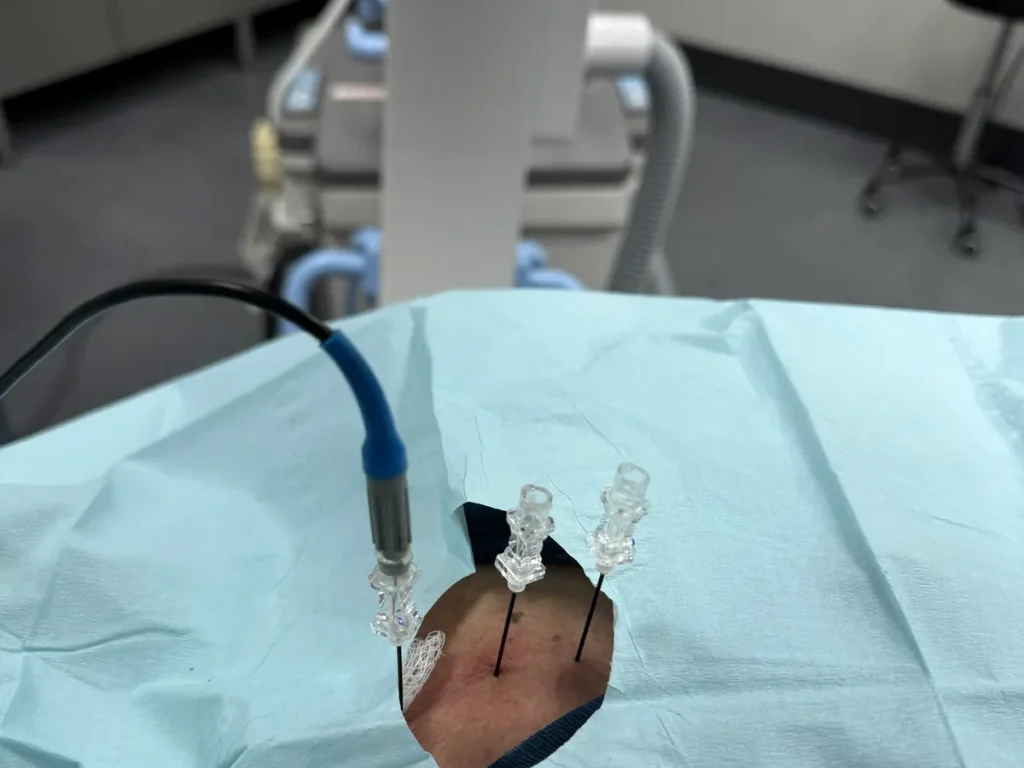
When we need a more precise answer, a nerve block approach can serve as both treatment and diagnostic confirmation. That is how we reduce the “spray and pray” approach.
If you are comparing styles of care, it helps to see, in broad terms, what our team offers: pain treatments we use.
5) Surgery: the narrow indications that actually justify it
Surgery fits when pain won’t let up or lasts despite enough conservative care. It also fits when there is severe or worsening nerve loss. That is a tighter set of reasons than many people are told.
The evidence also does not clearly show that surgery gives better long-term results than non-surgical care in all patients. So the decision is less about fear. It is more about matching risks and benefits to your nerve status and how much the symptoms weigh on you.
When to seek urgent evaluation
Most cases of this arm pain are not emergencies, but a few are. Get care fast if your weakness keeps getting worse. Also get care fast for trouble with balance or hand control, loss of bowel or bladder control, or severe symptoms that keep climbing.
Don’t let “it is probably a nerve” delay care when there are spinal cord concerns or nerve problems getting worse fast.
Frequently asked questions
What are the most common cervical radiculopathy triggers?
The most common triggers are wear-and-tear changes that irritate a neck nerve root, plus inflammation at the root. Flare-ups often follow long posture strain or neck movement. When symptoms last after conservative care, you need a guided plan. See epidural steroid injection for how this is evaluated.
Is disc herniation always the main cause of cervical radiculopathy arm pain?
No. In the Rochester study, a disc protrusion explained only 21.9% of cases. So a herniation on a scan does not automatically mean it is the pain source. That is why diagnosis has to rest on your nerve pattern, not the report alone. See selective nerve root block for how this is evaluated.
What is the role of an epidural steroid injection for arm pain from the neck?
An epidural steroid injection can calm inflammation around the targeted nerve root. That can give you back enough function to finish rehab. It fits best when your symptoms match one root level and conservative care has not helped enough. See electrodiagnostic testing for how this is evaluated.
How do nerve block procedures help with cervical radiculopathy arm pain?
A nerve block can confirm that a suspected root level is the driver. In some patients, it also eases symptoms. In good hands, treatment gets more precise, because the procedure is tied to the exam and the expected anatomy. See diagnostic nerve blocks for how this is evaluated.
When should radiofrequency ablation be considered instead of epidural injections?
Radiofrequency ablation targets certain pain sources, often the facet joints. That is a different problem from an inflamed nerve root. If you have classic nerve root arm pain, this may not address the main problem, unless your exam points to the facet joints. See image-guided procedures for how this is evaluated.
To discuss your own case, request an appointment through the appointment request form, call (314) 481-5000, or text (314) 886-5902. You can review the full range of pain treatments, read about the pain management doctors in St. Louis, or find both offices on the locations page.
Sources
- Radhakrishnan K, Litchy WJ, O’Fallon WM, Kurland LT. “Epidemiology of cervical radiculopathy. A population-based study from Rochester, Minnesota, 1976 through 1990.” Brain, 1994;117(Pt 2):325–335. Records-linkage survey, 561 patients. doi:10.1093/brain/117.2.325
Dr. Gurpreet Singh Padda, MD, MBA, MHP