Light affects pain through melatonin. About 95% of your body’s melatonin is made in your cells during the day, when infrared sunlight reaches the mitochondria (the cell’s power plants). That cell-made melatonin fights inflammation. Life indoors behind glass and under LED lights blocks infrared. So that production falls, and inflammation and pain rise.
Patients often ask Dr. Padda what light could have to do with their pain. This article gives the big-picture answer he shares in clinic. Sunlight is far more than the light you see. One invisible part of it may play a real role in inflammation and pain. Everything below comes from his short talk. It is best seen as a new, practice-based way of thinking, not settled standard care.
What is in sunlight besides visible light?
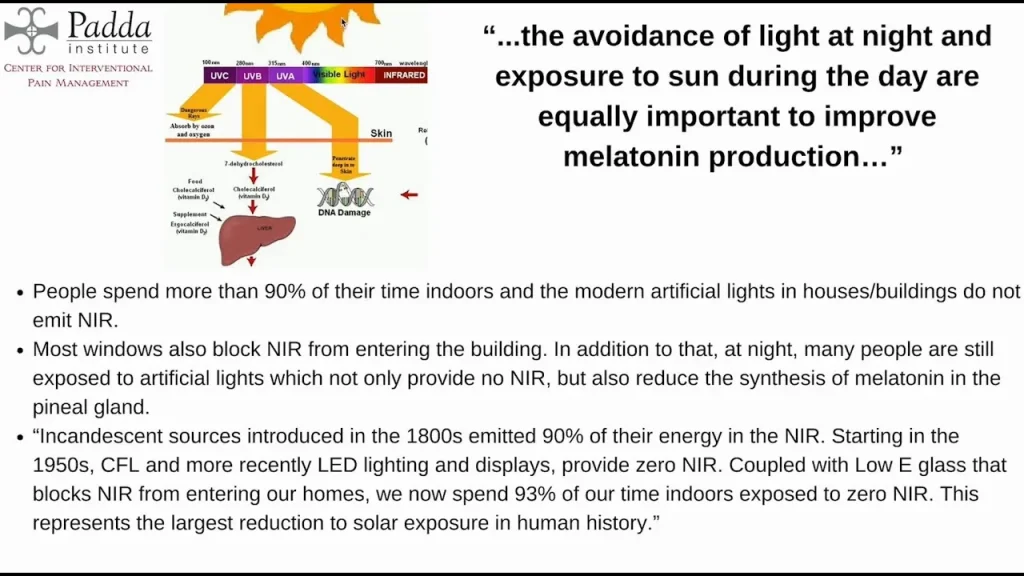
Visible light—the small band you see color and shapes by—is only a sliver of what sunlight gives off. Beyond it sits ultraviolet light. UVA is usually blamed for the DNA damage behind skin cancer. UVB is what lets your skin make vitamin D. At the other end is infrared light, a deep red between roughly 760 and 1000 nanometers. It is often invisible and felt only as heat. That infrared band, Dr. Padda explains, is where the pain story begins.
How does infrared light help your body make melatonin?
Most of us know melatonin as the sleep hormone the pineal gland releases in the dark. But that is only about 5% of your body’s melatonin. The other 95%, Dr. Padda says, is made during the day. Infrared light passes through the skin and reaches the mitochondria—the power plants of your cells—where it acts on the cytochrome c system. This cell-made melatonin works on your reactive-oxidase system as a potent anti-inflammatory. It calms inflammation right where your cells make energy.
Why does life indoors leave you more inflamed?
Here is the problem. We spend more and more time indoors behind glass and under LED lights. That light lets visible light through but blocks UVB and infrared. Block UVB, and you make less vitamin D. Block infrared, and you shut down that daytime melatonin. Dr. Padda estimates we have lost roughly 90% of our infrared light since the 1950s. That leaves the body in a highly inflamed state. He ties this to higher risks of metabolic inflammation, metabolic syndrome, obesity, and even cancer—apart from the DNA damage from UVA.
When should you seek light, and when should you avoid it?
The practical lesson Dr. Padda gives his patients is about timing. Avoid light at night—especially blue light—so your pineal gland can release the melatonin that helps you sleep. But seek daytime light, specifically infrared daylight, to make the cell melatonin that drives recovery and fights inflammation. He calls the worst case getting UVA without any infrared. This is a practice-based approach he offers alongside a fuller evaluation. Individual results vary.
Frequently asked questions
How can light affect my pain?
Dr. Padda explains that infrared light from the sun passes through the skin and reaches your cells' mitochondria. There it helps make most of your body's melatonin during the day. That cell-made melatonin fights inflammation hard. When you live indoors and lose infrared, that production falls and inflammation can rise. It is a new, practice-based idea, not settled standard care. Individual results vary.
Isn't melatonin only about sleep?
Only about 5% of your melatonin, from the pineal gland, is tied to sleep. The other 95%, Dr. Padda says, is made in your cells during the day in response to infrared light. It fights inflammation. That is why he sees it as key for pain patients, not just for rest.
Should I use a light device or take supplements for this?
Do not start, stop, or change any medication or supplement without consulting your physician. Dr. Padda sees light as one part of a bigger plan. Talk with your doctor first about any device, vitamin D, or melatonin supplement, and match it to your situation. Individual results vary.
Why do I feel better after getting some sun?
Sunlight does more than light up the room. Its UVB band lets your skin make vitamin D. Its infrared band reaches the mitochondria in your cells. Dr. Padda says that is where about 95% of your body’s melatonin is made during the day. That cell-made melatonin fights inflammation. It calms inflammation right where your cells make energy.
Does sunlight through a window count?
Not fully. Window glass and LED lights let visible light through but block UVB and infrared. Block UVB, and you make less vitamin D. Block infrared, and daytime melatonin shuts down. Dr. Padda estimates we have lost roughly 90% of our infrared light since the 1950s. That is why he tells patients to seek infrared daylight, not just a bright room.
Why should I avoid blue light at night?
At night your pineal gland releases the melatonin that helps you sleep. Light, especially blue light, gets in the way. Dr. Padda’s rule is about timing. Avoid light at night so you can sleep. Seek infrared daylight by day so your cells can make the melatonin that drives recovery and calms inflammation.
Where are you located and how do I book?
Padda Institute Center for Interventional Pain Management, 4477 Woodson Rd, Suite 100, St. Louis, MO 63134. Book at painmd.tv/appointment/ or call (314) 481-5000.
Key takeaways
- How it works: daytime infrared light reaches your mitochondria and helps make melatonin inside your cells. That melatonin fights inflammation hard.
- Evidence status: a new, practice-based approach to inflammation and pain, not proven standard care.
- Why timing matters: avoid light at night for sleep. Seek infrared daylight by day for cell repair and to fight inflammation.
- Next step: ask how light exposure fits your pain plan—book at painmd.tv/appointment/.
This article is educational and is not a substitute for evaluation, diagnosis, or treatment by a physician. Individual results vary. Do not start, stop, or change any medication without consulting your physician.
Find the source of your pain — not just the signal
Padda Institute Center for Interventional Pain Management builds a custom, root-cause plan for each patient. Interventional care and metabolic medicine, under one roof in St. Louis.
Or call or text us — 4477 Woodson Rd, Suite 100, St. Louis, MO 63134.
Msg & data rates may apply. Reply STOP to opt out, HELP for help. Text is not a secure channel — please don’t send medical or personal health information by text, and don’t use text for emergencies.
Medically reviewed by Dr. Gurpreet Singh Padda, MD, MBA, MHP — Board Certified in Anesthesiology, Pain Medicine, Interventional Pain Management, Addiction Medicine, and Obesity Medicine. Last reviewed July 2026.
Dr. Gurpreet Singh Padda, MD, MBA, MHP