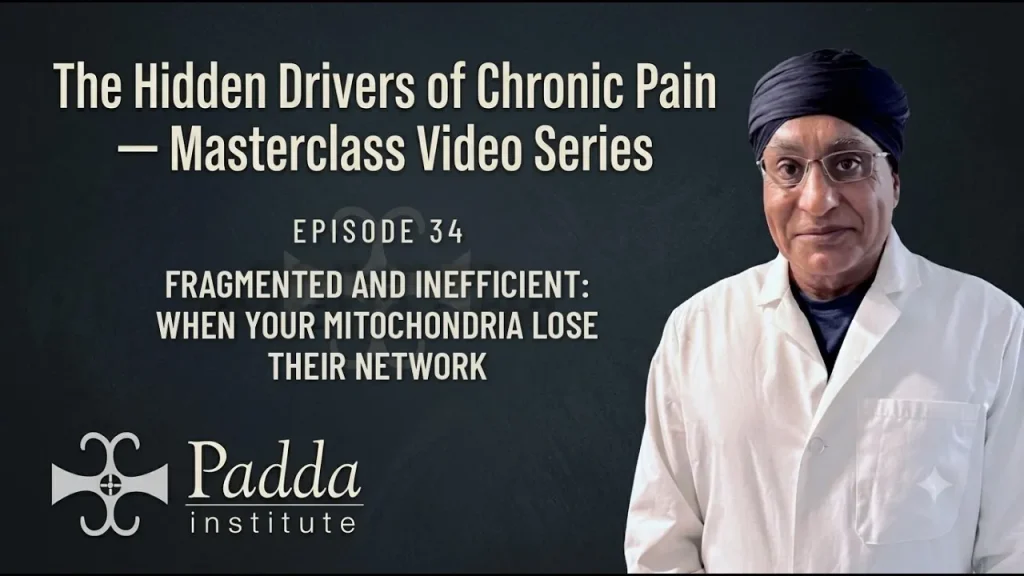
If you live with deep muscle fatigue and burning, tingling nerve pain that no one has fully explained and you have wondered whether it is even real this article offers a concrete cellular explanation. Dr. Padda describes how your mitochondria constantly merge and divide to meet demand, and how chronic stress and inflammation can tip that balance toward fragmentation, quietly feeding both nerve and muscle pain.
Mitochondria are dynamic: fusion and fission
Mitochondria are not fixed little objects. They constantly undergo two opposing processes. Fusion is when they merge into larger, interconnected networks, which makes them more efficient and lets them share resources and buffer stress. Fission is when they divide into smaller separate units, which helps distribute mitochondria and isolate damaged portions for cleanup. In a healthy cell, fusion and fission are balanced, and that balance lets mitochondria adapt fluidly to whatever demand the cell faces. This plasticity is a feature it keeps your cellular power grid responsive.
Why chronic stress fragments the network
Chronic stress and systemic inflammation the background state of so many chronic pain patients shift this balance heavily toward fission. The result is excessive fragmentation: a population of small, divided, isolated mitochondria instead of healthy interconnected networks. Fragmented mitochondria are problematic in two ways. First, they are less capable of sustained, efficient energy production. Second, they are structurally more prone to leaking their inflammatory contents into the cell’s interior. That means the fragmentation directly feeds the inflammation that drove the fragmentation another self-reinforcing pattern.
How this lands as the pain you feel
In your nerves, fragmented and inefficient mitochondria mean an energy crisis that makes nerves hyperexcitable, exacerbating peripheral neuropathy that burning, tingling, electric nerve pain. In your muscles, which are densely packed with mitochondria and highly dependent on them, fragmentation contributes to fatigue and localized muscle pain, the deep muscular aching and exhaustion so many patients describe. The leaked inflammatory content keeps the local environment irritated and sensitized. As Dr. Padda emphasizes, that deep, drained, aching exhaustion is not laziness or imagination it reflects a measurable change in the power grid of your cells.
How we work to rebuild the grid at the Padda Institute
The approach Dr. Padda describes is to shift the balance back from fragmentation toward healthy mitochondrial networks and the way to do that is by removing the chronic stress and inflammation driving it. That means the full toolkit of this series: lowering the metabolic and inflammatory load and restoring autonomic balance and vagal tone to pull you out of chronic stress. As the stress and inflammation recede, mitochondria can re-fuse into efficient networks, sustained energy production returns, the inflammatory leaking stops, and the nerve and muscle pain can finally ease. This is a whole-person, practice-based approach, and individual results vary.
Frequently asked questions
What is mitochondrial fragmentation?
Mitochondrial fragmentation is a shift in the normal balance between fusion (mitochondria merging into efficient networks) and fission (dividing into smaller units) toward too much fission. It leaves you with small, isolated mitochondria that produce less energy and are more prone to leaking inflammatory contents. Chronic stress and systemic inflammation are described as key drivers of this shift.
Zombie Mitochondria: When Cellular Cleanup Fails and Pain Sets In goes through it in detail.
Can fragmented mitochondria cause nerve and muscle pain?
According to this discussion, yes fragmented, inefficient mitochondria create an energy crisis that makes nerves hyperexcitable (worsening burning, tingling neuropathic pain) and leaves mitochondria-rich muscles fatigued and aching. Research is described as increasingly connecting disrupted mitochondrial dynamics to neuropathic pain. Individual results vary.
See The ROS-Inflammation Loop That Keeps Chronic Pain Alive.
Will supplements or medication rebalance my mitochondria?
This discussion frames the fix as removing the chronic stress and inflammation that drive fragmentation, rather than any single pill; the emphasis is on lowering metabolic and inflammatory load and restoring vagal tone. No specific supplement or drug is presented as a cure here. Do not start, stop, or change any medication or supplement without consulting your physician. Individual results vary.
The mechanism is covered in Endoplasmic Reticulum Stress: When Cells Are Too Stressed to Heal.
Where are you located and how do I book?
Padda Institute Center for Interventional Pain Management, 4477 Woodson Rd, Suite 100, St. Louis, MO 63134. Book at painmd.tv/appointment/ or call (314) 481-5000.
Key takeaways
- Mechanism: chronic stress shifts mitochondria toward fission, fragmenting the network into weak, leaky units.
- Evidence status: mitochondrial dynamics are described as well established, with research increasingly linking them to neuropathic pain.
- Why timing matters: fragmentation and inflammation reinforce each other, deepening nerve and muscle pain over time.
- Next step: reducing stress and inflammation may let networks re-form book at painmd.tv/appointment/.
Medically reviewed by Dr. Gurpreet Singh Padda, MD, MBA, MHP — Board Certified in Anesthesiology, Pain Medicine, Interventional Pain Management, Addiction Medicine, and Obesity Medicine. Last reviewed July 2026.
This article is educational and is not a substitute for evaluation, diagnosis, or treatment by a physician. Individual results vary. Do not start, stop, or change any medication without consulting your physician.
Find the source of your pain — not just the signal
Padda Institute Center for Interventional Pain Management builds a customized, root-cause plan for each patient. Interventional care and metabolic medicine, under one roof in St. Louis.
Or call (314) 481-5000 or text (314) 886-5902 — 4477 Woodson Rd, Suite 100, St. Louis, MO 63134.
Msg & data rates may apply. Reply STOP to opt out, HELP for help. Text is not a secure channel — please don’t send medical or personal health information by text, and don’t use text for emergencies.
Dr. Gurpreet Singh Padda, MD, MBA, MHP