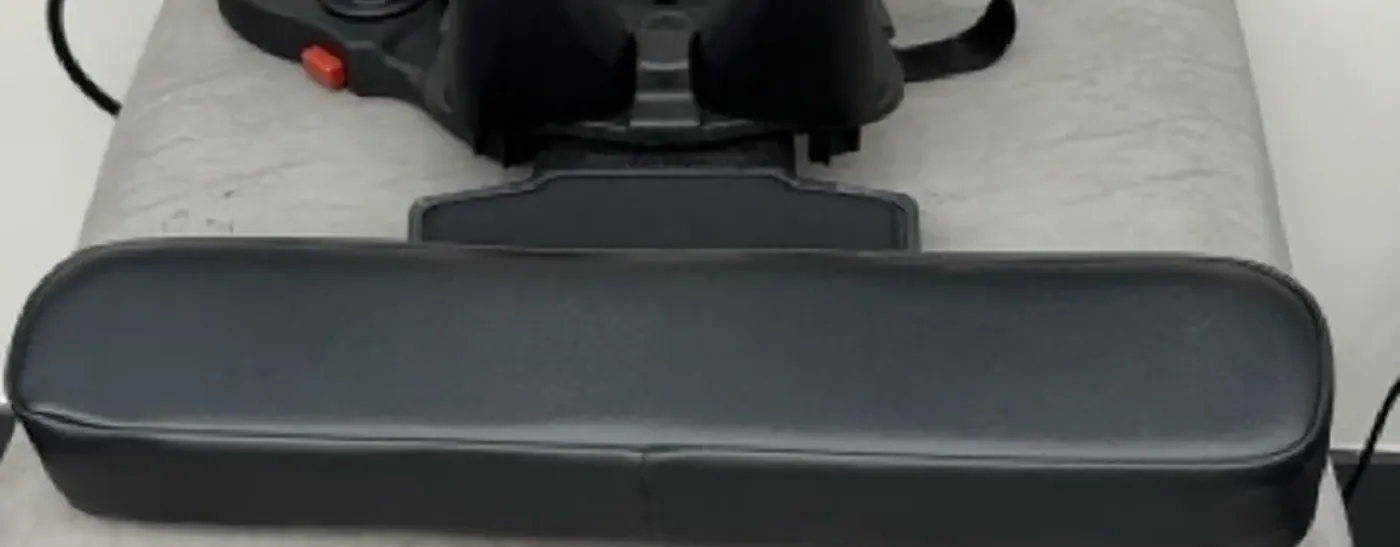
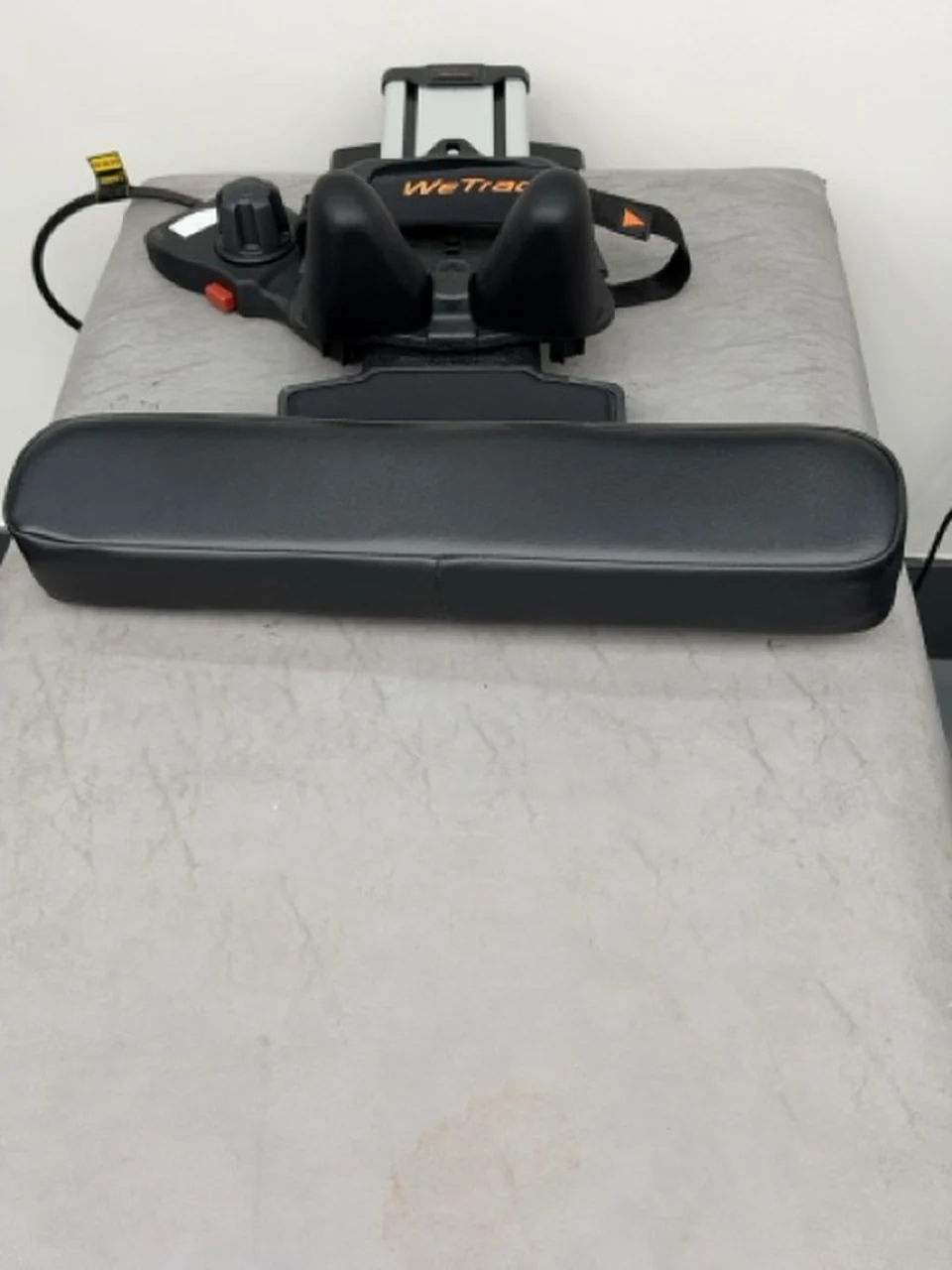
Pneumatic cervical traction unit at Padda Institute, St. Louis

Cervical traction · St. Louis

Pneumatic Cervical Traction in St. Louis

Pneumatic cervical traction is controlled, measured decompression (a gentle stretch) of the neck. It takes pressure off the neck discs and nerve roots.

Prefer not to fill in a form?

Same-day and emergency appointments are available.

What is cervical traction and how does it work?

Cervical traction pulls along the neck with a controlled force. It gently eases the neck bones (vertebrae) apart. That gap lowers the pressure inside the discs. It also widens the bony openings where the nerve roots exit — the neural foramina.

When neck pain shoots into the shoulder or arm, the usual cause is a pinched nerve root. A bulging disc, a narrowed opening, or both can be pressing on it. Traction goes straight at that mechanical part. It gives the nerve more room for a while.

Ours is a pneumatic system. That means air pressure sets the force, not hanging weights. So we can set the force exactly and raise it slowly during a session. That matters, because an irritated neck reacts badly to sudden force.

Pneumatic cervical traction unit at Padda Institute, St. Louis

Why use pneumatic cervical traction instead of weights?

Old-style traction uses a hanging weight or a hand pulley. The force is harder to control and harder to repeat from one session to the next. It also lands less smoothly.

A pneumatic system sets the force by air pressure. So it can be dialed to an exact level, held, released and repeated the same way each time. In practice, we start well below the level that sets off your symptoms. Then we raise it on purpose over the sessions as you handle it better.

It also allows intermittent traction — cycles of pull and release, not one steady pull. Many people handle the cycles much better. The cycling also seems to help fluid move in and out of the disc, instead of just holding it stretched.

What conditions does cervical traction help?

Traction helps most when symptoms have a clear mechanical cause:

  • Cervical radiculopathy — neck pain that shoots into the shoulder, arm or hand, with or without numbness
  • Narrowed nerve openings from wear and tear
  • A bulging disc that irritates a nerve root
  • Persistent neck pain with stiff movement and tight, guarding muscles
  • Symptoms after a car crash, where whiplash has left lasting mechanical neck pain

A handy clue is position. If your arm symptoms ease when you lift your arm over your head, or when you gently pull your own head up, the nerve root is likely being squeezed. Then traction is worth trying.

Where does cervical traction fit in neck pain treatment?

Traction is a conservative treatment, and we treat it as one. It is cheap, low-risk and needs no needles or cuts. That makes it a sensible early step. But it does not replace finding out which part is making your pain.

If symptoms last, electrodiagnostic testing (nerve testing) shows for sure whether a nerve root is hit and at which level. From there, targeted options such as a selective nerve root block or cervical epidural steroid injection go straight at the inflammation around the nerve.

Traction also pairs well with the rest of the conservative plan. It often makes physical therapy bearable for people whose neck is too irritated to work with otherwise.

When is cervical traction not safe or not helpful?

We avoid traction when the spine may be unstable or when pulling could cause harm. That includes after some neck fractures, with major instability, with a spinal tumor or infection, with vertebrobasilar insufficiency (poor blood flow to the back of the brain), with inflammatory arthritis of the upper neck, and with severe osteoporosis.

It is also not the answer for every neck problem. Pain from the cervical facet joints (the small joints at the back of the neck), and not from a pinched nerve root, often does not respond. Sticking with traction that is not helping just delays the treatment that would.

Neck Pain Radiating Into Your Arm

The first step is finding out whether a nerve root is being squeezed. Call to set up an exam.

What Our Patients Say

Individual results vary. These are unpaid patient testimonials shared with permission and are not a guarantee of outcome. See all patient stories.

Cervical Traction FAQs

It should not. We raise the force slowly and keep it within what you can handle. Most people describe a stretch, and often quick partial relief of arm symptoms. Pain during traction means the force or the angle is wrong. We can adjust both.

Usually ten to twenty minutes. We often use cycles of pull and release instead of one steady pull. Most people handle the cycles better.

Some people notice a change within the first two or three sessions. If several sessions bring no change at all, that tells us something. It suggests the problem is not mainly mechanical compression (a squeezed nerve), so we would look elsewhere instead of going on.

No. Home devices pull with a force that is not measured and cannot be repeated. An irritated neck reacts badly to uncontrolled force. A pneumatic clinic system delivers an exact, repeatable level that we can adjust on purpose.

We avoid it with neck instability or some fractures, spinal tumor or infection, vertebrobasilar insufficiency, inflammatory arthritis of the upper neck, and severe osteoporosis. We review your history and imaging before we start.

It takes pressure off. It does not repair the disc. For many people, that relief is enough for symptoms to settle while the disc heals on its own. When it is not enough, injections aimed at the inflamed nerve root are the usual next step.

It works best when the pain has a clear mechanical cause, such as a nerve root pressed by a bulging disc or a narrowed opening. Traction gently eases the neck bones apart and gives the nerve more room. A handy clue: if arm symptoms ease when you lift your arm overhead or gently pull your head up, traction is worth trying. If several sessions bring no change, we look elsewhere.

For the right person, yes. Our pneumatic system sets the force by air pressure. It starts well below the level that sets off symptoms and rises slowly, and it should not hurt. We avoid traction with spinal instability or some fractures, spinal tumor or infection, vertebrobasilar insufficiency, inflammatory arthritis of the upper neck and severe osteoporosis. We review your history and imaging first.

Send A Message

For questions and concerns, please fill out the form below.

Prefer not to fill in a form?

Same-day and emergency appointments are available.

Pain Conditions We Treat

At Padda Institute, our pain management specialists provide the guidance and treatments tailored to your needs. We diagnose and evaluate to determine your best treatment plan, so that you can experience chronic pain relief like never before.
Severe Head And Neck Pain

The goal of the Padda Institute Headache Section is to provide diagnosis and treatment that will help people who experience severe pain..

Selective Nerve Root Block

Nerve roots exit your spinal cord and form nerves that travel into your arms or legs. These nerves allow you to move your arms, chest wall, and..
Car Accidents Injuries

At Padda Institute Of Pain Management, we understand that car accidents can result in a wide range of injuries. That pain can affect your daily life.

Schedule NowCall (314) 481-5000