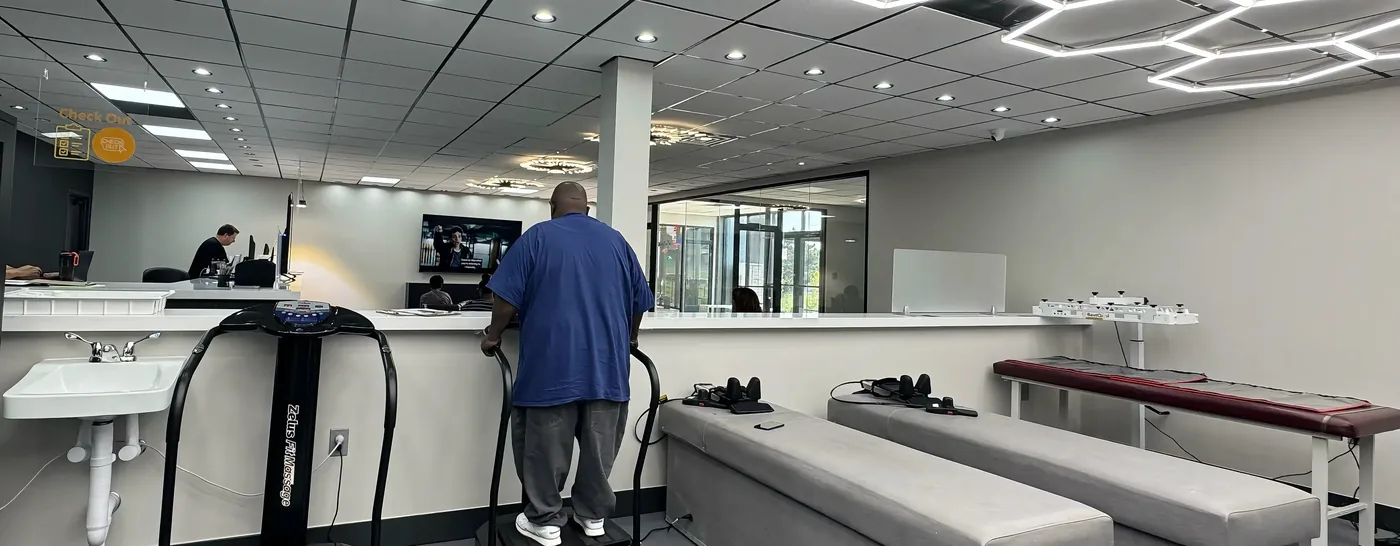
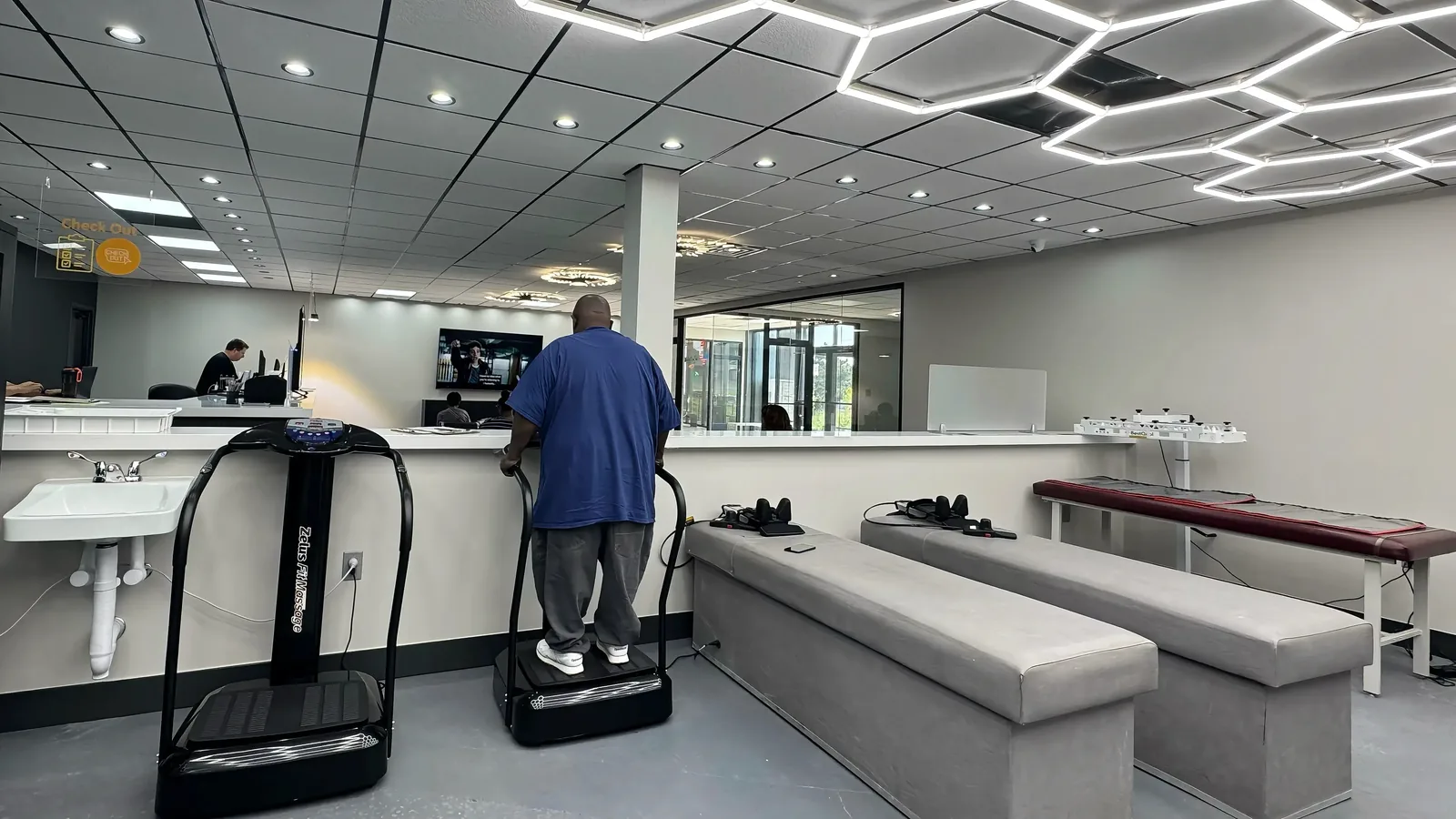
Whole body vibration platforms in the therapy area at Padda Institute, 4477 Woodson Rd, St. Louis

Whole body vibration therapy · St. Louis

Whole Body Vibration Therapy in St. Louis

Whole body vibration therapy uses a controlled shaking motion to work your muscles. It builds load tolerance when pain keeps you from normal exercise.

Prefer not to fill in a form?

Same-day and emergency appointments are available.

What is whole body vibration therapy?

You stand on a platform that shakes at a set speed. The movement is small and fast. Your muscles react on their own. They tighten by reflex many times per second as the surface moves under you.

Here is why that matters. Your muscles work without you bending a sore joint, lifting a weight, or making the move that sets off your pain. If pain has made normal exercise impossible, this is a way back in.

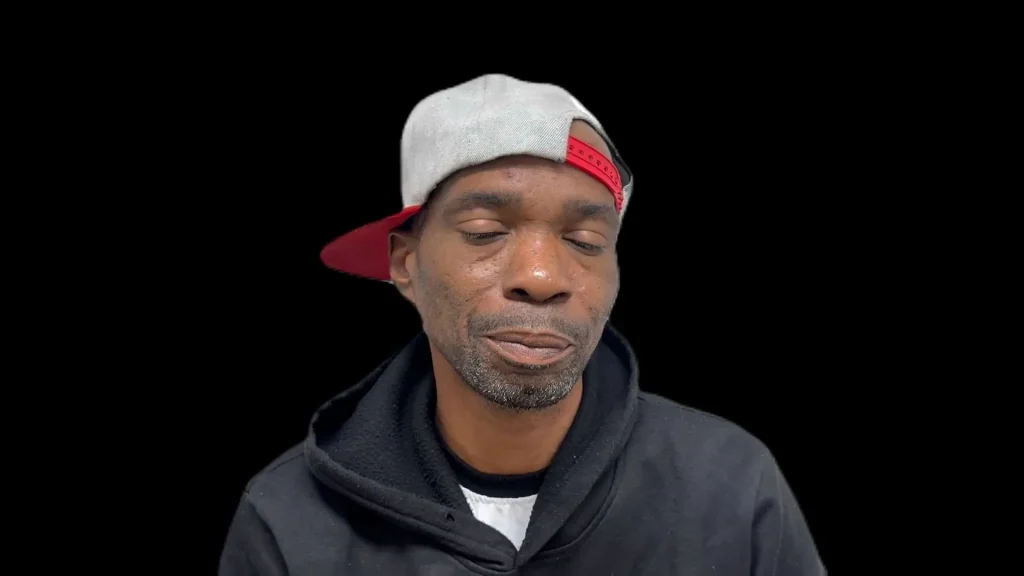
Patient standing on a whole body vibration platform in the therapy area at Padda Institute, St. Louis

Why does muscle matter in chronic pain?

Muscle does more than move you. It also acts like a gland. When it contracts, it releases signal molecules called myokines. Several of them fight inflammation.

That sets up a loop. Pain cuts your activity. Less activity costs you muscle. Less muscle means fewer myokine signals. Fewer of those signals means more inflammation and more pain. Getting out of shape is not just a result of chronic pain. It is one of the things that keeps the pain going.

So anything that works muscle in a person who cannot otherwise exercise does more than keep them strong.

How is whole body vibration therapy used?

Mostly as a bridge. It lets us start loading tissue in people who hurt too much, or are too out of shape, to begin regular physical therapy. The goal is to move on to active exercise as you can handle more.

It also loads bone. That matters if you have osteoporosis (thin, weak bones). It matters most if you have already had a vertebral compression fracture and need to load bone without jolting the spine.

It supports your rehab. It does not replace exercise that gets harder over time. If you can handle active rehab, that is better.

Who should avoid whole body vibration?

We avoid vibration in pregnancy, with a fresh blood clot (acute thrombosis), with a recent fracture or loose hardware, with retinal detachment, and with some implanted devices. Tell us if you have a pacemaker, a spinal cord stimulator or any implanted generator. We will check the maker’s guidance before we use it.

Severe osteoporosis calls for judgment, not a flat no. The right amount of loading helps bone. Too much does not. Where that line sits depends on your bone density and your fracture history.

A Way Back Into Movement

If pain has made exercise impossible, we often start here. Call to ask if it fits you.

What Our Patients Say

Individual results vary. These are unpaid patient testimonials shared with permission and are not a guarantee of outcome. See all patient stories.

Whole Body Vibration FAQs

No. It is a bridge for people who cannot yet handle regular exercise. The aim is to move on to active rehab. If you can already exercise, that works better.

Short. Usually several minutes. It is harder than it looks, so we build sessions up slowly instead of starting long.

Loading supports bone. Vibration loads bone without jolting the spine, which helps after a compression fracture. It is one part of bone health. It does not replace medical care for osteoporosis.

Tell us before your first session. We check the device maker's guidance instead of guessing, because the rules differ from one system to the next.

Pregnancy, acute thrombosis (a fresh blood clot), recent fracture or loose hardware, retinal detachment, and some implanted devices. Severe osteoporosis needs a case-by-case call, not a flat rule.

It does one job well. Standing on the platform makes your muscles tighten by reflex many times per second. So your muscles work without lifting a weight or bending a sore joint. That makes it a bridge for people whose pain has made exercise impossible. It does not replace exercise that gets harder over time. If you can already exercise, that is better.

The platform shakes in small, fast moves, and your muscles tighten on their own. Working muscle releases signal molecules called myokines. Several of them fight inflammation. The platform also loads bone without jolting the spine. That matters with osteoporosis and after a vertebral compression fracture. In short, it puts muscle and bone to work in someone who cannot yet exercise the usual way.

It is harder than it looks, so sessions start short and build up slowly. It does not replace active rehab. We avoid it in pregnancy, with acute thrombosis, recent fracture or loose hardware, retinal detachment and some implanted devices. Severe osteoporosis needs a case-by-case call, because the right amount of loading helps bone and too much does not.

Send A Message

For questions and concerns, please fill out the form below.

Prefer not to fill in a form?

Same-day and emergency appointments are available.

Pain Conditions We Treat

At Padda Institute, our pain management specialists provide the guidance and treatments tailored to your needs. We diagnose and evaluate to determine your best treatment plan, so that you can experience chronic pain relief like never before.
Vertebroplasty

Bed rest and strong pain medicine are no longer the only treatments for back pain caused by compression fractures of the spine. Now there is..

Spinal Cord Stimulation

Spinal cord stimulation uses a small implanted device to send mild electrical pulses to the spinal cord. The pulses block chronic nerve pain signals. Padda Institute does SCS…
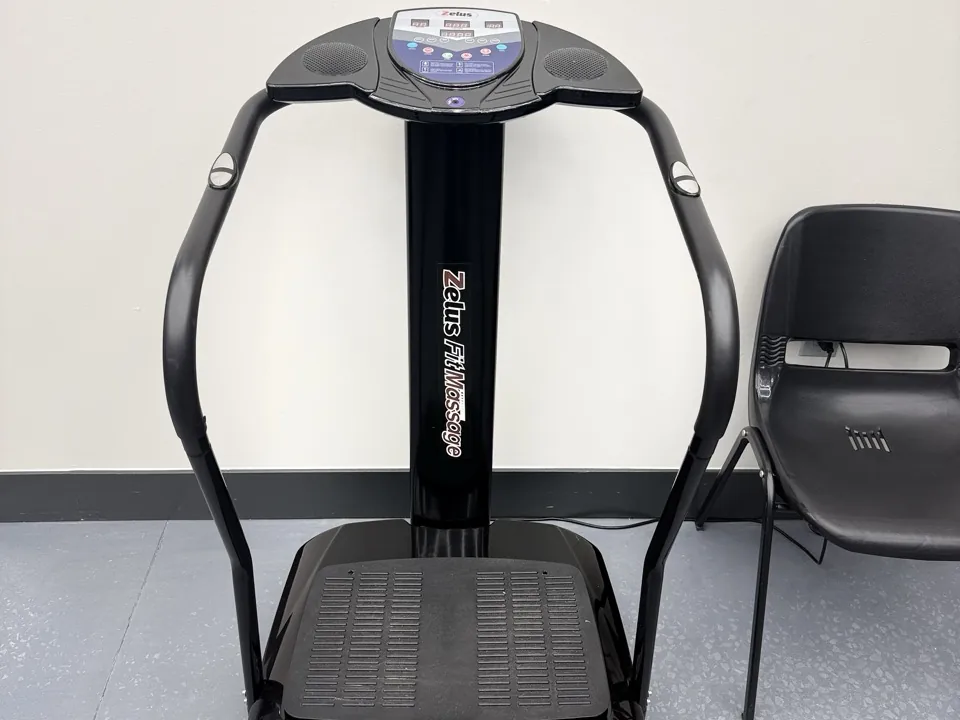
Diabetes And Neuropathy

Diabetic Peripheral Neuropathy (DPN) is the most common complication of diabetes, and often presents as a distal, symmetric..

Schedule NowCall (314) 481-5000