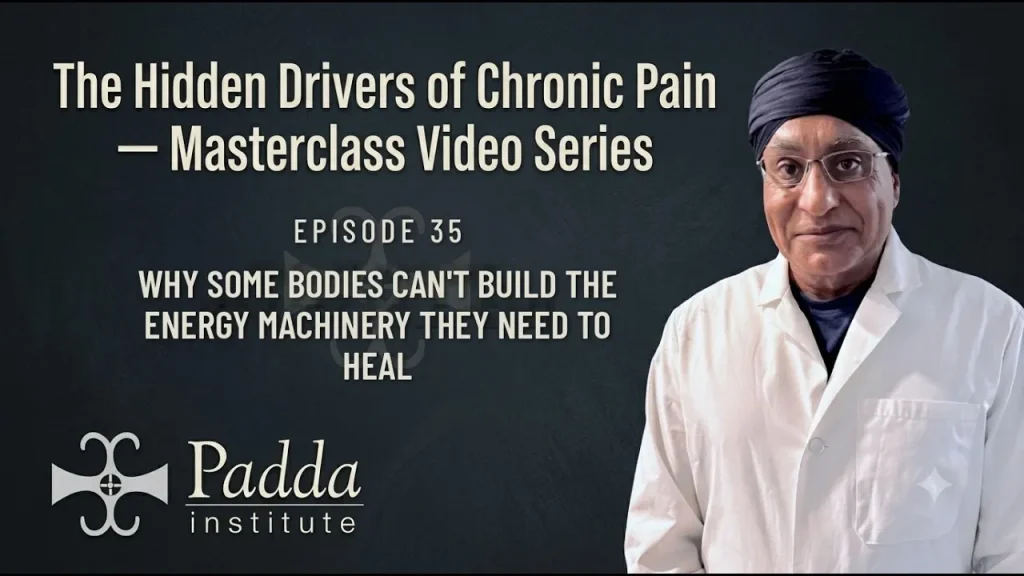
PGC-1 alpha is the master switch inside your cells that builds brand-new mitochondria. Those are the power plants you need to recover. Metabolic syndrome, visceral fat (deep fat packed around the organs), and a life spent sitting turn that switch down. That is why some bodies feel unable to heal. The right kind of movement turns it back on.
Maybe you could not exercise your way out of pain, and you felt like a failure for it. Here is the missing piece. Dr. Padda explains a master switch inside your cells called PGC-1 alpha that decides whether your body can build brand-new mitochondria. Those are the power plants you need to recover. In many people with chronic pain and a broken metabolism, that switch is turned down. That may be the deepest reason some bodies feel unable to heal.
What does PGC-1 alpha do?
Your cells hold a master control with a long name: peroxisome proliferator-activated receptor gamma coactivator 1-alpha. Thankfully, it is shortened to PGC-1 alpha. Think of it as the master on-switch for mitochondrial biogenesis, the process of making new mitochondria. When PGC-1 alpha is on, your cells build new power plants. They expand how much energy they can make. This is how a healthy body keeps a strong supply of mitochondria. Old ones wear out and get recycled, and PGC-1 alpha drives the building of fresh ones. It is the engine of renewal inside the cell.
Why does low PGC-1 alpha make healing feel impossible?
Now take patients with metabolic syndrome, visceral fat, and years of sitting. That is the profile this series keeps coming back to. In them, PGC-1 alpha is turned down and held down. Without that signal, the body cannot replace its worn-out mitochondria. That traps these patients in a double bind. Their energy supply is failing today. And they are physically hampered in building the new energy plants that recovery needs. The factory is breaking down, and the power to build new factories has been switched off. That is why pushing through exercise on an empty tank so often fails. And that failure was never your fault.
How do you increase PGC-1 alpha?
Here is the good news: we know what turns PGC-1 alpha on. The strongest trigger is physical activity, above all the right kind of movement and exercise. When your muscles work against a load, they send a strong signal. That signal turns PGC-1 alpha on and drives the building of new mitochondria. This is one of the deepest reasons movement heals. It is not just burning calories. It tells your cells to build new energy machines. Some metabolic states, like the right amount of metabolic stress and fasting, are also described as helping.
How we sequence recovery at the Padda Institute
With PGC-1 alpha, order matters. When pain makes movement impossible, Dr. Padda starts with interventional, regenerative, and metabolic tools. They lower the pain and clean up the metabolic setting enough to open a door. Then movement comes back step by step. Each dose is measured to turn on PGC-1 alpha and build new mitochondria without swamping a drained system. The answer is not to force it. It is to turn the switch back on with care, in the right order. Individual results vary.
Frequently asked questions
What is PGC-1 alpha?
PGC-1 alpha (peroxisome proliferator-activated receptor gamma coactivator 1-alpha) is described as the master on-switch for mitochondrial biogenesis. That is how your cells build new mitochondria. When it is on, cells expand how much energy they can make. When it is held down, the body struggles to replace worn-out mitochondria and rebuild what it needs to recover.
Zombie Mitochondria: When Cellular Cleanup Fails and Pain Sets In explains what happens when worn-out mitochondria are not cleared and replaced.
Why has exercise never helped my chronic pain?
Because if your PGC-1 alpha is turned down and your mitochondria are drained, your body truly lacks the energy to handle exercise like a healthy body would. You were told to push through without addressing that gap. That plan was set up to fail, and it was never your fault. The approach is to rebuild capacity slowly so movement becomes possible. Individual results vary.
To learn what working muscle releases, and why losing it keeps pain going, read Myokine Deficiency: Why Losing Muscle Turns Off Your Body’s Natural Anti-Inflammatory Medicine.
Should I just start an exercise program to activate PGC-1 alpha?
Not without guidance. Here, movement comes back only after pain and the metabolic setting are addressed. Then it is dosed step by step so a drained system is not swamped. Forcing exercise on a drained body is a bad idea. Do not start, stop, or change any medication or exercise program without consulting your physician. Individual results vary.
Does exercise increase PGC-1 alpha?
Yes. Physical activity is the strongest trigger for PGC-1 alpha. When your muscles work against a load, they send a strong signal. That signal turns it on and drives the building of new mitochondria. That is why movement heals. It is not just burning calories. It tells your cells to build new energy machines. Individual results vary.
What is the full name of PGC-1 alpha?
PGC-1 alpha stands for peroxisome proliferator-activated receptor gamma coactivator 1-alpha. The long name is almost always cut to PGC-1 alpha, also written PGC-1α. Think of it as the master on-switch for mitochondrial biogenesis. That is how your cells build brand-new mitochondria and expand how much energy they can make.
What turns PGC-1 alpha down?
In people with metabolic syndrome, visceral fat, and years of sitting, PGC-1 alpha is turned down. Without that signal, the body fails to replace worn-out mitochondria. Energy output falters, and the power to build new energy plants is switched off. That double bind is why pushing through exercise on an empty tank so often fails.
Where are you located and how do I book?
Padda Institute Center for Interventional Pain Management, 4477 Woodson Rd, Suite 100, St. Louis, MO 63134. Book at painmd.tv/appointment/ or call (314) 481-5000.
Key takeaways
- Mechanism: PGC-1 alpha is the master switch for building new mitochondria. Its suppression blocks the power to heal.
- Evidence status: described as mainstream, careful cell biology. The groundwork is credited to Dr. Bruce Spiegelman.
- Why timing matters: order is key. Lower pain first, then bring back movement to turn the switch back on.
- Next step: rebuild your power to recover, with care and in order. Book at painmd.tv/appointment/.
This article is educational and is not a substitute for evaluation, diagnosis, or treatment by a physician. Individual results vary. Do not start, stop, or change any medication without consulting your physician.
References
- Spiegelman BM. Foundational research establishing PGC-1 alpha as the master regulator of mitochondrial biogenesis. (confirm citation)
Find the source of your pain — not just the signal
Padda Institute Center for Interventional Pain Management builds a customized, root-cause plan for each patient. Interventional care and metabolic medicine, under one roof in St. Louis.
Or call or text us — 4477 Woodson Rd, Suite 100, St. Louis, MO 63134.
Msg & data rates may apply. Reply STOP to opt out, HELP for help. Text is not a secure channel — please don’t send medical or personal health information by text, and don’t use text for emergencies.
Medically reviewed by Dr. Gurpreet Singh Padda, MD, MBA, MHP — Board Certified in Anesthesiology, Pain Medicine, Interventional Pain Management, Addiction Medicine, and Obesity Medicine. Last reviewed July 2026.
Dr. Gurpreet Singh Padda, MD, MBA, MHP