Summary: PRP is a popular and safe tool in regenerative medicine. It treats knee OA, carpal tunnel syndrome, low back pain, plantar fasciitis and more. But does it work? A new infographic by Chris Centeno, CMO at Regenexx, shows that PRP beats many common treatments.
Platelet-rich plasma (PRP) therapy is a medical treatment that uses a patient’s own blood to help tissue heal and rebuild. It is a concentrate packed with platelets and many growth factors that drive healing.
The PRP procedure starts with a blood draw, like a routine blood test. The blood goes into a centrifuge, a machine that spins it fast to split it into layers. That pulls the platelet-rich plasma away from the rest of the blood. What is left is a dense dose of platelets. The PRP is then prepared for injection into the problem area, such as a painful knee or another joint.
To give PRP, we inject the platelet-rich plasma into the hurt tissue. The packed platelets release growth factors and other active proteins. These tell cells to multiply, repair tissue and build new blood vessels. That speeds up the body’s own healing and helps tissue rebuild.
Because it heals, PRP therapy treats many conditions. In orthopedics, it is often used for chronic tendon injuries, such as tennis elbow, Achilles tendonitis, and rotator cuff tears.
PRP has also worked for fresh sports injuries, including ligament and muscle strains.
In dermatology (skin medicine), PRP is used to refresh the face, smooth skin, and fade wrinkles and scars.
PRP therapy is also growing in use for osteoarthritis. It calms inflammation and helps repair cartilage in worn joints. Surgeons are testing it to speed wound healing and cut recovery time.
PRP needs only a needle, and it uses autologous (patient-derived) blood. So the risk of allergic reactions and infections is low. How well PRP works can vary with the condition and with each patient’s response.
Since its use is so widespread, the question is, does it work? Is there clinical evidence?
They say a picture is worth a thousand words. Chris Centeno, Chief Medical Officer (CMO) at Regenexx, made excellent infographics. They sum up all the PRP studies done in 2024.
The picture makes it plain. More than 90% of studies found that PRP works well. It is better for pain relief and tissue repair in knee OA, hip OA, carpal tunnel syndrome and more.
In fact, only 12 studies found that PRP did not work. The author noted that most of those studies gave the therapy the wrong way. They did not use true PRP therapy. Even if we count those weak studies, the picture still shows that PRP works in more than 90% of the cases.
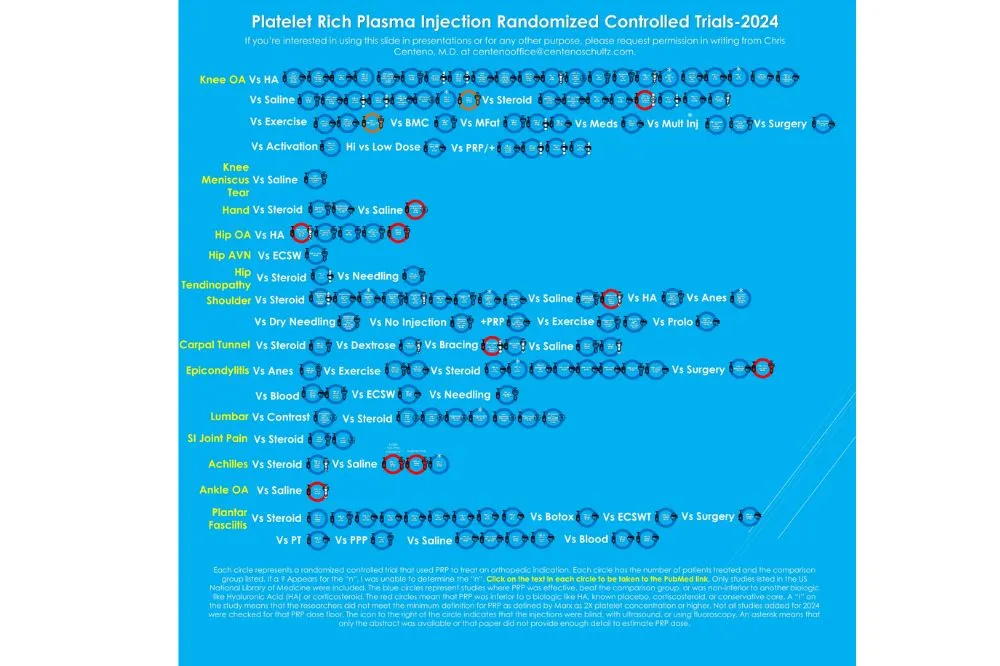
Figure 1 All studies using PRP to treat various health conditions (Blue circles show studies in which PRP was better than other treatments, and red circles show studies in which it wasn’t)
Of course, these infographics might not be perfect. The author noted that many people might say PRP is not compared with surgery. Still, that gap does not lower the value of this image. It clearly shows that PRP beats many common treatments for chronic pain and for inflamed and worn-down tissue. It may also help prevent surgeries.
Source:
Centeno, C. (2024, July 9). My 2024 PRP RCT Infographic. Regenexx. https://regenexx.com/blog/my-2024-prp-rct-infographic/
Dr. Gurpreet Singh Padda, MD, MBA, MHP