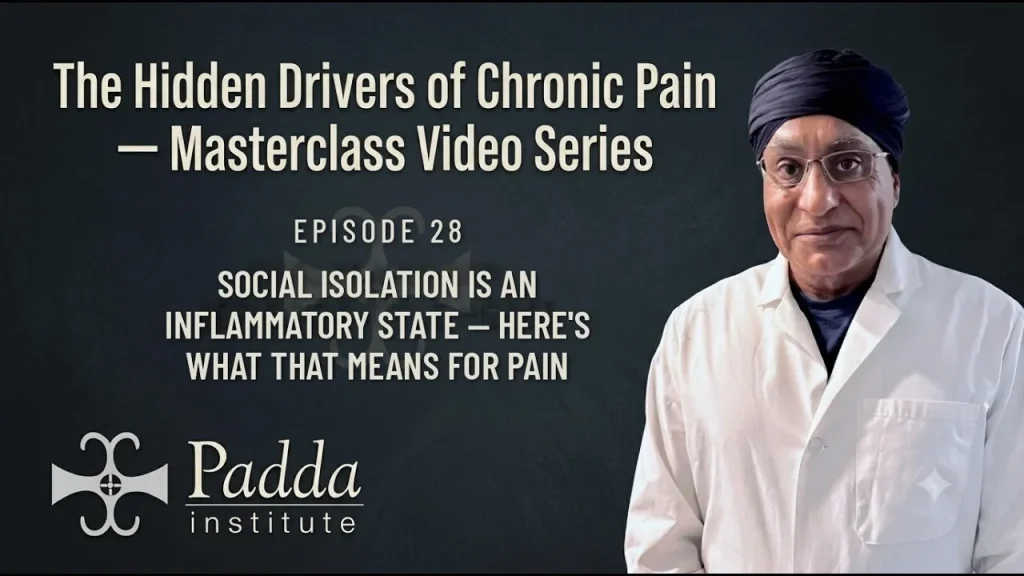
Loneliness makes physical pain worse. Your body reads chronic social isolation as a threat. The stress response then raises inflammatory markers in your blood. That inflammation makes your nerves more sensitive and lowers your pain threshold. Isolation is a body state that drives inflammation, not only a feeling.
What if loneliness were not only a feeling, but a physical state of inflammation you can measure? Research shows that isolated people carry more inflammation in their blood. That inflammation directly lowers your pain threshold. Your need for people is not just emotional. It is biological. This article is part of our Hidden Drivers of Chronic Pain series. It explains why social isolation belongs in any talk about chronic pain.
Is loneliness a physical state, not just a feeling?
We tend to file loneliness under psychology, as a feeling apart from the body. The research has knocked down that wall. Social isolation and loneliness are now known to be body states that drive inflammation. Your body evolved to live in a group. So it reads long-term disconnection as a threat. That threat switches on your stress and inflammation systems. Loneliness is not just felt in the mind. It shows up in the immune system, as inflammatory markers you can measure in the blood.
How does loneliness raise inflammation in the body?
Studies led by Dr. Steve Cole and Dr. John Cacioppo showed that chronic loneliness is associated with a clear shift in how immune genes behave. The shift is toward more inflammation. Isolated people tend to show more inflammatory markers through the whole body. The path runs mostly through a stress response that stays switched on. This is the same HPA axis and sympathetic system covered earlier in this series. When it gets stuck on, it drives up inflammation. And you know what that inflammation does. It makes your nerves more sensitive and lowers your pain threshold.
Why does chronic pain make you lonely?
Here is the cruel loop we see all the time: chronic pain isolates people. It wears you out. It limits what you can do. It makes seeing people hard, and slowly the world shrinks. Then that isolation raises inflammation. That lowers your pain threshold, so the pain gets worse, and you pull away further. Pain pushes you into loneliness. Loneliness pushes the pain back up. From the inside, this downward spiral can feel impossible to break. It is almost never named as part of the medical picture. Naming it is the first step to breaking it.
How do you break the cycle of pain and loneliness?
The evidence is strong. Research links social isolation and loneliness to higher inflammatory markers and changed immune gene activity. Large studies connect loneliness to worse health. The link between inflammation and pain sensitivity runs through this whole series. Connection is not a luxury. It is part of physical health. Our approach treats you as a whole person. It counts social connection as a real factor in your inflammation and pain. We work to break the loop from the pain side. We use interventional, regenerative, and metabolic tools to cut your pain enough that you can take part in life again. As you reconnect, the inflammation from isolation eases. Then the spiral can begin to run upward instead.
Frequently asked questions
Can loneliness actually make physical pain worse?
Yes. Social isolation and loneliness are body states that drive inflammation. Your body reads long-term disconnection as a threat. That threat switches on stress systems and raises inflammatory markers in the blood. The inflammation makes your nerves more sensitive and lowers your pain threshold. So the pain truly gets stronger.
What is the pain-isolation loop?
Chronic pain limits what you can do and makes seeing people hard, so the world shrinks. That isolation raises inflammation. That lowers your pain threshold and makes the pain worse, which isolates you further. It is a downward spiral. Naming it is the first step to breaking it. Individual results vary.
Is reconnecting enough, or do I still need medical care and my medications?
Reconnecting can be a real part of healing. But it works alongside medical care, not in place of it. Our approach cuts pain enough that you can take part in life again. Do not start, stop, or change any medication without consulting your physician as you work on both the pain and the isolation.
What happens if a person is lonely for too long?
Your body evolved to live in a group, so it reads long-term disconnection as a threat. The stress response (the HPA axis and the sympathetic system) gets stuck on. Immune genes shift toward more inflammation, and inflammatory markers rise in the blood. That inflammation makes your nerves more sensitive and lowers your pain threshold. Large studies also connect loneliness to worse health overall.
Can chronic pain cause loneliness?
Yes. Chronic pain wears you out. It limits what you can do and makes seeing people hard, so the world slowly shrinks. That isolation then raises inflammation. That lowers your pain threshold and makes the pain worse, which isolates you further. It is rarely named as part of the medical picture. Naming it is the first step to breaking it.
What should I do if chronic pain has left me lonely and isolated?
Treat both sides of the loop. At the Padda Institute, the work starts from the pain side. We use interventional, regenerative and metabolic tools to cut pain enough that you can take part in life again. As you reconnect with people, the inflammation from isolation eases. Then the spiral can begin to run upward instead of down. Connection is part of physical health, not a luxury.
Where are you located and how do I book?
Padda Institute Center for Interventional Pain Management, 4477 Woodson Rd, Suite 100, St. Louis, MO 63134. Book at painmd.tv/appointment/ or call (314) 481-5000.
Key takeaways
- Social isolation and loneliness are body states that drive inflammation you can measure. They are not just feelings.
- The path runs through a stress system that stays switched on. That raises inflammation and lowers your pain threshold.
- Pain and isolation feed each other in a downward loop. A medical workup rarely names it.
- Cut the pain enough to reconnect. Then the inflammation from isolation eases and the spiral runs upward.
This article is educational and is not a substitute for evaluation, diagnosis, or treatment by a physician. Individual results vary. Do not start, stop, or change any medication without consulting your physician.
References
- Cole SW, Cacioppo JT, et al. Research on chronic loneliness, pro-inflammatory immune gene expression, and systemic inflammation.
Find the source of your pain — not just the signal
Padda Institute Center for Interventional Pain Management builds a customized, root-cause plan for each patient. Interventional care and metabolic medicine, under one roof in St. Louis.
Or call or text us — 4477 Woodson Rd, Suite 100, St. Louis, MO 63134.
Msg & data rates may apply. Reply STOP to opt out, HELP for help. Text is not a secure channel — please don’t send medical or personal health information by text, and don’t use text for emergencies.
Medically reviewed by Dr. Gurpreet Singh Padda, MD, MBA, MHP — Board Certified in Anesthesiology, Pain Medicine, Interventional Pain Management, Addiction Medicine, and Obesity Medicine. Last reviewed July 2026.
Dr. Gurpreet Singh Padda, MD, MBA, MHP