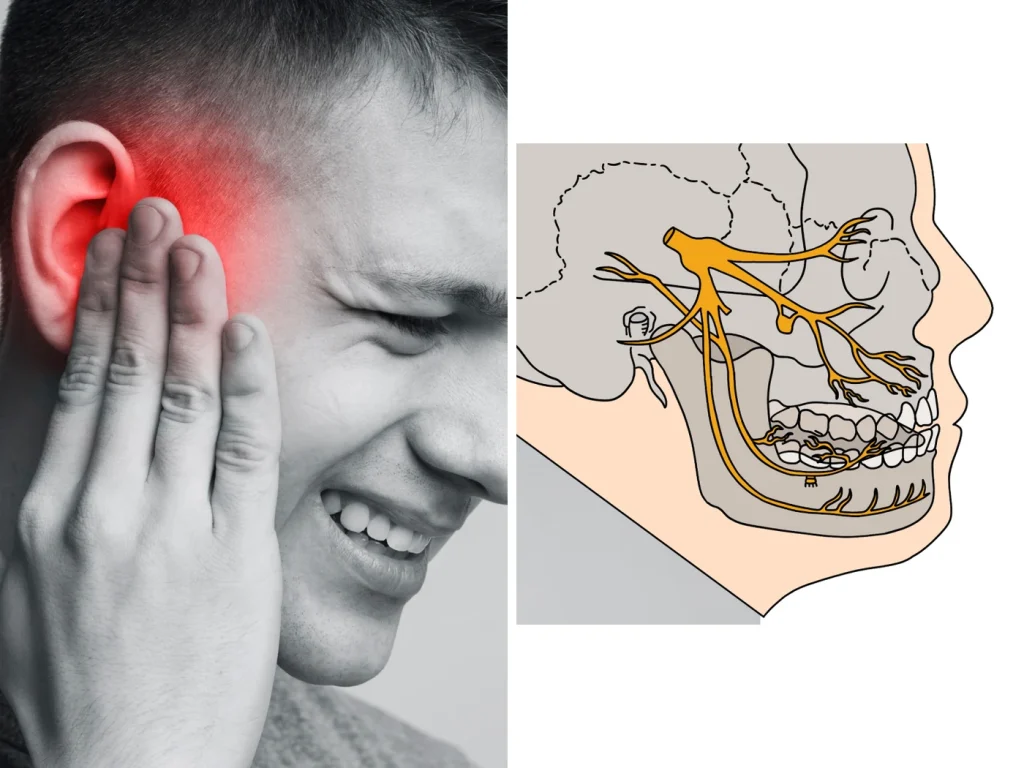
Trigeminal neuralgia produces sudden attacks of severe facial pain, usually on one side. People describe it as shock-like or stabbing. Each attack usually lasts only a few seconds, though it can last up to two minutes. Attacks may repeat many times a day.1 That pattern sets it apart from most other facial pain: extreme pain, very short attacks, set off by ordinary touch. It is also why the condition is so often mistaken for a dental problem first.
Which nerve, and which part of the face
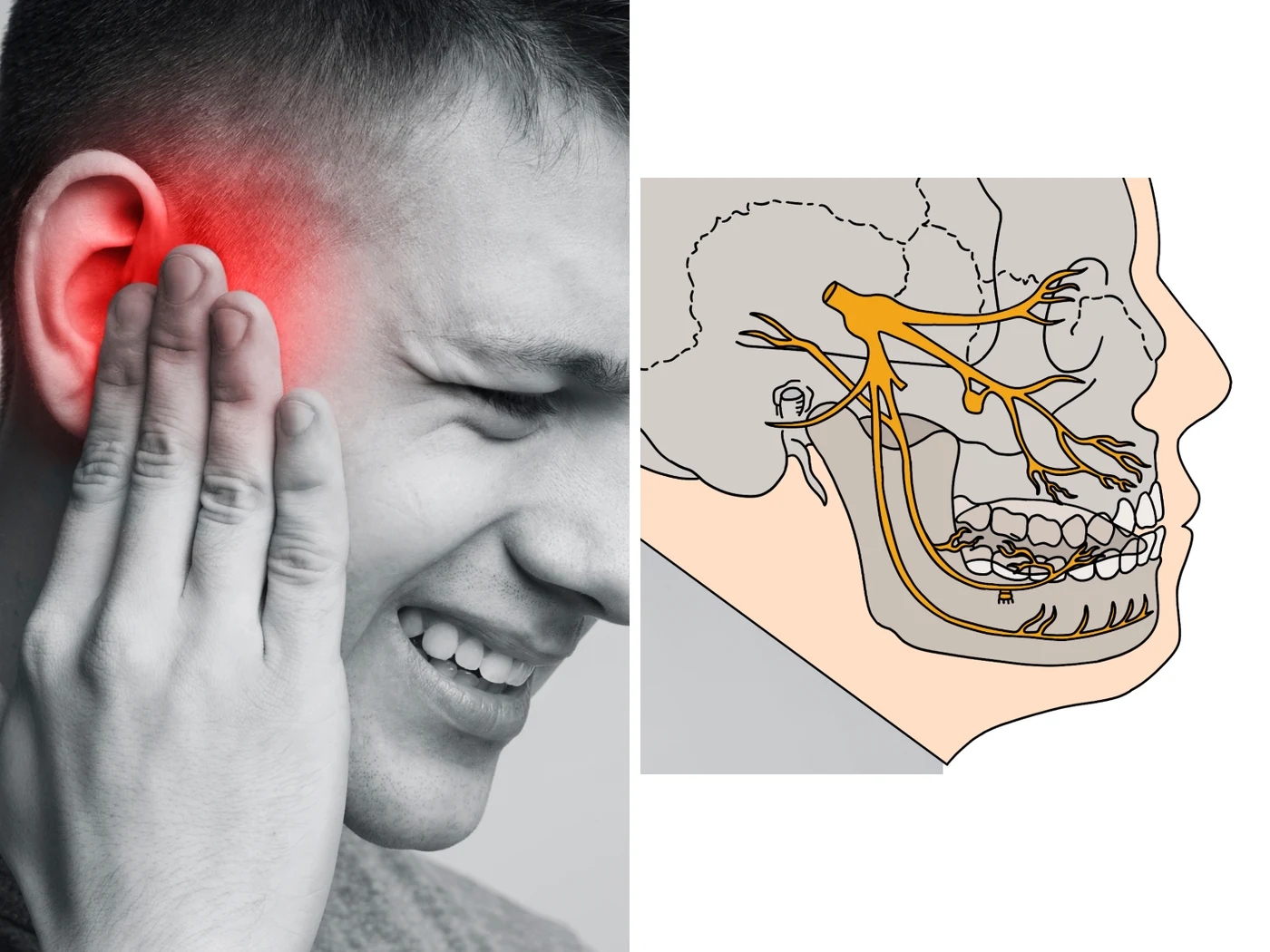
The trigeminal nerves are a pair of cranial nerves. They connect the brain and brain stem to different parts of the face. Each has three branches that carry feeling from the upper, middle and lower parts of the face. The ophthalmic branch supplies most of the scalp, forehead and front of the head. The maxillary branch supplies the cheek, upper jaw, top lip and teeth.1
The maxillary branch serves the upper teeth. So pain along that branch can feel exactly like a toothache to the person who has it. Many patients have had dental work that did not stop the pain.
What sets off an attack
Attacks can be set off by vibration or contact with the cheek: shaving, washing the face, putting on makeup. Brushing teeth, blowing the nose, eating, drinking, talking, or wind can set them off too.1 The pain rarely occurs during sleep.1
Say this plainly to family members, because the triggers look trivial from the outside. Dodging a breeze or not eating in company is not avoidance behavior. It is a sensible response to something that reliably causes severe pain.
It can progress
Pain may stop for a while and then return. In some cases the condition is progressive. Attacks get longer and more frequent over time. In progressive trigeminal neuralgia a person may feel pain all the time.1 Early evaluation matters for that reason.
Why it happens
In the classic form, which is the most common, a blood vessel is found pushing on part of the trigeminal nerve root. That vessel is usually the superior cerebellar artery.1
Secondary trigeminal neuralgia is caused by another disorder such as multiple sclerosis, a tumor, or an arteriovenous malformation (a tangle of blood vessels). People with secondary trigeminal neuralgia are more likely to be younger and to have pain on both sides of the face. Only 15% of cases are secondary.1 When no cause is found after a diagnostic workup, it is called idiopathic. That is the least common type.1
So pain on both sides of the face in a younger person changes the workup. It is not a detail to note in passing.
How it is treated, and one thing that does not work
Anticonvulsant medicines, used to block pain signals, can reduce how often attacks happen. These include carbamazepine, oxcarbazepine, gabapentin, pregabalin, lamotrigine, topiramate and phenytoin. More than one may be used together if a single drug fails. Baclofen and botulinum toxin A may be tried when anticonvulsants do not work or side effects are a problem.1 The treating physician decides which drug and what dose.
Common painkillers such as aspirin and ibuprofen, and opioid medications such as hydrocodone, are not usually helpful in treating trigeminal neuralgia.1 That is a useful fact for anyone who has been cycled through painkillers with no benefit and decided the pain must be imagined. It is not. This pain simply does not respond to that class of drug.
Where facial and head pain is being evaluated, the practice’s approach to severe head and neck pain and to targeted nerve blocks is described on those pages.
Frequently asked questions
How long does a trigeminal neuralgia attack last?
Usually only a few seconds, though attacks can last up to two minutes and may come back many times a day. Very short attacks with severe pain are the hallmark. Related facial and head pain evaluation is described under severe head and neck pain.
Why does my face hurt when I brush my teeth or feel a breeze?
Light touch and vibration are known triggers, along with shaving, washing the face, eating, drinking, talking and wind. This is part of the condition. It is not oversensitivity or imagination. See the range of pain treatments for how facial pain is approached.
Could this be something other than trigeminal neuralgia?
Possibly. Pain on both sides of the face, or onset at a younger age, raises the odds of a secondary cause such as multiple sclerosis or a tumor. Secondary causes make up about 15% of cases and change the workup. Evaluation options are outlined on the pain management doctors in St. Louis page.
Will painkillers help?
Usually not. Aspirin, ibuprofen and opioids such as hydrocodone do not usually work for this condition. That is one reason treatment focuses elsewhere. How the practice handles medication burden in general is described under opioid stewardship.
Does it get worse if left alone?
It can. Pain may go away and come back. In progressive cases attacks become longer and more frequent, and sometimes constant. That argues for getting evaluated rather than waiting. You can arrange that through the appointment request form.
To have facial pain evaluated, request an appointment, call (314) 481-5000, or text (314) 886-5902.
Sources
- National Institute of Neurological Disorders and Stroke. Trigeminal Neuralgia. National Institutes of Health. Accessed August 12, 2026. NINDS — Trigeminal Neuralgia
Dr. Gurpreet Singh Padda, MD, MBA, MHP