Most lasting pain outlives the original injury. The tissue healed years ago. What keeps the pain going is metabolic inflammation, not the old damage. Stronger drugs fail too. That is because the nervous system up-regulates (adds more of) its opioid receptors within weeks. So doses climb without touching why the pain is still there.
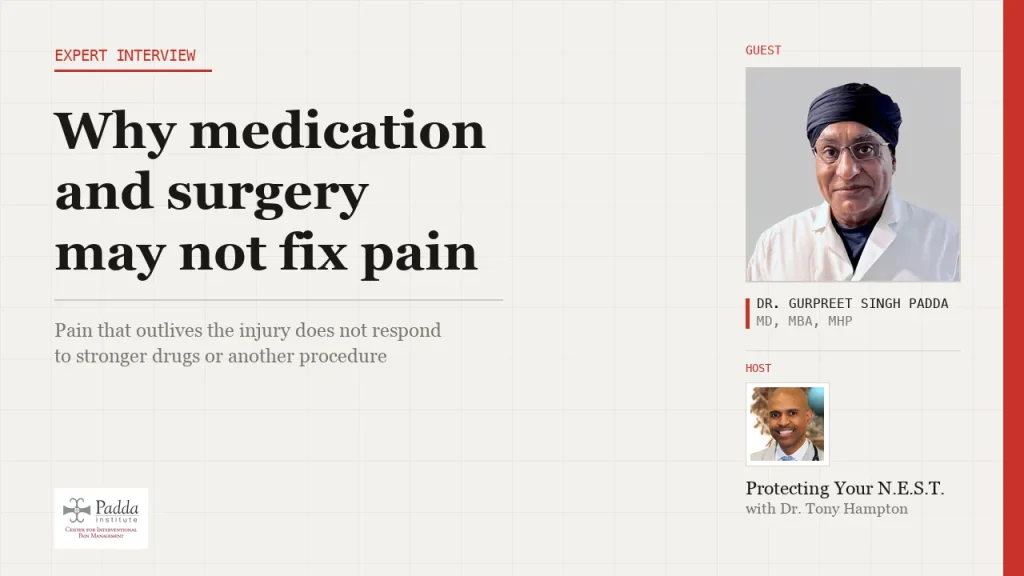
Maybe you were hurt years ago. The injury healed long ago, but the pain never left. You are not imagining it, and more medication may not be the answer. In a conversation with Dr. Tony Hampton, Dr. Gurpreet Singh Padda, MD, MBA, MHP, explained why this kind of long-lasting pain often does not respond to stronger drugs or another procedure. He also explained why he looks at metabolic inflammation instead. This article sums up the medical ideas from that talk.
Can an old injury cause pain years later?
Dr. Padda drew a clear line between two types of pain. The first is acute pain. That is the kind you feel if a truck runs over your foot. It hurts a lot. It may need surgery or an orthopedic procedure. Over a short time the injury heals and the pain goes away. The second kind, and the focus of the talk, is pain that outlives the duration of the injury. Someone was hurt five, seven, or ten years ago. The tissue healed, yet the pain stays. He said this second kind is what the vast majority of people with ongoing pain are really dealing with. It is a completely different problem from a fresh injury.
Why do opioids stop working for chronic pain?
The usual answer to lasting pain is often more and stronger narcotics. Dr. Padda explained why that approach tends to fail. The human nervous system adapts fast. Give it an opioid, and it quickly adjusts by up-regulating its receptors. So the drug loses effect. In the talk he said the drug works fairly well for roughly the first 28 to 30 days. But by around 60 days a person needs more and more drug to get the same relief. That climb, he argued, does not deal with why the pain is still there in the first place. It just chases a moving target.
What keeps pain going after an injury heals?
Dr. Padda has more than twenty years in practice. He said he has treated about 65,000 to 70,000 patients. He said his clinic concluded that lasting pain is often an issue of metabolic inflammation. That is a problem of the body’s metabolism, not the original injury. He cited a striking figure in the talk: under 12.2% of people in the U.S. were metabolically healthy on the 2009–2016 survey. So the large majority are metabolically unwell. As he puts it, if you cannot fix a patient’s diet, you cannot fix their pain. He said his clinic works on metabolism every day. The figure for the general population has since been revised downward. It is under 12.2% on the NHANES 2009–2016 definition, and under 7% on the tighter criteria used after 2021.
How can I get relief from chronic pain?
Dr. Padda’s practical point is that chronic pain should be checked as part of a person’s overall metabolic health, not treated only as a local structural problem. In the talk, he and Dr. Hampton noted that metabolic health ties into many conditions people rarely link to pain. Diabetes, high blood pressure, dementia, and cancer are among them. So improving it may bring benefits well beyond pain relief. At the Padda Institute, the focus is on finding and treating those underlying metabolic drivers, including diet. The default is not to keep raising medications. This reflects the clinic’s practice-based approach and is not a promise of any specific outcome.
Frequently asked questions
If my injury healed years ago, why do I still have pain?
Dr. Padda separates pain that outlives the original injury from a fresh injury. He blames much of it on metabolic inflammation, not unhealed tissue. In his view, that is why the pain stays long after the injury should have healed. This is a practice-based framework, and individual results vary.
Why don't stronger pain pills fix long-term pain?
Because the nervous system adapts to opioids by up-regulating its receptors. So tolerance builds. Dr. Padda described a drug working for roughly 28 to 30 days, then needing higher doses by around 60 days. Raising the dose chases the symptom without dealing with why the pain remains. Individual results vary.
Should I stop my pain medication to work on my metabolism?
No — do not start, stop, or change any medication without consulting your physician. Dr. Padda's clinic works to find and treat underlying metabolic drivers over time. Where it fits, the clinic helps patients wean under supervision. This is not something to try alone. Individual results vary.
For why stopping opioids suddenly on your own is not the safe route, read Why Abrupt Opioid Tapering Is Also Harm.
What is the difference between acute and chronic pain?
Acute pain is the kind you feel if a truck runs over your foot. It hurts a lot, and it may need surgery or an orthopedic procedure. As the injury heals, the pain goes away. The other kind outlives the injury. Someone was hurt five, seven or ten years ago. The tissue healed, and the pain stays. That second kind is what most people with ongoing pain have.
Will another procedure or surgery fix pain from an old injury?
Often not. Surgery and procedures fit a fresh injury, where fixing the damage lets the pain resolve. When the tissue healed years ago, the old damage is not what keeps the pain going. So another procedure, like a stronger drug, can miss the real driver. Dr. Padda looks instead at metabolic inflammation and the diet behind it.
How is metabolic health connected to chronic pain?
Dr. Padda says lasting pain is often a problem of metabolic inflammation, not the original injury. In his framing, if you cannot fix a patient's diet, you cannot fix their pain. Metabolic health also ties into conditions people rarely link to pain, including diabetes, high blood pressure, dementia and cancer. So improving it can pay off well beyond pain relief.
Where are you located and how do I book?
Padda Institute Center for Interventional Pain Management, 4477 Woodson Rd, Suite 100, St. Louis, MO 63134. Book at painmd.tv/appointment/ or call (314) 481-5000.
Key takeaways
- Pain that outlives a healed injury is a different problem than acute injury pain and needs a different approach.
- The nervous system adapts to narcotics. So tolerance builds, and rising doses rarely fix long-term pain.
- Dr. Padda attributes much persistent pain to metabolic inflammation, citing that under 12.2% of Americans were metabolically healthy in 2009–2016, a share now below 7%.
- Next step: have the metabolic drivers of your pain checked at the Padda Institute instead of relying on medication alone.
This article is educational and is not a substitute for evaluation, diagnosis, or treatment by a physician. Individual results vary. Do not start, stop, or change any medication without consulting your physician.
Find the source of your pain — not just the signal
Padda Institute Center for Interventional Pain Management builds a customized, root-cause plan for each patient. Interventional care and metabolic medicine, under one roof in St. Louis.
Or call or text us — 4477 Woodson Rd, Suite 100, St. Louis, MO 63134.
Msg & data rates may apply. Reply STOP to opt out, HELP for help. Text is not a secure channel — please don’t send medical or personal health information by text, and don’t use text for emergencies.
Medically reviewed by Dr. Gurpreet Singh Padda, MD, MBA, MHP — Board Certified in Anesthesiology, Pain Medicine, Interventional Pain Management, Addiction Medicine, and Obesity Medicine. Last reviewed July 2026.
Dr. Gurpreet Singh Padda, MD, MBA, MHP