Chronic pain drives addictive eating through dopamine, the brain’s reward and learning signal. Food and some pain medications both hit that reward system. When the usual source of that hit is out of reach, the brain grabs the easiest one: food. It is a wiring problem, not a lack of willpower.
Maybe you live with chronic pain and cannot seem to control your eating. You are not simply lacking willpower. Here, Dr. Padda explains the real link between pain and addictive eating—a loop built on dopamine, the brain’s reward and learning signal. It explains why so many people with pain also fight their weight and metabolic health. Everything below comes from his talk.
What does dopamine have to do with eating?
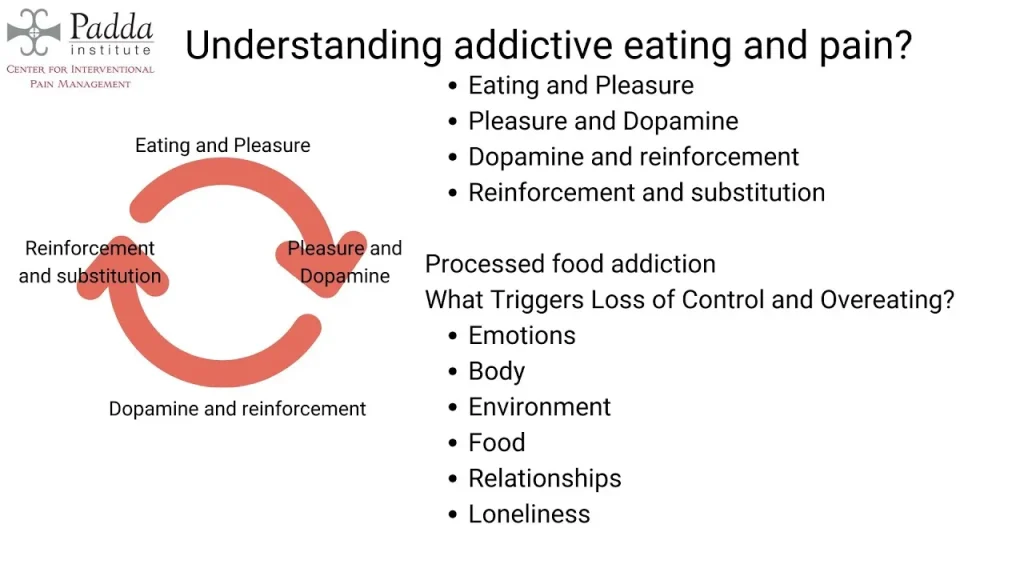
Humans are hardwired to seek pleasure—it is what drives us to act instead of sit still. Eating triggers a release of dopamine. Dopamine is a learning signal. It tells your brain “that was good, do it again.” For most of history, the foods that gave us that reward were also the most nourishing. So the loop kept us healthy. The brain repeats what feels good, and each time the habit gets stronger.
How does processed food hijack your dopamine?
Modern food companies, Dr. Padda explains, build products to hijack that dopamine system. A bag of chips can taste amazing with no real food value—so you cannot stop at one. He defines processed food as food changed until it no longer looks like anything in nature. Think high-fructose corn syrup, added carbohydrate, artificial sugars, and vegetable oils your tongue cannot even tell are rancid. The result is a strong pull to keep eating foods that reward the brain but starve the body.
Why does chronic pain lead to overeating?
Here is the link to pain. Anything that hits the dopamine reward system—including some pain medications—creates the same drive. When a person loses whatever was giving them that dopamine release, they often substitute something else that gives a similar hit. Food is the easiest option. That is why, Dr. Padda notes, many people with severe pain overeat. He adds that triggers such as surroundings, relationships, and above all loneliness feed this loss of control. He describes loneliness as sitting at the base of addiction itself.
What this means at the Padda Institute
This link has real metabolic costs. Dr. Padda states that under 7% of the U.S. population is metabolically healthy. In the pain population, the figure is under 1%. In his own clinic’s studies, about 0.1% of patients arrive metabolically healthy. These are figures he reports from practice, so individual results vary. That is why care here looks past the pain to the eating patterns, triggers, and isolation driving it. He also points to a resource built for this, addictionology.center. It focuses on the many factors behind addiction.
Frequently asked questions
Why do I overeat when my pain is bad?
According to Dr. Padda, both food and some pain treatments release dopamine, the brain's reward and learning signal. When that reward is gone, the brain pushes you to swap in something with a similar hit. Food is usually the easiest option. This is a wiring issue, not a simple failure of willpower. Triggers like stress and loneliness make it stronger. Individual results vary.
There is more on this in Hedonic Substitution in Pain Patients: The Link Between Opiates, Addictive Processed Foods, and Inflammation.
What counts as processed food?
Dr. Padda defines processed food as anything changed so much that it no longer looks like something in nature. That includes added vegetable oils, high-fructose corn syrup, extra or artificial sugars, and calorie-dense ingredients. They trigger dopamine without real nutrition. These foods are built to keep you eating. That is why one chip becomes the whole bag.
For how processed food drives inflammation and pain, read How Inflammation and Diet Drive Chronic Pain and Hormone Problems.
Could my pain medication be linked to my eating?
Dr. Padda explains that pain medications act on the same dopamine reward system as food. So losing them can push you to overeat instead. Do not start, stop, or change any medication without consulting your physician; any change should be made with your doctor as part of a plan that also addresses the underlying pain and eating patterns. Individual results vary.
What is addictive eating?
Addictive eating is eating you cannot seem to control. The brain's dopamine reward loop drives it, not hunger. Eating releases dopamine, a learning signal that tells your brain to repeat what felt good. Processed foods are built to hit that signal hard without real nutrition. So the loop keeps pulling you back. It is a wiring problem, not a lack of willpower.
Which foods drive addictive eating?
Dr. Padda points to processed food: food changed until it no longer looks like anything in nature. That includes high-fructose corn syrup, added carbohydrate, artificial sugars and vegetable oils your tongue cannot even tell are rancid. These foods reward the brain without feeding the body. That is why you cannot stop at one chip, and the whole bag disappears.
Does loneliness make addictive eating worse?
Yes. Dr. Padda names triggers such as surroundings, relationships and above all loneliness. They drive the loss of control over eating. He describes loneliness as sitting at the base of addiction itself. That is why care at the Padda Institute looks past the pain to the eating patterns, triggers and isolation behind it. It is also why he points patients to addictionology.center.
Where are you located and how do I book?
Padda Institute Center for Interventional Pain Management, 4477 Woodson Rd, Suite 100, St. Louis, MO 63134. Book at painmd.tv/appointment/ or call (314) 481-5000.
Key takeaways
- Mechanism: eating releases dopamine, a learning signal that locks in the habit. Pain and pain medications use the same system.
- Evidence status: this is a clinical explanation Dr. Padda uses from practice. The metabolic-health figures are what he sees in practice.
- Why timing matters: when a dopamine source is lost, the brain swaps in food. That drives overeating and metabolic decline.
- Next step: treat the eating, triggers, and pain together. Book at painmd.tv/appointment/.
This article is educational and is not a substitute for evaluation, diagnosis, or treatment by a physician. Individual results vary. Do not start, stop, or change any medication without consulting your physician.
Find the source of your pain — not just the signal
Padda Institute Center for Interventional Pain Management builds a customized, root-cause plan for each patient. Interventional care and metabolic medicine, under one roof in St. Louis.
Or call or text us — 4477 Woodson Rd, Suite 100, St. Louis, MO 63134.
Msg & data rates may apply. Reply STOP to opt out, HELP for help. Text is not a secure channel — please don’t send medical or personal health information by text, and don’t use text for emergencies.
Medically reviewed by Dr. Gurpreet Singh Padda, MD, MBA, MHP — Board Certified in Anesthesiology, Pain Medicine, Interventional Pain Management, Addiction Medicine, and Obesity Medicine. Last reviewed July 2026.
Dr. Gurpreet Singh Padda, MD, MBA, MHP