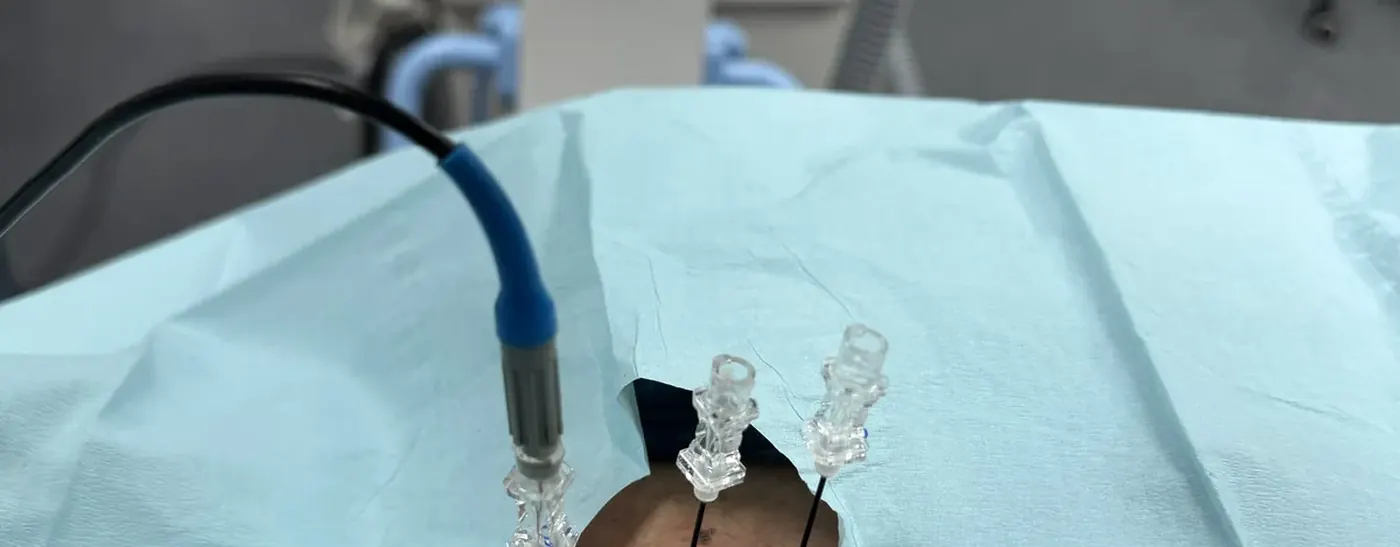
An important development is the sixty-day percutaneous system. A fine lead is placed, worn for up to sixty days, then withdrawn, with no permanent implant left behind. The rationale is that sustained modulation may reset the sensitized circuit rather than simply masking the signal while the device runs.
Published prospective work supports durable relief in a meaningful proportion of patients after the lead is removed, and the RESET trial met its primary endpoint, with more patients achieving at least fifty percent pain relief at three months than those receiving standard interventional care. The evidence base is younger and smaller than for spinal cord stimulation, and we present it that way rather than as settled.
Auricular vagal stimulation for diabetic peripheral neuropathy
For painful diabetic peripheral neuropathy we use the NS-100, a programmable peripheral electrical nerve stimulator manufactured by Nalu. It is an FDA-cleared Class II device.
It is applied to the auricular branches — the nerve branches at the ear — rather than to the nerves in the painful limb, and it acts as a vagal stimulator. That is the part patients find counter-intuitive: the device is placed at the ear and the pain being treated is in the feet. It works through the vagal pathway and its influence on how pain signals are processed, not by interrupting the painful nerve where it hurts.
The stimulator is worn for a defined period — up to 30 days, though most patients are treated for around 20. Nothing is left permanently in place.
Placement is done under local anesthetic with no sedation, you drive yourself home, and there are no activity restrictions afterward.
On coverage. Peripheral nerve stimulation is a covered category under Medicare’s national coverage determination for electrical nerve stimulators, and local coverage determinations set the criteria that apply. That is the category, not a promise about your claim: your specific plan, indication and documentation still govern, so coverage is verified before anything is scheduled. An authorization, where one is obtained, is not itself a guarantee of payment.
See diabetic peripheral neuropathy for how the condition is evaluated before this point is reached.