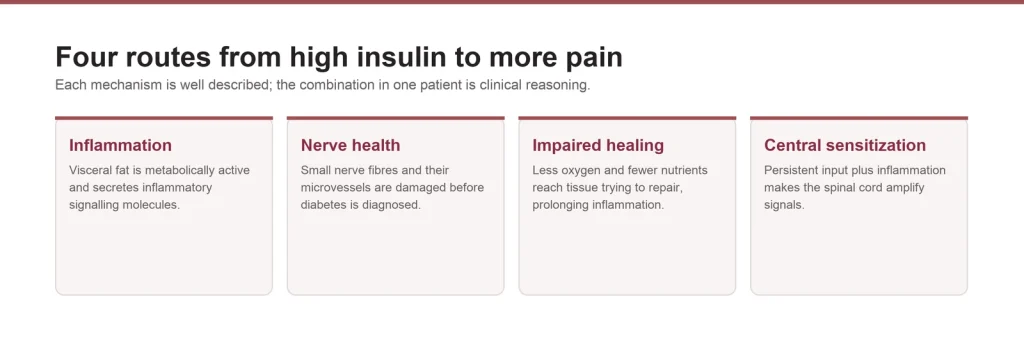
Chronically high insulin amplifies pain through inflammation, small-fiber nerve damage, poor healing and central sensitization. It often does this while blood sugar still reads normal. This talk was given to a clinical audience at LowCarbUSA and is more technical than most articles here.
Most patients with chronic pain are told their problem is structural. A disc, a joint, a pinched nerve. Sometimes that is true.
But many of the patients who come to our clinic have something else going on under the scan finding: chronically elevated insulin. Not diabetes — most have never been told they have it. High insulin, with blood sugar still in the normal range.
This article explains the proposed link between the two. It is honest about which parts are proven and which are inference.
What does insulin do besides control blood sugar?
Insulin’s textbook job is moving sugar out of the blood. That sells it far short.
Insulin is a growth and storage hormone. It shapes fat storage and salt retention. It sets the body’s fight-or-flight tone. It acts on blood vessel muscle and on inflammation signals. When insulin stays high, all of those systems stay off balance.
That is why insulin shows up in a talk about back pain.
How does high insulin cause more pain?
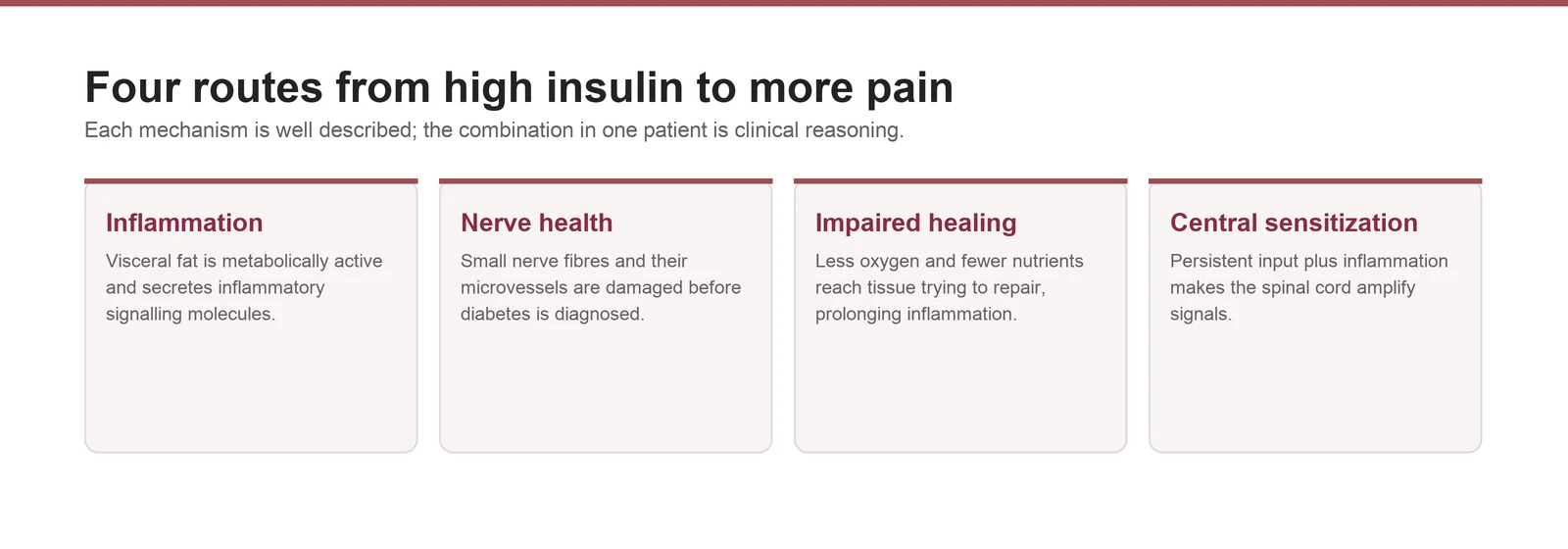
Here is how high insulin could plausibly amplify a pain problem. I want to be clear about how sure we are. Each of these mechanisms is well described in the research. But using the combination to explain one patient’s pain is clinical reasoning, not a proven chain of cause.
Inflammation. Insulin resistance and the belly fat that comes with it create constant low-grade inflammation. Fat is not dead storage. It is active tissue that pumps out inflammation signals. Nerves soaking in those signals get more sensitive.
Nerve health. High sugar and insulin over time damage small nerve fibers and the tiny blood vessels that feed them. This is the same process that causes diabetic neuropathy. But it does not politely wait for the diabetes diagnosis. Small-fiber changes can be measured in people with pre-diabetes.
Impaired healing. When the tiny blood vessels fail, less oxygen and fewer nutrients reach tissue that is trying to heal. An injury that should heal in six weeks takes six months. And tissue stuck in a long inflammatory phase keeps sending pain signals.
Central sensitization. Steady pain input from the body plus whole-body inflammation push the spinal cord and brain to amplify signals. That is the volume-control problem covered in central sensitization.
Why does a normal blood sugar test miss high insulin?
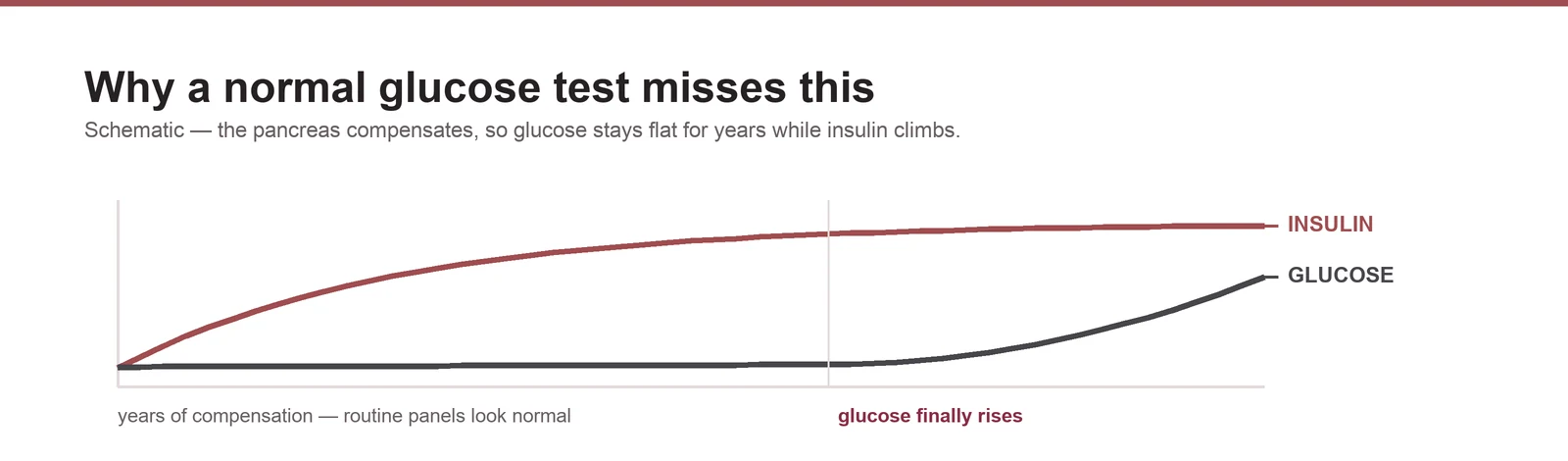
The routine metabolic panel measures blood sugar. It does not measure insulin.
The pancreas fights insulin resistance by making more and more insulin. So blood sugar can stay normal for years while insulin climbs. A patient can have very high insulin with a fasting blood sugar their doctor calls perfect.
This is not a fringe idea. Dr. Joseph Kraft made this point with more than 14,000 glucose tolerance tests done with insulin measurement. Abnormal insulin responses were common in patients whose sugar curves looked normal. His patients were sent to him for testing, not picked at random. So his percentages should not be applied to the general public. But the principle holds.
If you want the earlier signal, you have to ask for it: fasting insulin along with glucose, and the triglyceride-to-HDL ratio. More on what to ask for in insulin resistance before diabetes.
How does treating high insulin change pain treatment?
Say a patient’s pain is driven partly by metabolic inflammation. Then the metabolic problem is a treatment target — not a side issue for a different doctor.
In practice, a procedure is more likely to hold when the terrain under it is improving. It is less likely to hold when it is not. It also means diet change is not lifestyle advice bolted onto pain care. For some patients, it is the part doing the most work.
What it does not mean is that insulin causes pain in every patient. Nor does metabolic care replace proper structural diagnosis and treatment. A pinched nerve root still needs to be found. The two questions are asked together, not instead of each other.
Frequently asked questions
Can high insulin cause pain if I do not have diabetes?
High insulin with normal blood sugar is common and is not diabetes. Each link to pain is well described. These are inflammation, small-fiber nerve changes, damage to tiny blood vessels and central sensitization. Whether they are the main driver in your case is a clinical judgment. It needs an evaluation, not a conclusion drawn from an article.
Is the link between hyperinsulinemia and chronic pain proven?
The single mechanisms are proven. The full chain of cause in one patient is clinical reasoning, not proven fact. No randomized trial has tested treating hyperinsulinemia as a pain treatment against usual care. I would rather tell you that plainly than overstate it. Individual results vary.
What test would show this?
Ask for fasting insulin with fasting glucose, the triglyceride-to-HDL ratio, and HbA1c. Together they show the problem much earlier than glucose alone. None of these is costly or unusual. They are just not on the default panel, so you have to ask for them.
Will fixing my insulin make my pain go away?
It may reduce it. It also tends to make other treatments work better and last longer. It is not a guarantee. And it does not replace diagnosing a structural problem that needs its own treatment. Anyone promising a cure is overselling. Individual results vary.
How do you know you have hyperinsulinemia?
Not from a routine blood panel, because it measures sugar, not insulin. The pancreas makes more and more insulin to fight insulin resistance. So blood sugar can stay normal for years while insulin climbs. Most of the patients we find it in have never been told they have diabetes. You have to ask for the earlier signal: fasting insulin along with glucose, and the triglyceride-to-HDL ratio.
Does high insulin damage nerves before diabetes is diagnosed?
It can. High sugar and insulin over time damage small nerve fibers and the tiny blood vessels that feed them. This is the same process that causes diabetic neuropathy. And it does not wait for the diabetes diagnosis. Small-fiber changes can be measured in people with pre-diabetes, while a standard sugar test can still look normal.
How is hyperinsulinemia treated when it is feeding chronic pain?
The metabolic problem becomes a treatment target alongside the pain, not a side issue for a different doctor. For some patients, diet change is the part doing the most work. A procedure is more likely to hold when the metabolic terrain under it is improving. A structural problem, such as a pinched nerve root, still has to be found and treated.
Where can I be evaluated for this?
Padda Institute Center for Interventional Pain Management is at 4477 Woodson Rd, Suite 100, St. Louis, MO 63134, next to St. Louis Lambert International Airport. A second location is at 12174 Natural Bridge Rd, St. Louis, MO 63044. The practice serves the St. Louis region across Missouri and Illinois. Call (314) 481-5000 or text (314) 886-5902, Monday to Friday, 8:00 AM to 5:00 PM.
Key takeaways
- Insulin is a growth and storage hormone. It affects inflammation, blood vessel tone and nerve health — not only blood sugar.
- Four plausible routes from high insulin to worse pain: inflammation, small-fiber nerve damage, poor healing, and central sensitization.
- Blood sugar can stay normal for years while insulin climbs. So standard panels miss the early stage.
- Ask for fasting insulin and triglyceride-to-HDL, not glucose alone.
- The mechanisms are proven. The chain of cause in one patient is clinical reasoning, not proven fact.
This article is educational and is not a substitute for evaluation, diagnosis, or treatment by a physician. Individual results vary. Do not start, stop, or change any medication without consulting your physician. To be evaluated, request an appointment or call (314) 481-5000.
References
- Kraft JR. Detection of diabetes mellitus in situ (occult diabetes). Laboratory Medicine. 1975;6(2):10–22. Referred clinical population, not a population prevalence sample.
- Araújo J, Cai J, Stevens J. Prevalence of optimal metabolic health in American adults: NHANES 2009–2016. Metabolic Syndrome and Related Disorders. 2019;17(1):46–52.
- Woolf CJ. Central sensitization: implications for the diagnosis and treatment of pain. Pain. 2011;152(3 Suppl):S2–S15.
- Eddy D, Schlessinger L, Kahn R, Peskin B, Schiebinger R. Relationship of insulin resistance and related metabolic variables to coronary artery disease: a mathematical analysis. Diabetes Care. 2009;32(2):361–366.
Get evaluated by a physician who treats the terrain, not just the signal
Chronic pain, metabolic disease and trauma physiology reinforce each other. At the Padda Institute they are assessed together, because treating one alone underperforms.
Or call or text us.
Medically reviewed by Dr. Gurpreet Singh Padda, MD, MBA, MHP — Board Certified in Anesthesiology, Pain Medicine, Interventional Pain Management, Addiction Medicine, and Obesity Medicine. Last reviewed July 2026.
Dr. Gurpreet Singh Padda, MD, MBA, MHP