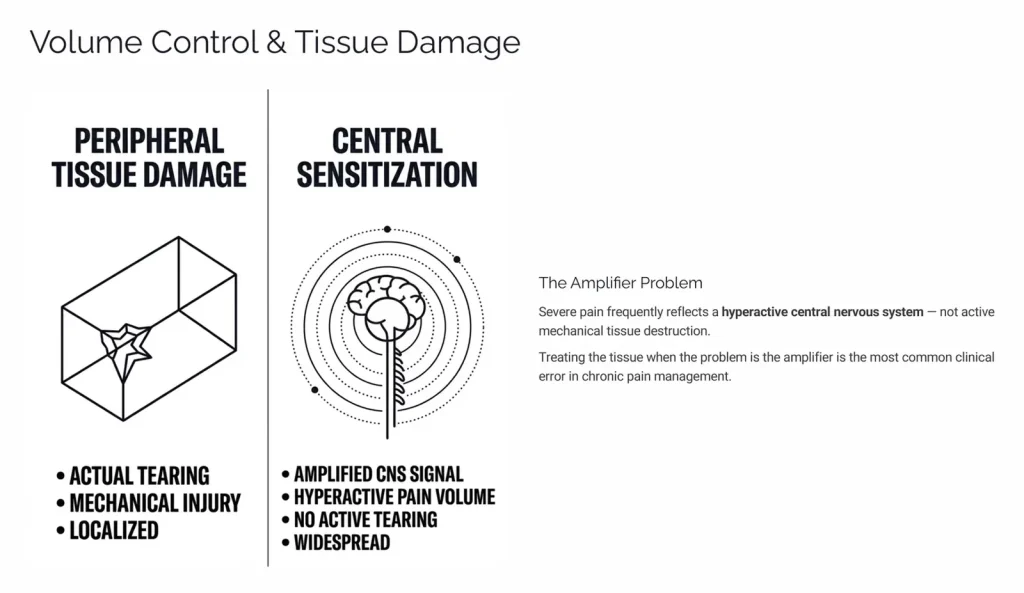
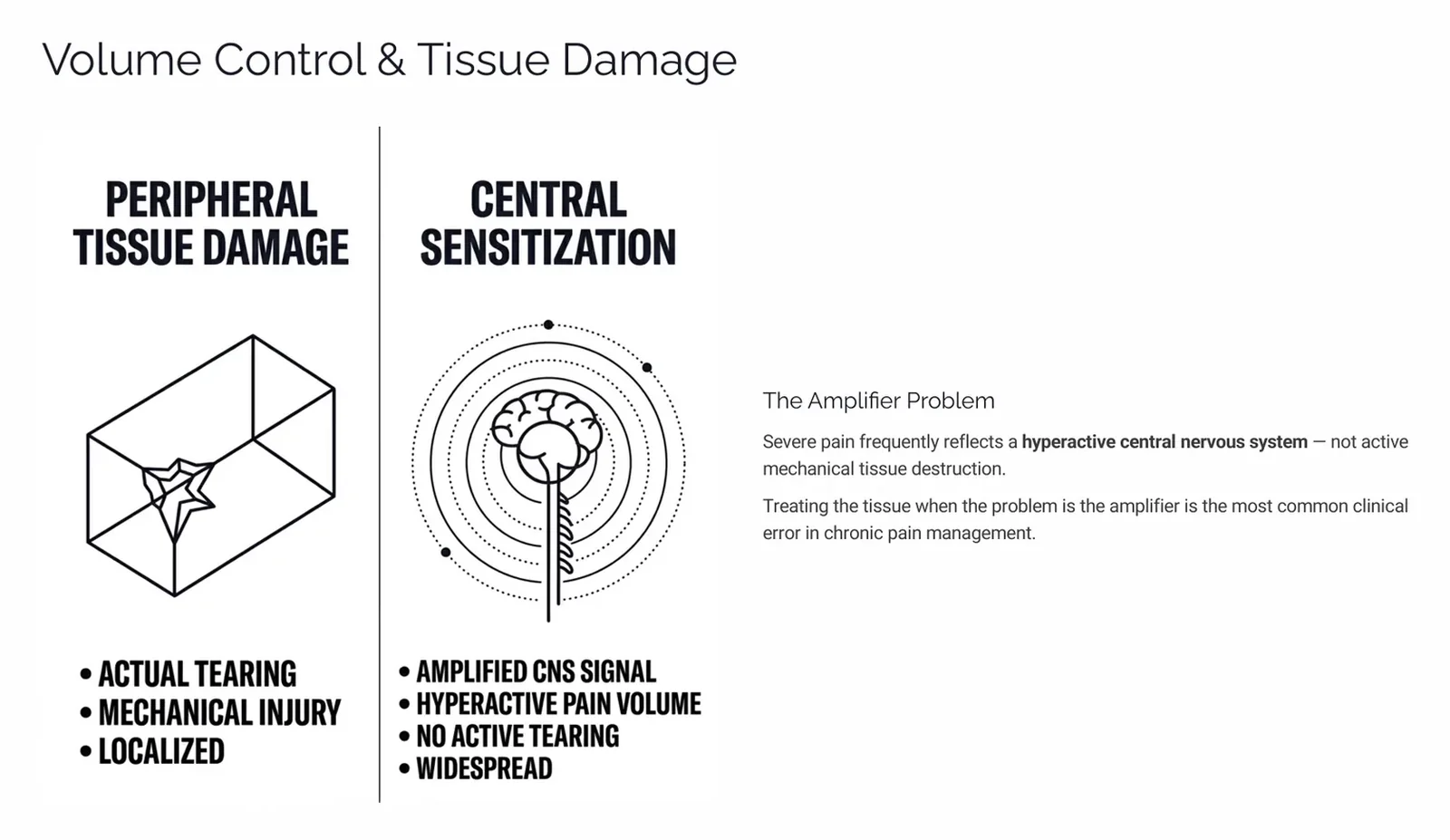
Your scan does not match your pain because of central sensitization. The spinal cord and brain turn up the volume on incoming signals and leave it there. The MRI shows the hardware. The pain is made by the processing. That is why a scary scan can belong to a comfortable person.
The most common mistake in chronic pain care is treating the tissue when the problem is the amplifier.
That one sentence explains why your scans may not match your symptoms. It explains why a perfect procedure can leave you unchanged. And it explains why “the scan looks fine” is not the comfort it is meant to be.
What is central sensitization?
Think of the nervous system as having a volume control on incoming signals.
In central sensitization, that volume control is turned up and stays up. This is mainstream pain science, not a fringe idea. The spinal cord and brain amplify signals that would once have felt minor or gone unnoticed.1
So severe pain often reflects an overactive central nervous system, not tissue that is still being torn down.
This is why a person with a frightening MRI can be comfortable, and a person with a clean MRI can be in genuine agony, and both are telling the truth. The scan images the hardware. The pain is produced by the processing.
If we keep operating on tissue while the amplifier stays at max, we get just what the body science predicts. The procedure works. The patient does not change.
Can medication fix central sensitization?
Pills do not fix metabolic debt.
Drugs are truly useful, and I prescribe them. But chronic pain rooted in metabolic problems or poor habits can’t be fixed with chemicals. That is because the chemistry sits downstream of the cause.
Say pain is being kept alive by body-wide inflammation from a diet high in refined carbs and industrial seed oil. Add five hours of broken sleep and constant, unmanaged stress. Then no molecule is treating the condition. It is muffling the alarm while the fire keeps burning.
That is sometimes the correct thing to do temporarily. It is never the plan.
How do you fix central sensitization?
Not by avoiding everything. This is the trap most pain patients fall into, and it makes sense. Movement hurts, so movement stops.
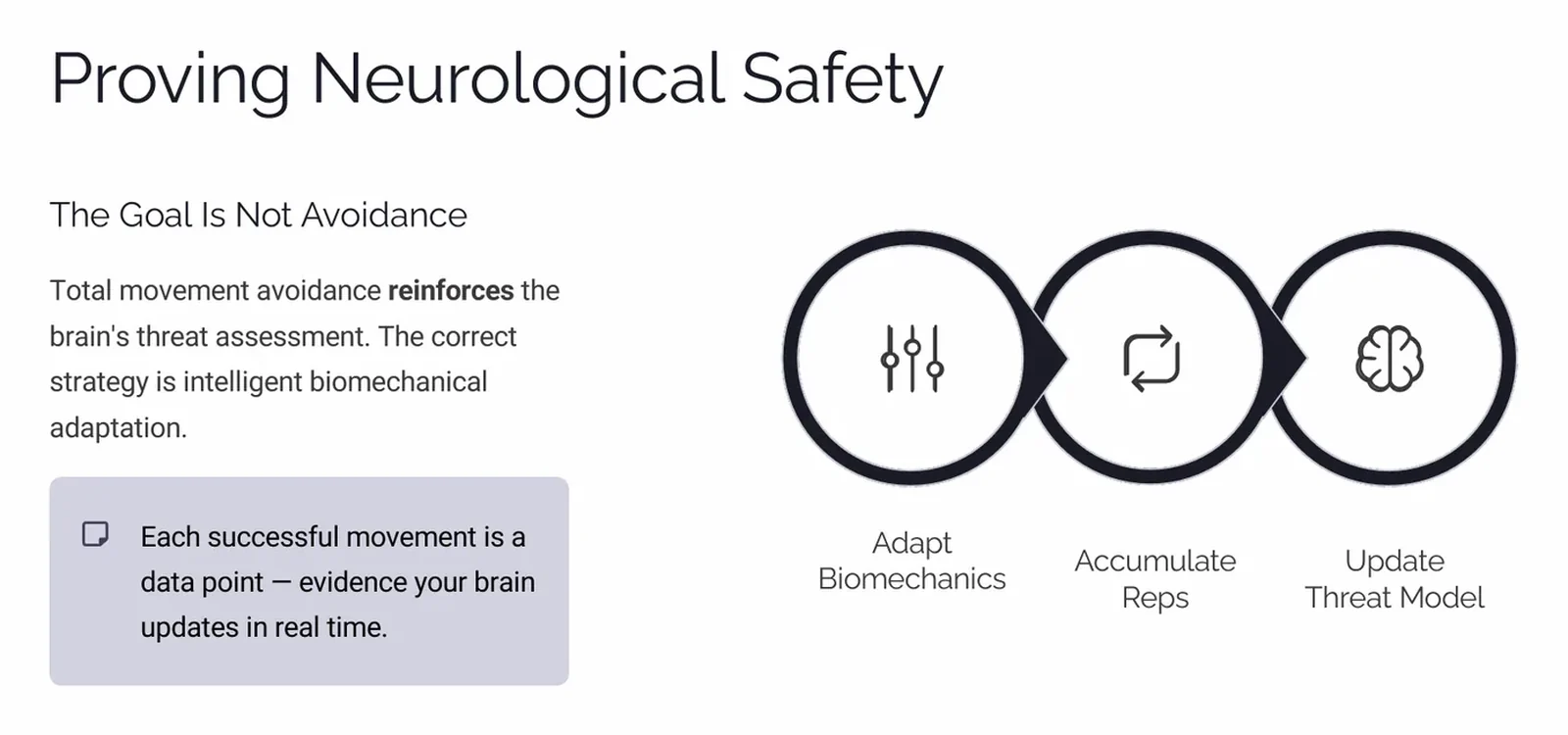
But total avoidance is evidence. Every time you do not do something because it might hurt, you confirm your brain’s assessment that the movement is dangerous. Avoidance reinforces the threat model rather than protecting you from it.
The right strategy is smart body adaptation. Change the movement so it can be done safely. Then do it, again and again.
Each successful movement is a data point. The nervous system keeps updating its threat estimates based on what you actually do, not on what you tell yourself.
- Update the threat model
- Accumulate the repetitions
- Adapt the biomechanics
Can chronic pain be a learned habit?
Two related ideas that patients find most surprising.
First, chronic pain often lasts as a learned habitual loop, a pattern the brain has not switched off. No ongoing tissue damage is needed to keep it going. The loop runs on its own momentum. And because it is learned, neuroplasticity, the brain’s power to rewire, means it can be unlearned.
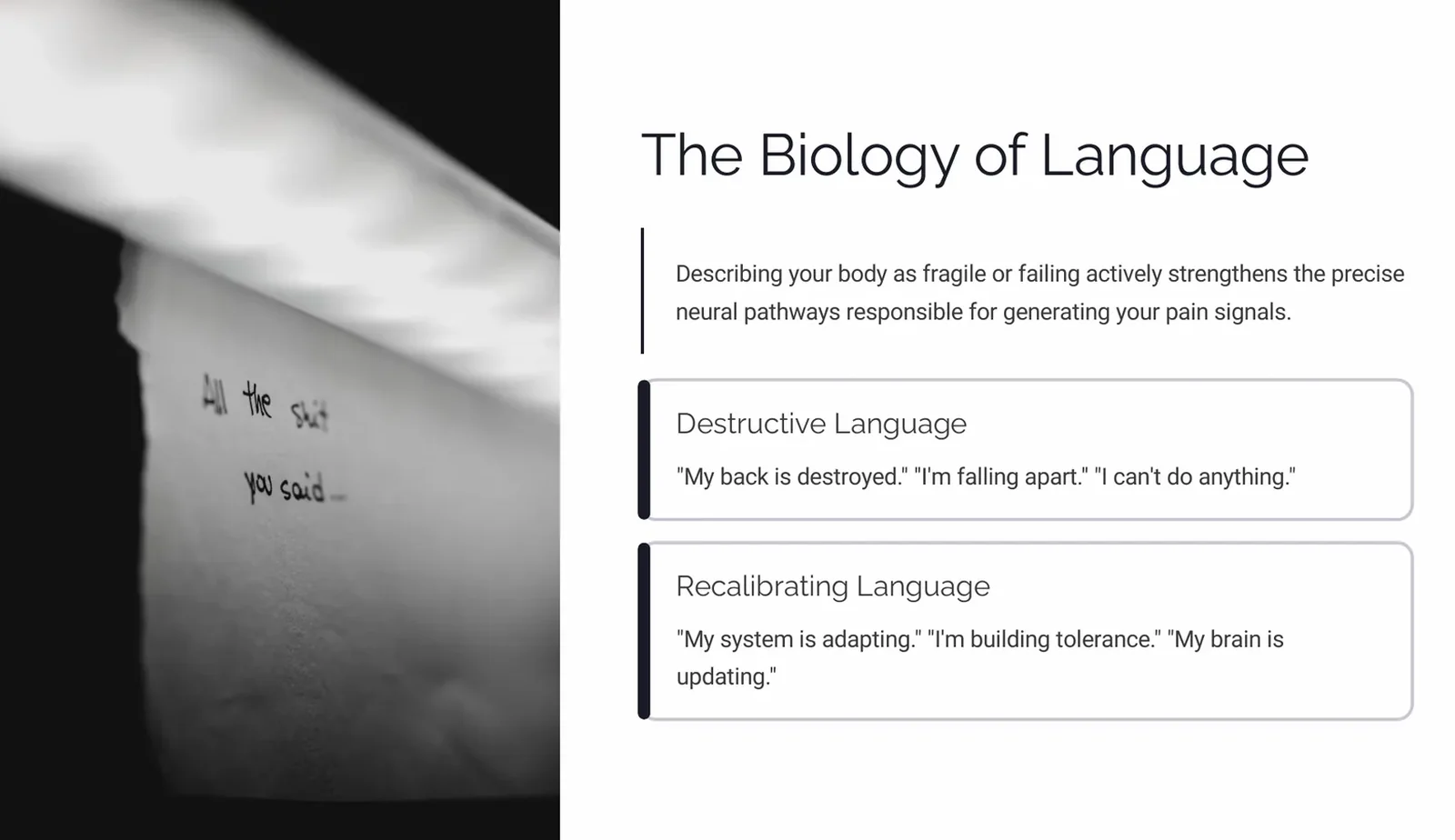
Second, and following from the first: the words you use about your body are not neutral. Calling yourself fragile or failing rehearses and strengthens the nerve pathways that make the pain signal.
“My back is destroyed.” “I’m falling apart.” “I can’t do anything.” Each time you say it, you rehearse the pain.
Compare: “My system is adapting.” “I’m building tolerance.” “My brain is updating.”
This is not telling you to lie to yourself. Fake cheer is its own problem. Those second statements are more accurate, not less. They describe what is actually happening in a nervous system under treatment.
Why do pain procedures stop working?
The hardest thing I tell patients, and I say it before scheduling anything.
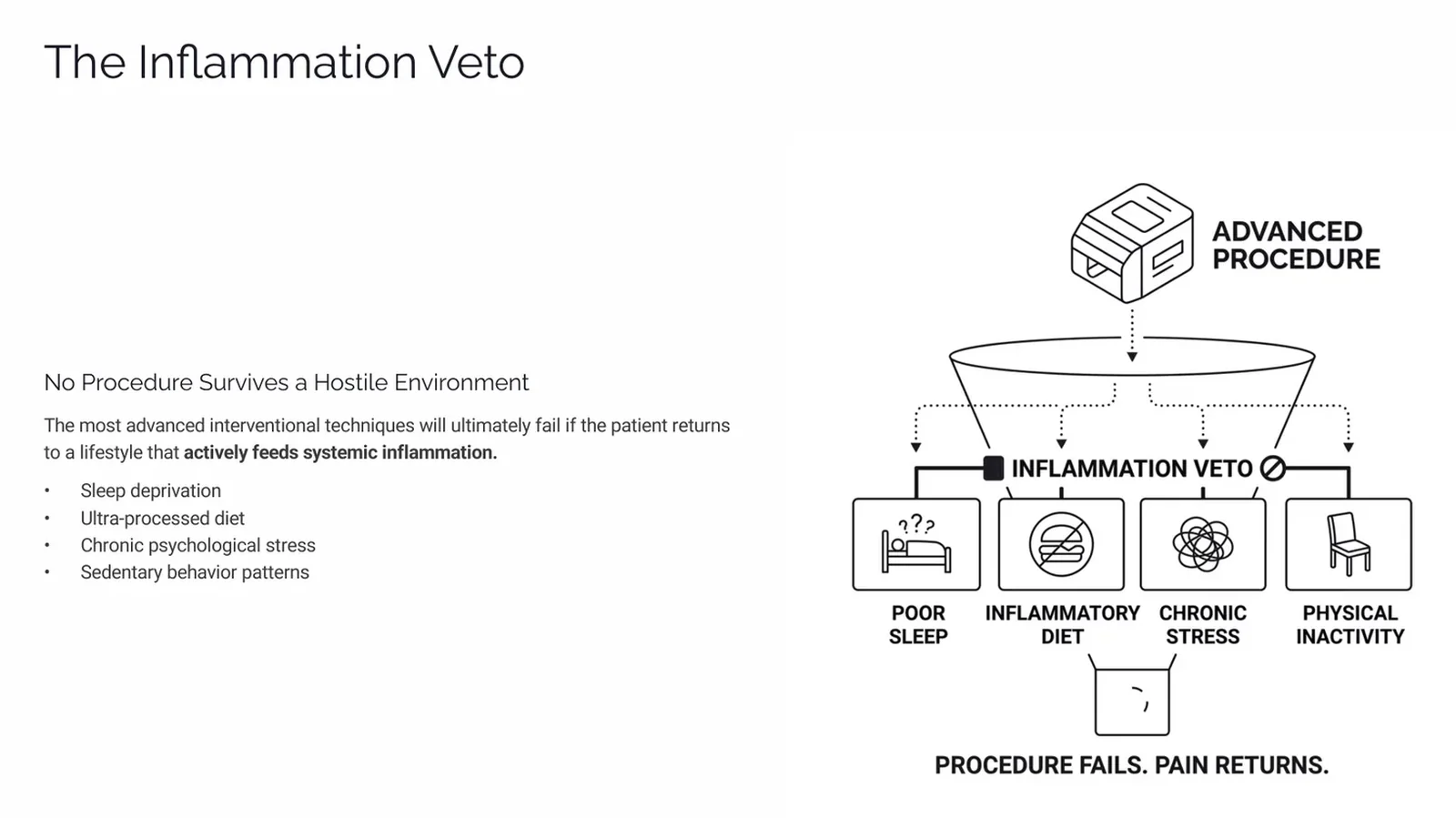
No procedure survives a hostile environment.
The best interventional technique there is, done perfectly, in the right patient, at the right level, will still fail in the end. It fails if that patient goes back to a lifestyle that keeps feeding body-wide inflammation.
Four things carry that veto:
- Sleep deprivation
- An ultra-processed diet
- Chronic psychological stress
- Sedentary behavior
Any one of them can outlast good technical work. Together they will.
This is not about blame. It is about sequencing. If the terrain is addressed first, or at minimum alongside, the procedure has something to hold onto.
Hardware and software
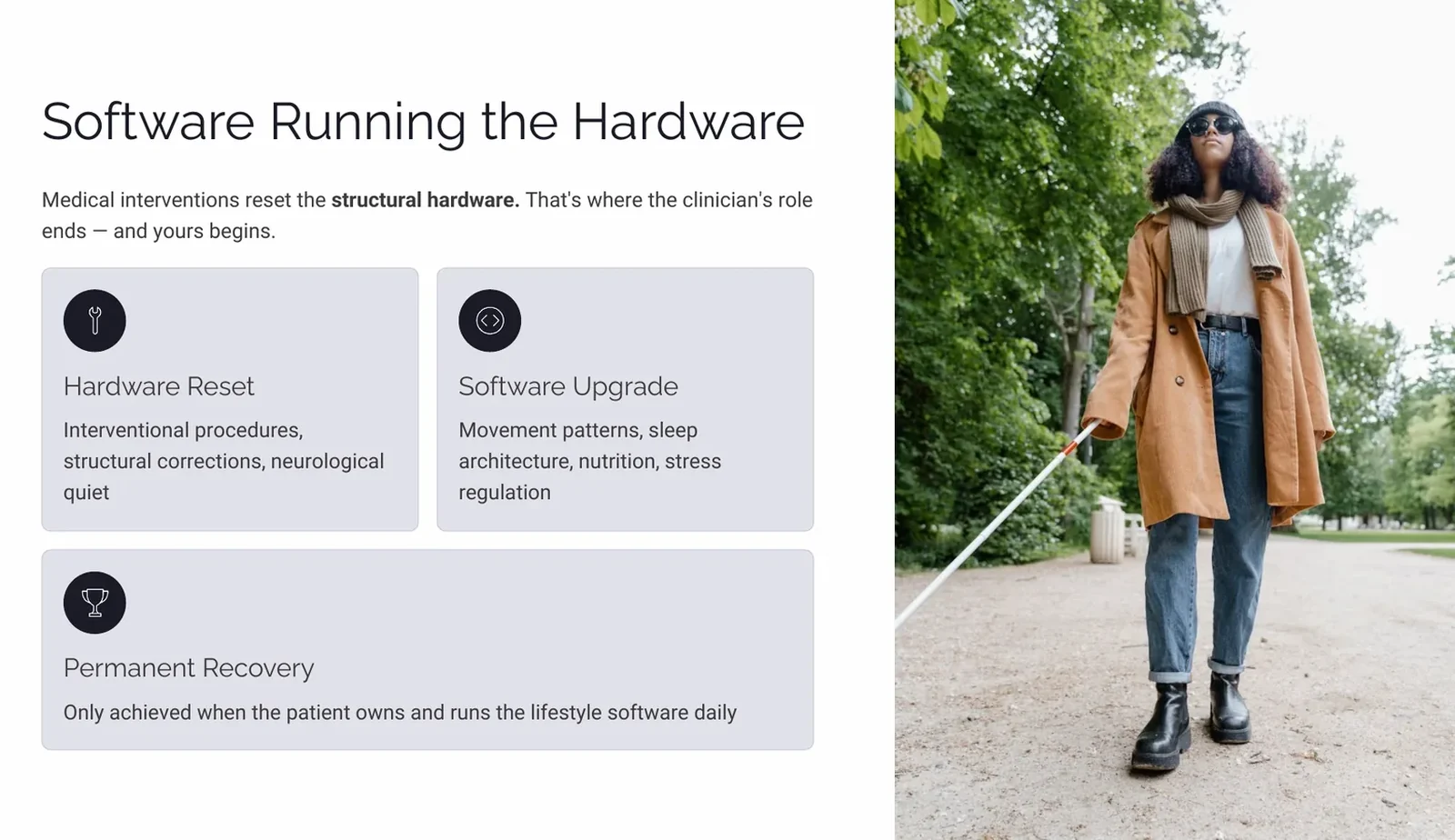
Medical treatment resets the hardware: procedures, fixing structure, a stretch of neurological quiet. That is my job, and it ends there.
The software is yours: how you move, how you sleep, what you eat and how you handle stress.
Lasting recovery happens when the patient owns the lifestyle software and runs it every day.
I can reset hardware as many times as insurance permits, and it will not make you well. What makes you well is what runs on it afterward. That is not a limitation of medicine — it is the actual mechanism of recovery, and it places the controlling variable in your hands.
Frequently asked questions
If my MRI shows a herniated disc, is that not the cause of my pain?
It may add to it. But scan findings and pain levels match far more loosely than people expect. Big structural findings show up all the time in people with no pain at all. And severe pain happens with normal scans. The scan is one piece of the diagnosis, not the diagnosis itself. That is why a physician weighs it against your exam and history.
Is central sensitization a real diagnosis or a way of saying it is psychological?
It is real, measurable nerve science. It describes signals being amplified in the spinal cord and brain. It is not a mental health diagnosis, and it does not mean the pain is imagined. It explains why pain can be severe without matching tissue damage.
Can central sensitization be reversed?
Neuroplasticity, the brain’s power to rewire, means the pattern can change. The levers used most are step-by-step movement, better sleep and less body-wide inflammation. Gains are usually gradual, not sudden, and they vary a lot from person to person. Individual results vary.
Will an injection help if my problem is central sensitization?
It can, by creating a stretch of lower pain when movement retraining becomes possible. That is the purpose. What it will not do is turn the amplifier down by itself. Whether a procedure fits depends on your exam and imaging, and that is a decision for your physician. Do not start, stop, or change any medication without consulting your physician.
What causes central sensitization?
The terrain keeps the volume turned up. Body-wide inflammation from a diet high in refined carbs and industrial seed oil, broken sleep, constant unmanaged stress and sitting too much all hold the amplifier at max. Over time, the amplified signal can run as a learned habitual loop that goes on with no ongoing tissue damage. Because it is learned, it can be unlearned.
Where can I be evaluated for this in the St. Louis region?
Padda Institute Center for Interventional Pain Management, 4477 Woodson Rd, Suite 100, St. Louis, MO 63134, next to St. Louis Lambert International Airport, with a second location at 12174 Natural Bridge Rd, St. Louis, MO 63044, serving the St. Louis region across Missouri and Illinois. Call (314) 481-5000 or text (314) 886-5902, Monday to Friday, 8:00 AM to 5:00 PM. Bring your imaging and the dates of any previous injections.
Key takeaways
- Central sensitization amplifies signals. The scan shows hardware. The pain is made by processing.
- Severe pain often reflects an overactive nervous system, not tissue still being torn down.
- Avoidance is evidence that feeds the brain’s threat model. Modified movement updates it.
- Chronic pain can persist as a learned loop with no ongoing tissue damage, and learned loops can be unlearned.
- Poor sleep, an ultra-processed diet, constant stress and inactivity can defeat any procedure.
This article is educational and is not a substitute for evaluation, diagnosis, or treatment by a physician. Individual results vary. Do not start, stop, or change any medication without consulting your physician. To be evaluated, request an appointment or call (314) 481-5000.
References
- Woolf CJ. Central sensitization: implications for the diagnosis and treatment of pain. Pain. 2011;152(3 Suppl):S2–S15.
Get evaluated by a physician who treats the terrain, not just the signal
Chronic pain, metabolic disease and trauma physiology reinforce each other. At the Padda Institute they are assessed together, because treating one alone underperforms.
Or call or text us.
Medically reviewed by Dr. Gurpreet Singh Padda, MD, MBA, MHP — Board Certified in Anesthesiology, Pain Medicine, Interventional Pain Management, Addiction Medicine, and Obesity Medicine. Last reviewed July 2026.
Dr. Gurpreet Singh Padda, MD, MBA, MHP