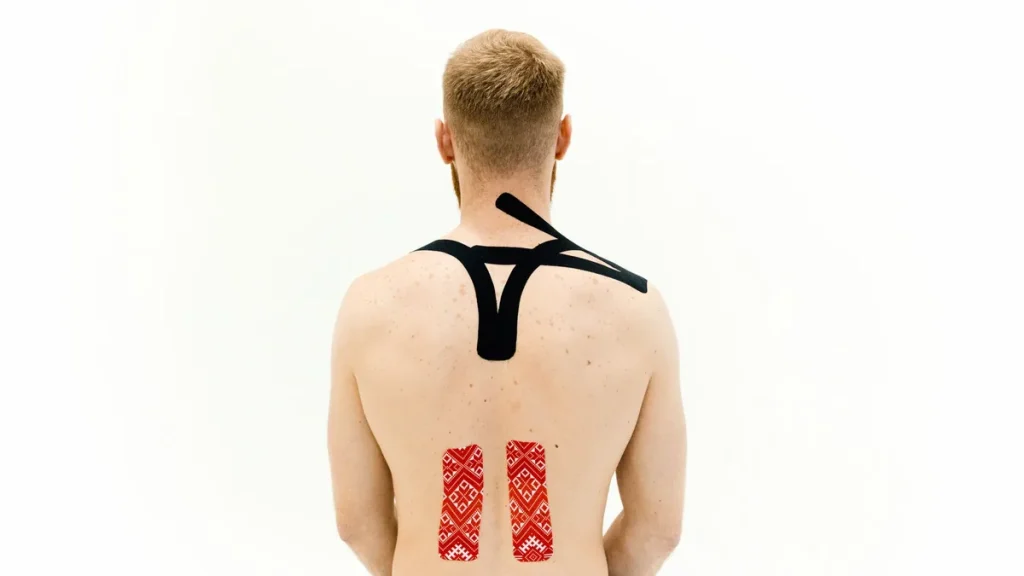
With a bulging disc, sleep on your side with a pillow between the knees, or on your back with a pillow under them. Break up long sitting, because sustained flexion (bending forward) drives disc material backward. Spinal stenosis runs the other way. Bending forward opens the canal. Arching backward, including sleeping flat on your stomach, narrows it.
A bulging disc and spinal stenosis are both problems of the spine. But the advice on how to position yourself runs in opposite directions. Advice that helps one can make the other worse. That is why so much of what people find online contradicts itself. The advice is not wrong. It is answering a different question.
Why do a bulging disc and spinal stenosis need opposite positions?
Bending forward and bending backward do measurably different things to the spinal canal. When the lumbar spine extends (arches backward), the canal narrows, and this has been measured directly. One MRI study looked at patients with lumbar spinal stenosis. The cross-sectional area of the dural sac (the sleeve that holds the nerves) shrank at all five lumbar levels in extension compared with a flexed position. Extension, not axial compression (pressure down the spine), was the main cause of that shrinking. Studies of interspinous devices show the same link from the other direction. The canal and foraminal area (the side openings for the nerves) shrink as the spine moves from flexion into extension.
The anatomy explains why. In extension, the ligamentum flavum (a band at the back of the canal) buckles inward. The facet joints slide over each other. The disc bulges slightly backward. All three changes take away from the same space. In flexion, the ligamentum flavum is pulled tight and thins, the facets separate, and the canal opens.
So for spinal stenosis, which is a space problem, flexion is generally the friend and extension the enemy. This is the mechanism behind the “shopping cart sign” in stenosis. People with stenosis can walk a whole supermarket leaning on a cart. Leaning forward buys them canal space. They lose that tolerance the moment they stand upright.
For a disc bulge or herniation, the problem is not mainly space. It is pressure and the position of the disc material. Sustained flexion loads the front of the disc and drives the soft inner material backward. It pushes toward structures that are already irritated. That is why long sitting, a sustained flexed position, is often the worst part of a disc patient’s day.
Same two movements. Opposite consequences. That is the whole reason generic advice fails.
Which positions put the most pressure on a disc?
Intradiscal pressure (the pressure inside a disc) has been measured in a living person. A sensor was implanted in an L4-L5 disc and read during ordinary daily activities. The values explain a lot of what patients already feel:
- Lying prone — 0.1 MPa
- Lying on the side — 0.12 MPa
- Relaxed standing — 0.5 MPa
- Sitting unsupported — 0.46 MPa
- Nonchalant, relaxed sitting — 0.3 MPa
- Sitting in maximum flexion — 0.83 MPa
- Standing flexed forward — 1.1 MPa
- Lifting 20 kg with a rounded back — 2.3 MPa
- Lifting 20 kg with flexed knees — 1.7 MPa
- Lifting 20 kg held close to the body — 1.1 MPa
Two conclusions come straight off that list. Lying down drops disc pressure to a fraction of any upright posture. That is why position at night matters more than people think. And how you lift changes disc pressure roughly twofold. Same weight, moved differently.
An honest note on this data. It is a single-subject study: one volunteer, one healthy disc, one set of measurements. It confirmed the earlier work it was designed to check on most activities. It disagreed with it on standing versus sitting. Use these numbers as a map of relative loading, not as a value for your own spine. And note that a degenerated or herniated disc, which is what you have if you are reading this, was not what was measured.
How to sleep with a bulging disc in the lower back
The goal overnight is to keep the lumbar spine near neutral, avoid sustained flexion, and stop the pelvis from rotating.
On your side, with a pillow between the knees
Side lying measured among the lowest-pressure positions. The pillow between the knees is not a comfort extra. Without it, the top leg falls forward and rotates the pelvis. That twists the lumbar spine and holds it twisted for hours. Use a pillow thick enough that the top knee sits level with the hip instead of dropping toward the mattress. Keep the hips and knees only slightly bent. Curling into a tight fetal position brings back the sustained flexion you are trying to avoid.
On your back, with a pillow under the knees
Lying flat lets the hip flexors pull the pelvis into a forward tilt and the lumbar spine into extension. A pillow under the knees releases that pull and lets the low back settle. If a gap remains under your waist, a rolled towel there supports the curve.
Prone, with a caveat
Lying face down measured the lowest disc pressure of any position. But it holds the lumbar spine in extension and twists the neck for as long as you are there. Some people with a disc bulge truly prefer it and do well. The low pressure reading is a real finding, not a myth. If you sleep face down, put a flat pillow under the belly and pelvis to reduce the lumbar extension. Use the thinnest head pillow you can to reduce the neck twist.
C5-C6 disc bulge: sleeping position for the neck
A C5-C6 disc bulge produces a pattern you can spot: neck pain traveling to the shoulder and down the outer arm to the thumb and index finger, sometimes with weakness in the biceps. At night, the key factor is pillow height. The pillow sets the angle the neck holds for six to eight hours.
- On your back: the pillow should fill the gap between the back of the head and the upper back. That way the neck keeps its natural curve without the chin being pushed toward the chest. Too tall a pillow holds the neck in sustained flexion. A contoured neck pillow, with a raised edge under the neck and a lower center for the head, does this well for many people.
- On your side: the pillow needs to be higher. It should be thick enough to fill the distance from the outer shoulder to the ear. Then the head stays level with the spine instead of tipping toward the mattress. Broad shoulders need a taller pillow. That is why one pillow does not work for two people in the same bed.
- On your stomach: this is the position worth changing. It holds the neck twisted near its limit for hours, and no pillow setup fixes that.
- Arm position: sleeping with the arm overhead or under the pillow narrows the space nerves pass through at the shoulder. It also pulls on an already irritated nerve root. Keep the arm down, resting on a pillow in front of you when side lying.
What the evidence supports here. A randomized trial in chronic neck pain tested a contoured neck support pillow for sleep and neck exercises, alone and combined. Neither the pillow alone nor the exercises alone was statistically better than the control plan. The combination was statistically significant and clinically meaningful. The lesson is not that pillows do not work. It is that a pillow is one part of a plan and does very little as a standalone purchase.
How to sit with a slipped disc
Sitting is where most disc patients lose ground, because it combines flexion with time.
- Support the lumbar curve. A lumbar roll, cushion or rolled towel at belt level keeps the low back from collapsing into flexion. This is the most valuable change you can make in a workday.
- Hips slightly above the knees. Raising the seat, or tilting it very slightly forward, reduces the backward pelvic tilt that drags the lumbar spine into flexion.
- Sit back, not perched forward. Unsupported sitting measured higher disc pressure than relaxed, supported sitting. Using the backrest does real work.
- Feet flat on the floor or a footrest. Dangling feet and crossed legs both rotate the pelvis.
- Change position every 20 to 30 minutes. Holding still under load is a large part of the problem, no matter how good the posture is. The disc pressure study concluded that changing position often matters for disc nutrition. That is because discs have no blood supply. They depend on load cycling to move fluid.
- Getting up: slide to the front edge, keep the back straight, and stand using the legs. Bending forward first is a loaded flexion movement. That is the exact combination that provokes disc pain.
- Driving: a car seat is usually the worst chair a person owns. It is reclined with the pelvis tipped backward. Add a lumbar roll, raise the seat, and move it close enough that you are not reaching for the pedals.
What positions should you avoid with spinal stenosis?
Extension narrows the canal. So the movements to be careful with are the ones that put and hold the lumbar spine in extension. This is a list of things to approach carefully with a clinician. It is not a list of things that are banned for everyone.
- Sustained back extension such as prone press-ups, cobra and upward dog, and standing back bends. These are often prescribed for a disc bulge. That is why stenosis patients handed generic back-pain exercises often feel worse.
- Prolonged standing still and walking long distances upright. Do leg symptoms start after a predictable walking distance and ease when you sit or lean forward? That is neurogenic claudication (nerve pain from walking), and it is telling you something specific about your canal.
- Overhead lifting and reaching, which drive the lumbar spine into extension to keep balance.
- Running and high-impact work, which combine repeated extension with load.
- Sleeping flat on the stomach, which holds extension all night.
- Deep loaded trunk rotation, which narrows the foramen where the nerve root exits.
Better tolerated instead: stationary cycling while leaning slightly forward, walking on an incline or pushing a cart, water exercise, and flexion-biased conditioning. Sleeping on the side with the knees moderately drawn up keeps the canal open overnight. So does sleeping on the back with a pillow under the knees.
One caution, since this page has now argued for flexion twice. Living in flexion has its own costs. A permanently rounded posture weakens the back muscles and shifts load onto the discs. The goal is a flexion bias during provoking activities, not a flexed life.
Can a sleeping position fix a bulging disc or stenosis?
Positioning changes symptoms. It does not change the anatomy causing them. What it buys is sleep, tolerance and function. That is worth a great deal, because poor sleep and pain feed each other. A systematic review with meta-analysis of prospective cohorts found sleep problems associated with a higher risk of developing chronic musculoskeletal pain. Widespread pain in turn raised the risk of long-term sleep problems. Breaking that loop is a clinical goal, not a comfort measure.
The limits are worth naming plainly. Research on sleeping positions specifically is thin. Much of what is written confidently online is extrapolated from biomechanics studies like the ones cited here. It does not come from trials that randomized patients to positions and measured outcomes. Those biomechanics studies also used narrow samples. The pressure work used a single volunteer with a healthy disc. The imaging work used patients selected for a stenosis study. Neither tested the ordinary pain-clinic patient: a person with a degenerated disc, a metabolic condition, obesity and a decade of symptoms. That does not make the mechanical principle wrong. The mechanism is measured, not assumed. But it does mean the advice should be adjusted to what your own body reports. A position that reliably eases your symptoms is better evidence for you than a general rule.
The other half is well established: long bed rest is not the answer. In acute low back pain, advice to stay active produced small gains in pain and function compared with advice to rest in bed. In sciatica, there was little or no difference between the two. Nobody has shown that resting more helps.
Get evaluated if these apply
Call 911 or go to an emergency department now if you have loss of bowel or bladder control, numbness in the groin or inner thighs, or weakness in both legs that is getting worse fast. These can signal cauda equina syndrome. That is a surgical emergency, not a positioning problem.
Get an evaluation without waiting if you have weakness in one limb that keeps getting worse, a foot that drags or catches, numbness that is spreading, symptoms after a significant fall or accident, or fever with new back pain.
When positioning is not enough
Are you planning your day around which chair you can stand and which side you can sleep on? Then positioning has stopped being a solution. It has become a coping strategy.
The evaluation that changes things finds what is actually causing the pain: disc, nerve root, facet joint, sacroiliac joint, or a mix. That decides the treatment. At the Padda Institute, Dr. Gurpreet Singh Padda, MD, MBA, MHP works through conservative and interventional options before minimally invasive ones. Those include physical therapy, image-guided injections and nerve blocks, radiofrequency ablation, and extracorporeal shockwave therapy. Where conservative and interventional care have been exhausted, he uses minimally invasive procedures, including the MILD [Minimally Invasive Lumbar Decompression] procedure for lumbar spinal stenosis and sacroiliac joint fusion. Which one fits depends entirely on the diagnosis. And the diagnosis is the part that gets skipped.
To be seen: call or text us, or request an appointment. No referral is required, and same-day appointments are available.
Frequently asked questions
1. What is the best sleeping position for a bulging disc in the lower back?
For most people it is side lying with a pillow between the knees. Make it thick enough that the top knee stays level with the hip, so the pelvis does not rotate. Lying on the back with a pillow under the knees is the next option. It releases the hip flexors that would otherwise tip the pelvis and arch the low back. Side lying measured among the lowest intradiscal pressures of any position studied. Avoid curling into a tight fetal position. That brings back the sustained flexion that provokes disc pain. Learn more: How sleep disruption and chronic pain feed each other.
2. How should I sleep with a C5-C6 disc bulge?
Pillow height is what matters. On your back, the pillow should fill the gap behind the neck and keep its natural curve, without pushing the chin toward the chest. On your side, it needs to be tall enough to fill the gap from the outer shoulder to the ear. That keeps the head level with the spine. Stomach sleeping is worth changing. It holds the neck twisted near its limit for hours, and no pillow setup fixes that. Keep the arm down, not overhead. Learn more: Why neck pain persists months after a car accident.
3. Which exercises should I avoid with spinal stenosis?
The ones that put and hold the lumbar spine in extension, because extension narrows the spinal canal. That includes prone press-ups, cobra and upward dog, standing back bends, overhead lifting and reaching, running and high-impact activity, long periods of standing still, and deep loaded rotation. Sleeping flat on the stomach does the same thing overnight. Review this list with a clinician. It is not a ban for everyone. Flexion-biased options such as stationary cycling, incline walking and water exercise are usually better tolerated. Learn more: Spinal stenosis and leg pain when walking.
4. Why does bending forward relieve spinal stenosis but bending backward make it worse?
Because stenosis is a space problem. In extension the ligamentum flavum buckles inward, the facet joints slide over each other and the disc bulges slightly backward. All of these take away from the canal. MRI measurement in stenosis patients found the dural sac cross-sectional area shrank at all five lumbar levels in extension. Extension, not compression, was the main cause. Flexion reverses each of those changes. That is why leaning on a shopping cart lets people walk further than standing upright does. Learn more: Interspinous spacers for lumbar spinal stenosis.
5. How should I sit with a slipped disc?
Support the lumbar curve with a roll or cushion at belt level. Keep the hips slightly above the knees. Use the backrest instead of perching forward, keep the feet flat, and change position every 20 to 30 minutes. Unsupported sitting measured higher disc pressure than relaxed supported sitting. Sitting in maximum flexion measured nearly double the pressure of standing. When standing up, slide to the front of the seat and rise with the legs. Do not bend forward first. Learn more: Internal disc disruption when the MRI looks normal.
6. Is it better to sleep on a firm or soft mattress with back pain?
Neither extreme. A mattress that lets the hips sink while the shoulders stay high holds the lumbar spine bent to the side all night. One too firm to support the waist leaves the curve unsupported. You need enough support to keep the spine in line with itself. That differs with body weight and shape, so there is no single correct firmness. Judge it by whether you wake stiffer than you went to bed. Learn more: The different causes of sciatica.
7. Should I rest in bed when my back is bad?
Not for long. A Cochrane review looked at acute low back pain. Advice to stay active produced small gains in pain relief and function compared with advice to rest in bed. In sciatica, there was little or no difference between the two. Positioning is for making sleep and needed sitting bearable, not for spending more time lying down. Long rest weakens the muscles that support the spine. Learn more: Why medications and surgery may not fix your pain.
8. Can a bulging disc heal without surgery?
Herniated disc material can be reabsorbed without surgery. A systematic review has identified factors that help predict how likely this is in a given patient. They include clinical factors, the type and size of the herniation, what the herniated material is made of, imaging features, and spinal physiology. That review notes it is limited by a lack of high-quality prospective studies. Positioning and activity management support the process; they do not drive it. Nerve symptoms that persist should be evaluated, not waited out. Learn more: Why leg pain can persist after back surgery.
9. Does poor sleep make back pain worse, or does back pain just ruin sleep?
Both directions have support. A systematic review with meta-analysis of prospective cohort studies covered 116,746 participants. It found that sleep problems at the start may raise the risk of chronic musculoskeletal pain in both the short and long term. It also found that widespread pain at the start may raise the risk of long-term sleep problems. The authors were careful to say this two-way link needs more study. In practice, treating sleep is part of treating the pain, not an afterthought. Learn more: Sleep disruption and chronic pain.
10. When should positioning advice stop being the plan?
When you are planning your day around which chair and which side of the bed you can stand, or when leg symptoms limit how far you can walk. At that point the useful question is which structure is causing the pain: disc, nerve root, facet joint or sacroiliac joint. That decides which treatment has a chance of working. Seek care right away, not by appointment, for loss of bowel or bladder control, groin numbness, or fast-worsening weakness in both legs. Learn more: What the ER can and cannot do for pain.
11. What is the best sleeping position for spinal stenosis?
On your side with the knees moderately drawn up, or on your back with a pillow under the knees. Both keep the lumbar spine slightly flexed, and flexion opens the spinal canal. Avoid sleeping flat on your stomach. It holds the low back in extension all night and narrows the canal. That is the reverse of the disc advice, where a tightly curled position is the one to avoid.
12. What makes a bulging disc worse?
Sustained flexion under load. Long stretches of sitting, especially slumped in a reclined car seat, drive disc material backward toward structures that are already irritated. Lifting 20 kg with a rounded back measured about twice the disc pressure of the same weight held close to the body. Bending forward first to get out of a chair adds the same loaded flexion. So slide forward and stand with the legs.
13. Is lying down good for a bulging disc?
For relief, yes. In the pressure study, lying on the side or face down dropped disc pressure to a fraction of any upright posture. That is why your position at night matters. For recovery, not for long. In acute low back pain, advice to stay active did slightly better than advice to rest in bed. Lie down to sleep and to settle a flare, then keep moving.
Dr. Gurpreet Singh Padda, MD, MBA, MHP


