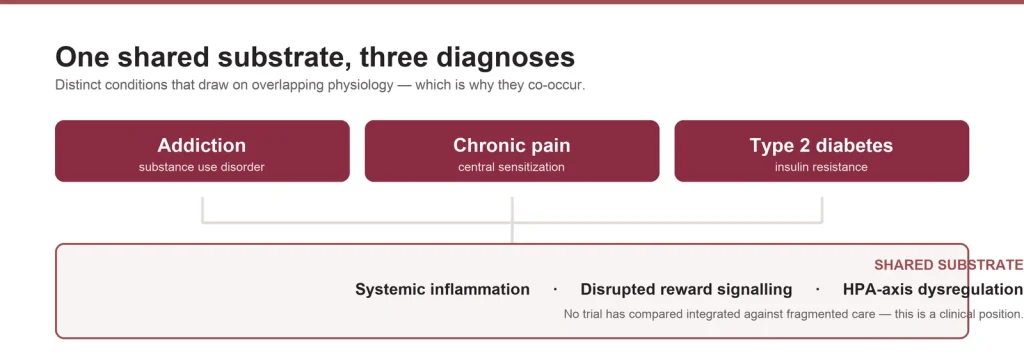
Addiction, chronic pain and type 2 diabetes keep turning up in the same patients because they share one root: metabolic dysfunction. With it come chronic inflammation, scrambled reward signals and a stress system out of control. Treating the three together works better than treating them in three different buildings.
Standard care treats them in three different buildings. An addiction doctor, a pain doctor and a hormone doctor (endocrinologist) each run a separate plan. Often none of them knows what the others are doing.
The argument here is that this split is a mistake, because the three conditions share a root. Treating them together works better than treating them apart.
Why these three cluster together
Start with what we see, not the theory. These conditions show up together far more often than chance would predict.
People with chronic pain have higher rates of substance use disorder. People with type 2 diabetes have higher rates of chronic pain. People in recovery from addiction have high rates of metabolic disease. Each pairing is well documented.
The usual explanation is a chain of events. Pain leads to opioid prescriptions, which lead to dependence. Diabetes causes nerve damage, which causes pain. Addiction wrecks the habits that would prevent diabetes. All of that is real and explains part of it.
But it does not explain the whole pattern. And it treats each link as an accident instead of a shared cause.
The shared substrate
The proposed common ground is metabolic dysfunction. More exactly, it is the chronic inflammation and scrambled reward signals that come with it.
Look at what these three conditions share under the hood:
- Inflammation. Low-grade inflammation through the whole body is central to type 2 diabetes. It turns pain up by putting the spinal cord on high alert (central sensitization). And more and more, it is tied to the brain side of substance use disorder.
- Dopamine and reward. Insulin works in the brain, including in areas that run reward. Highly processed, fast-absorbed food fires up reward circuits along paths that overlap with those in addiction.
- A stress system out of control. The HPA axis, the body’s main stress system, is thrown off in all three. That feeds inflammation, appetite problems, poor sleep and craving alike.
None of this means the three are the same disease. It means they draw on shared body chemistry. So a treatment aimed at that shared part can move more than one of them.
I want to be careful here, because this is where this kind of argument usually goes too far. The shared mechanism is real and fairly well described. The claim that treating the metabolic root is the best route for all three is a clinical position — mine. It comes from practice. It is not the result of a randomized trial comparing joined-up care against split care. No such trial exists.

What treating them together looks like
In practice, integration means a few concrete things.
We check metabolic health no matter which door the patient came through. A patient who comes in with pain gets fasting insulin, triglyceride-to-HDL and HbA1c checked, not only imaging.
We treat diet change as a treatment, with a dose and a tracking plan. It is not generic advice at the end of a visit.
Opioid decisions are made with the whole picture in view. This practice weans patients off opioids instead of raising doses. The metabolic work is part of what makes tapering bearable, because a less inflamed nervous system is a less touchy one.
And we measure progress with numbers in all three areas: blood sugar and insulin markers, a pain and function score, and substance use. That way, gains in one show up against the others.
Why fragmentation actively hurts
Separate treatment is not just wasteful. It can work against itself.
A drug for one condition can worsen another. Some psychiatric and pain drugs drive weight gain and worsen insulin resistance. Steroid injections raise blood sugar for several days. Rising opioid doses can cause hyperalgesia, which means more pain from more drug. Meanwhile, they do nothing about the metabolic driver underneath.
When three doctors each chase their own result with no view of the others, the patient takes the hit from the interactions.
Frequently asked questions
Are addiction, chronic pain and diabetes really the same condition?
No. They are separate diagnoses with separate criteria and treatments. The argument is that they share a lot of the same body chemistry: inflammation, scrambled reward signals and a stress system out of control. That is why they show up together so often. And it is why treating that shared layer can improve more than one at a time.
Is integrated treatment proven better than seeing three separate specialists?
Not by a randomized trial. No study has compared joined-up care against split care for these three, and I will not claim otherwise. The case from mechanism is strong, and it is how this practice is organized. But it is a clinical position, not a proven protocol. Individual results vary.
Does this mean my pain medication caused my diabetes?
Not directly, but the interactions are real and worth reviewing. Some drugs used for pain and mood cause weight gain and worsen insulin resistance. Steroid injections raise blood sugar for a while. That is a reason to review your whole drug list with one doctor who can see all of it. It is not a reason to stop anything. Do not start, stop, or change any medication without consulting your physician.
Do you prescribe opioids for chronic pain?
This practice works to cut and stop opioids, not raise them, because rising doses can cause hyperalgesia, which is extra pain sensitivity caused by the drug itself. Any change to an opioid plan must be supervised. Stopping suddenly or without supervision is dangerous.
Where can I be evaluated for all three together?
Padda Institute Center for Interventional Pain Management is at 4477 Woodson Rd, Suite 100, St. Louis, MO 63134, next to St. Louis Lambert International Airport, with a second location at 12174 Natural Bridge Rd, St. Louis, MO 63044. The practice serves the St. Louis region across Missouri and Illinois. Call (314) 481-5000 or text (314) 886-5902, Monday to Friday, 8:00 AM to 5:00 PM.
Key takeaways
- Addiction, chronic pain and type 2 diabetes show up together far more than chance would predict.
- They share inflammation, scrambled reward signals and a stress system out of control.
- Treating the shared metabolic layer can move more than one condition at once.
- Split care lets the treatment for one condition worsen another.
- Joined-up care is a well-reasoned clinical position, not a trial-proven protocol.
This article is educational and is not a substitute for evaluation, diagnosis, or treatment by a physician. Individual results vary. Do not start, stop, or change any medication without consulting your physician. To be evaluated, request an appointment or call (314) 481-5000.
References
- Araújo J, Cai J, Stevens J. Prevalence of optimal metabolic health in American adults: NHANES 2009–2016. Metabolic Syndrome and Related Disorders. 2019;17(1):46–52.
- Woolf CJ. Central sensitization: implications for the diagnosis and treatment of pain. Pain. 2011;152(3 Suppl):S2–S15.
- Feinman RD, Pogozelski WK, Astrup A, et al. Dietary carbohydrate restriction as the first approach in diabetes management: critical review and evidence base. Nutrition. 2015;31(1):1–13.
- Malhotra A, DiNicolantonio JJ, Capewell S. It is time to stop counting calories, and time instead to promote dietary changes. Open Heart. 2015;2(1):e000273.
Get evaluated by a physician who treats the terrain, not just the signal
Chronic pain, metabolic disease and trauma physiology reinforce each other. At the Padda Institute they are assessed together, because treating one alone underperforms.
Or call or text us.
Medically reviewed by Dr. Gurpreet Singh Padda, MD, MBA, MHP — Board Certified in Anesthesiology, Pain Medicine, Interventional Pain Management, Addiction Medicine, and Obesity Medicine. Last reviewed July 2026.
Dr. Gurpreet Singh Padda, MD, MBA, MHP