For most people, chronic pain does not go away all at once: among American adults with chronic pain, 10.4% were pain-free a year later. The share that moves is larger than most patients are told, and belief and hope measurably change the odds.
A school bus driver arrives after nine years of pain and six on an opioid. Nobody has told her that the disc on her film is the least interesting thing about her, or that much of what drives her pain can still be moved.
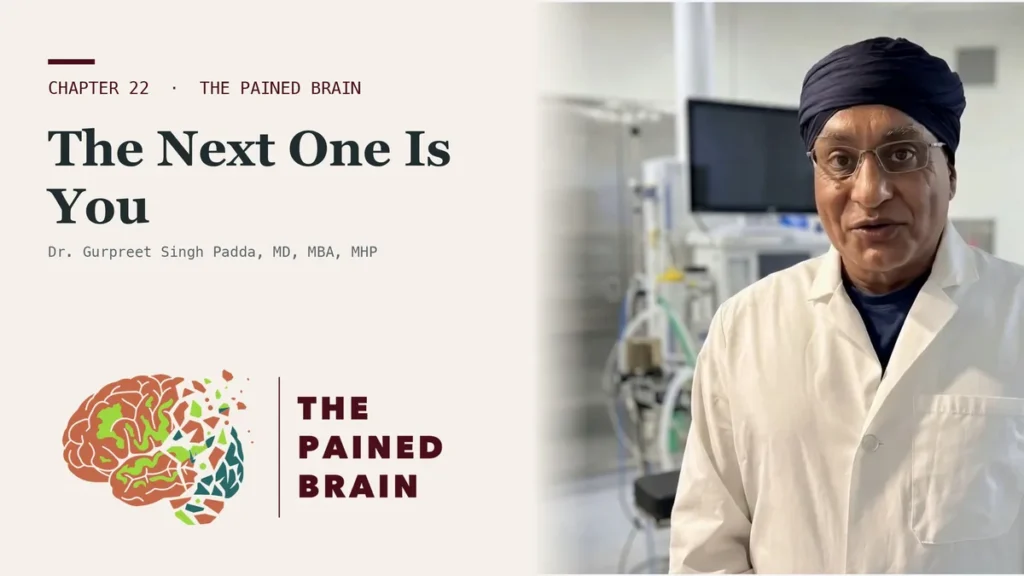
I am Dr. Gurpreet Singh Padda, MD, MBA, MHP, and the video above is the final chapter of The Pained Brain, written with Dr. KrisJay Fucanan, MD. Will chronic pain ever go away? For most people the honest answer is not all of it, and not this year. But the share that does move is larger than most patients are told. And the things that move it have names and measurements.
Will chronic pain ever go away? The odds, printed without softening
Among American adults with chronic pain in one year, 61.4% still had it the next and 10.4% were pain-free. That recovery rate beats the 5.4% to 8.7% seen in four European cohorts. New chronic pain arrived at 52.4 per thousand person-years, several times the rate for diabetes. In Norway, 8% of people with moderate or severe chronic pain recovered within a year. The authors put it bluntly: once pain has lasted several years, the outlook becomes poor. In Scotland, 79% still had it four years later. Across eight waves of follow-up, only 11% improved slowly and steadily. Another 31% crossed back and forth over the line, which is how most patients actually live it.
Two named conditions sharpen the picture. Among 1,555 people with fibromyalgia, 44% stopped meeting criteria at least once. Some 25% had at least moderate improvement in pain, and 38.6% got worse. In complex regional pain syndrome, 5.4% were symptom-free at a year. Those are the odds a patient gets when she is handed nothing else.
Does what you believe change whether chronic pain goes away?
Among 406 people whose back pain had just turned chronic, 42% were pain-free at a year. Each point of perceived risk that the pain would last slowed recovery, at a hazard of 0.91. In older adults followed five years, 38.5% recovered and 66.6% improved. Less hopeful beliefs at the start marked those who did not. Expectation predicts return to work. Depression, job satisfaction and stress do not.
The hard end of it is hopelessness. Among 720 hospital inpatients, chronic pain carried 2.29 times the odds of a positive suicide screen. Hopelessness about one’s condition carried 5.69. Acceptance of pain broke the chain that runs from severity, to feeling like a burden, to suicidal thinking. The indirect effect fell from 2.50 at low acceptance to 0.08 at high. The scientists who named learned helplessness revised it after fifty years. Passivity is the default response to pain nobody can control. What gets learned is control. Hopelessness is not a mood. It is a prognostic factor (a sign of how things will go), and it can start changing in a single visit.
Can the way a doctor talks to you change your pain?
In 1987 a family doctor randomized 200 patients who had symptoms but no findings to a positive or a negative consultation. Two weeks later, 64% felt better after the positive visit, against 39% after the negative one. The treatment itself barely mattered, 53% against 50%. When nurses paired the same painkiller (analgesic) with better communication, pain fell 4.17 points instead of 2.29, and opioid use dropped.
The limit keeps the word honest. Feeling reassured, by itself, did not reduce disability or healthcare use in acute back pain. Hope is a diagnosis, a mechanism, a plan with a dose, and a bridge across the worst of it.
Why policy alone cannot repair a terrain
The top-down case deserves its full strength. Comprehensive smoke-free laws brought coronary admissions down to 0.848 of their former level. New York counties that restricted trans fats saw heart attack and stroke admissions fall 6.2% more than counties that did not. Folic acid added to food prevents about 1,326 neural tube defects a year. No walking group did any of that.
Sugar is the fair test, because it is the terrain’s first input. Across 62 studies in more than 45 countries, drink taxes passed 82% through to prices and cut sales 15%. Yet consumption did not change significantly. Adult obesity in the United States climbed from 30.5% to 41.9%. Adults reporting pain rose from 49% to 54%, an added 10.5 million people. The policies that worked removed one toxin from everyone. A terrain is a way of living, and it changes through the person living it. That is the argument behind treating metabolic disease at its dietary root.
Proven, and still undelivered
The Diabetes Prevention Program put 3,234 people with prediabetes through a coached lifestyle program. It cut new diabetes by 58%, against 31% for metformin. That is one case prevented for every 6.9 people over three years. In a nation with more than 88 million adults at risk, the program enrolled 455,954 people in eight years. Medicare has paid for it since 2018. Yet 9,015 beneficiaries used it, out of about 5.2 million eligible. Only 35.5% of early participants reached the 5% weight-loss goal. Those who needed it most lost least: 3.3% among Black and American Indian participants, against 5.1% among white ones. The system can prove a thing works. It still cannot hand it to a person at a kitchen table.
Does one person’s recovery change the whole household?
A person who changes changes the people she lives with. In the largest diabetes lifestyle trial, spouses who were never treated lost 2.2 kilograms, against 0.2 among control spouses. Some 26% of them lost 5% of their weight, against 9%, and fewer high-fat foods stayed in the house. In randomized couples, weight paths moved together at a correlation of 0.52. The older network studies are weaker, since the same statistics make a friend’s height contagious. So I rest on the trials.
Pain travels the same route. Children of a mother with chronic pain had 1.59 times the odds of pain complaints, and of a father 1.30. When women with a chronic pelvic pain condition were treated, their partners improved too, in both arms of the trial. One person’s recovery belongs to the household.
Most of the people who spread it are not physicians. When 592 low-income patients were paired with community health workers, their hospital days fell from 345 to 155. A diabetes prevention course run at a YMCA took off 6.0% of body weight, against 2.0%. In the poorest patients, peer support moved A1c by 0.20 and community health workers by 0.50. Small per person, and it adds up, because everyone who leads a walking group once joined one.
What does a pain practice do to improve the odds?
Teaching has a dose and a half-life. Diabetes education moves A1c by about 0.57, with ten contact hours as the threshold. The early gain fades back toward baseline by 52 weeks. Feedback holds what teaching starts. Among smart-scale owners, a month without stepping on the scale cost an obese person 1.37 kilograms.
Terrain repair has known sizes. In the largest lifestyle trial, 11.5% of people with type 2 diabetes reached remission at a year, against 2.0% with education alone. At a normal body mass index, losing 6.5% of body weight put 70% of a small group into remission. The effect on pain is inferred from mechanism and from arthritis trials, where knee relief arrives at about 7% of weight lost. Procedures remain a bridge that buys function now, never the destination. That point is made in the chapter on what fee-for-service builds.
So the physician’s first act is to refuse, out loud, to consign anyone to the average. Then comes handing over the markers: A1c, fasting insulin, kidney function, a weight target as a percentage, and your own expectation of recovery, written where you both can see it. The woman in the waiting room now leads a Tuesday walking group from a church parking lot. Her story reflects practice-reported figures from our own population, not trial outcomes, and individual results vary. How the five inputs interact is in the chapter on mind and metabolism, diabetes remission and pain are covered in what remission does to chronic pain, and the Chapter 22 supplement lists every study named here with what it cannot show.
Frequently asked questions
Will chronic pain ever go away?
For most people, not entirely and not quickly. In national data 61.4% of adults with chronic pain still had it a year later, and 10.4% were pain-free. The odds worsen once pain has lasted several years. What moves more readily is interference, spread and function. Those respond to the terrain and to what a patient believes about recovery. How many chances you actually get at pain management.
Does losing weight help chronic pain?
Measurably, and the threshold matters. In knee osteoarthritis, meaningful relief is expected at about 7% of body weight lost. On the metabolic side, 11.5% of people in the largest lifestyle trial reached diabetes remission at a year, against 2.0% with education. Diet alone can drive remission in type 2 diabetes.
Does my chronic pain affect my family?
Yes, in both directions. Children of a mother with chronic pain carried 1.59 times the odds of pain complaints. Caregivers of children in pain lost 38% of their work productivity. The good half is that recovery travels the same route: partners of treated patients improved without being treated themselves. Five ways to support the person caring for you.
Is another procedure worth it?
That depends on what the weeks after it are for. In one series, 30.5% of patients who had stopped working went back to work after a stimulator implant. Being out of work longer than three years beforehand sharply cut those odds. A procedure that buys function early, so the terrain work can happen, is medicine. Why each injection can buy less time than the last.
What should I bring to a first appointment?
Your medication list, your procedure history and any recent labs, especially an A1c, a fasting insulin and kidney function. Write down when the pain began and what has changed since. Write down what you believe your chances of recovery are, because that expectation is a variable in your own chart. What actually happens at a first interventional pain appointment.
Leave the first visit with numbers
We refuse to consign anyone to the average: you leave with your markers, a plan with a dose, and the bridge that makes the work possible.
Request an appointment, or call or text us.
Sources
- Nahin, R. L., Feinberg, T., Kapos, F. P., & Terman, G. W. (2023). Estimated Rates of Incident and Persistent Chronic Pain Among US Adults, 2019-2020. JAMA Network Open, 6(5), e2313563. https://doi.org/10.1001/jamanetworkopen.2023.13563
- Landmark, T., Dale, O., Romundstad, P., Woodhouse, A., Kaasa, S., & Borchgrevink, P. C. (2018). Development and course of chronic pain over 4 years in the general population: The HUNT pain study. European Journal of Pain, 22(9), 1606–1616. https://doi.org/10.1002/ejp.1243
- Costa, L. da C. M., Maher, C. G., McAuley, J. H., Hancock, M. J., Herbert, R. D., Refshauge, K. M., & Henschke, N. (2009). Prognosis for patients with chronic low back pain: inception cohort study. BMJ, 339, b3829. https://doi.org/10.1136/bmj.b3829
- Ryan, P. C., Lowry, N. J., Boudreaux, E., Snyder, D. J., Claassen, C. A., Harrington, C. J., Jobes, D. A., Bridge, J. A., Pao, M., & Horowitz, L. M. (2023). Chronic Pain, Hopelessness, and Suicide Risk Among Adult Medical Inpatients. Journal of the Academy of Consultation-Liaison Psychiatry, 65(2), 126–135. https://doi.org/10.1016/j.jaclp.2023.11.686
- Maier, S. F., & Seligman, M. E. P. (2016). Learned helplessness at fifty: Insights from neuroscience. Psychological Review, 123(4), 349–367. https://doi.org/10.1037/rev0000033
- Thomas, K. B. (1987). General practice consultations: is there any point in being positive? British Medical Journal (Clinical Research Ed.), 294(6581), 1200–1202. https://doi.org/10.1136/bmj.294.6581.1200
- Knowler, W. C., Barrett-Connor, E., Fowler, S. E., Hamman, R. F., Lachin, J. M., Walker, E. A., Nathan, D. M., & Diabetes Prevention Program Research Group (2002). Reduction in the incidence of type 2 diabetes with lifestyle intervention or metformin. The New England Journal of Medicine, 346(6), 393–403. https://doi.org/10.1056/NEJMoa012512
- Gorin, A. A., Wing, R. R., Fava, J. L., Jakicic, J. M., Jeffery, R., West, D. S., Brelje, K., & Dilillo, V. G. (2008). Weight loss treatment influences untreated spouses and the home environment: evidence of a ripple effect. Int J Obes (Lond), 32(11), 1678–84. https://doi.org/10.1038/ijo.2008.150
- Kangovi, S., Mitra, N., Norton, L., Harte, R., Zhao, X., Carter, T., Grande, D., & Long, J. A. (2018). Effect of Community Health Worker Support on Clinical Outcomes of Low-Income Patients Across Primary Care Facilities: A Randomized Clinical Trial. JAMA Intern Med, 178(12), 1635–1643. https://doi.org/10.1001/jamainternmed.2018.4630
- Shahid, A., Thirumaran, A. J., Christensen, R., Venkatesha, V., Henriksen, M., Bowden, J. L., & Hunter, D. J. (2024). Comparison of weight loss interventions in overweight and obese adults with knee osteoarthritis: A systematic review and network meta-analysis of randomized trials. Osteoarthritis and Cartilage, 33(4), 518–529. https://doi.org/10.1016/j.joca.2024.08.012
Dr. Gurpreet Singh Padda, MD, MBA, MHP