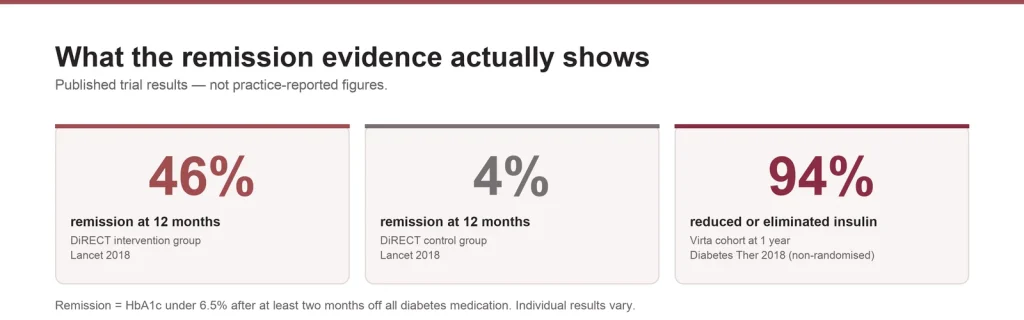
Yes, type 2 diabetes can go into remission. In the DiRECT trial, 46% of people in the treatment group reached it at 12 months, against 4% of controls. In clinical experience, chronic pain often improves too. It often happens within weeks, before the weight comes off, as inflammation, glucose swings and insulin come down.
Two questions get lumped together in this field. They need to be pulled apart.
Can type 2 diabetes go into remission? Yes. Randomized trials have shown it.
Does fixing the metabolic problem improve chronic pain? Often, in clinical experience, and for reasons that make sense in the body. But that exact question has not been tested the way the remission question has.
This article gives the real numbers for the first question. It is honest about the second. And it explains how to read the very high success rates you hear in this space. That includes rates from clinicians who mostly share this view.
What the remission trials actually achieved
DiRECT (the Diabetes Remission Clinical Trial) randomized primary care practices in the UK. At 12 months, remission was reached in 46% of intervention participants against 4% of controls.<sup>1</sup> Remission had a strict definition: HbA1c below 6.5% after at least two months off all diabetes medication. Average weight loss was 10 kg. At 12 months, 74% of the treatment group took no diabetes medication at all.
Virta Health’s continuous remote care model uses nutritional ketosis. At one year, it reported that 94% of patients on insulin had reduced or eliminated it. Average weight loss was around 12%.<sup>2</sup> This was an open-label, non-randomized, controlled study. By design, that is weaker evidence than DiRECT. But it was a large and carefully reported cohort.
Those are the anchor numbers. They are truly encouraging. They destroy the idea that type 2 diabetes must always get worse.

How to read the higher figures you will encounter
You will hear much higher success rates quoted in this space. Some claim 85 to 90% of patients reach resolution within a few months.
I want to be direct about how to read those. The honest view serves you better than the impressive one.
Numbers like that come from clinical practice, not from trials. Practice results differ from trial results in ways that reliably push them upward. The patients pick themselves and are highly motivated. There is no randomized control group. The word “resolution” may be defined more loosely than DiRECT’s two-months-off-all-medication standard. And patients who drop out often are not counted.
None of that means such results are made up. Motivated patients in an intensive program really can beat trial averages. But a practice figure far above the best published randomized evidence is a claim that needs checking. It is not an established result. That is true no matter who says it, including me.
The defensible statement is this: remission is within reach for a real share of people with type 2 diabetes. Trial evidence puts that share around 46% at 12 months under good conditions. Individual results vary a great deal.
Why pain often improves before the weight does
This is the part patients find most surprising. It is also the most interesting part of how the body works.
People often report less pain within weeks of a big change in diet. That is well before they lose much weight. The timing rules out weight loss as the main reason. It points to something faster.
Three plausible mechanisms work that fast:
Inflammation falls quickly. Removing refined carbohydrate, added sugar and industrial seed oil cuts inflammatory signals within days to weeks. A less inflamed nervous system is a less sensitive one.
Glucose variability settles. Large glucose swings stress nerve tissue and the endothelium (the lining of blood vessels). Flattening the curve removes a repeated hit.
Insulin comes down. Insulin affects how the body holds sodium, sympathetic tone (the stress nervous system), and how blood vessels behave. Lowering it changes conditions in the tissue, apart from any change in fat.
The honest caveat: no randomized trial has compared metabolic treatment against usual care with chronic pain as the main outcome. The reasoning about mechanisms is sound. The clinical pattern is consistent. But this is still clinical observation, not proven treatment. Individual results vary.
What this means practically
You may have both chronic pain and type 2 diabetes or pre-diabetes. If so, they are not two unrelated problems that happen to share a patient. Treating them as one problem is a better bet than treating either alone. And the metabolic work is the part most likely to change the course of the disease rather than the symptom.
Remission is also not a cure. It can be lost if the conditions that caused the disease come back. That matters. It is a state you keep up, not a box you tick.
Frequently asked questions
What percentage of people actually achieve type 2 diabetes remission?
DiRECT is the best randomized evidence. In it, 46% of the treatment group reached remission at 12 months, against 4% of controls. It used a strict definition: HbA1c below 6.5% after at least two months off all diabetes medication. Higher figures come from clinical practice. Those patients picked themselves and had no control group. Read those figures as claims that need checking. Individual results vary.
For how the dietary approach is carried out, read Treating Metabolic Disease at the Dietary Root Cause.
Is remission the same as being cured?
No. Remission means blood glucose is back in a non-diabetic range without medication. It can be lost if the conditions that drove it come back. That is why it is called a state you keep up, not a permanent cure. DiRECT’s follow-up studies show that lasting remission depends on keeping the weight off.
Why would my pain improve before I lose much weight?
Because the fastest mechanisms do not depend on weight. Inflammatory signals fall within days to weeks of removing refined carbohydrate and seed oils. Glucose swings settle. Insulin in the blood drops. All of these change how sensitive the nervous system is before fat changes much. Individual results vary.
For how removing refined carbohydrate and seed oil changes that signaling, read Sugar, Refined Grain and Seed Oil: The Mechanism Behind Each One.
Has metabolic treatment been proven to reduce chronic pain in a trial?
No, and I will not claim it has. No randomized trial has used chronic pain as the main outcome for a metabolic treatment. The mechanisms are well described. The clinical pattern is consistent. But this is clinical reasoning, not proven treatment.
Can I stop my diabetes medication if my numbers improve?
Never on your own. Glucose can fall fast when you change your diet. That makes hypoglycemia (low blood sugar) a real risk if you stay on insulin or a sulfonylurea at the old dose. That is exactly why DiRECT stopped medication under supervision as part of the plan. Your prescriber must adjust doses as the numbers move. Do not start, stop, or change any medication without consulting your physician.
Where can I be evaluated for both together?
Padda Institute Center for Interventional Pain Management is at 4477 Woodson Rd, Suite 100, St. Louis, MO 63134, next to St. Louis Lambert International Airport, with a second location at 12174 Natural Bridge Rd, St. Louis, MO 63044. The practice serves the St. Louis region across Missouri and Illinois. Call (314) 481-5000 or text (314) 886-5902, Monday to Friday, 8:00 AM to 5:00 PM.
The office, hours and directions are on our Locations page.
Key takeaways
- Type 2 diabetes remission is real and trial-proven: 46% at 12 months in DiRECT versus 4% of controls.
- Virta’s cohort reported 94% of insulin users cutting or stopping insulin at one year. It was a non-randomized study.
- Practice rates far above trial figures come from self-picked patients and looser definitions. Treat them as claims that need checking.
- Pain often improves within weeks, before weight loss. That points to inflammation and insulin, not body mass.
- No trial has yet tested metabolic treatment with chronic pain as the primary outcome.
This article is educational and is not a substitute for evaluation, diagnosis, or treatment by a physician. Individual results vary. Do not start, stop, or change any medication without consulting your physician. To be evaluated, request an appointment or call (314) 481-5000.
References
- Lean MEJ, Leslie WS, Barnes AC, et al. Primary care-led weight management for remission of type 2 diabetes (DiRECT): an open-label, cluster-randomised trial. The Lancet. 2018;391(10120):541–551.
- Hallberg SJ, McKenzie AL, Williams PT, et al. Effectiveness and safety of a novel care model for the management of type 2 diabetes at 1 year: an open-label, non-randomized, controlled study. Diabetes Therapy. 2018;9(2):583–612.
- Lean MEJ, Leslie WS, Barnes AC, et al. Durability of a primary care-led weight-management intervention for remission of type 2 diabetes: 2-year results of the DiRECT open-label, cluster-randomised trial. Lancet Diabetes & Endocrinology. 2019;7(5):344–355.
- Feinman RD, Pogozelski WK, Astrup A, et al. Dietary carbohydrate restriction as the first approach in diabetes management. Nutrition. 2015;31(1):1–13.
- Woolf CJ. Central sensitization: implications for the diagnosis and treatment of pain. Pain. 2011;152(3 Suppl):S2–S15.
Get evaluated by a physician who treats the terrain, not just the signal
Chronic pain, metabolic disease and trauma physiology reinforce each other. At the Padda Institute they are assessed together, because treating one alone underperforms.
Or call or text us.
Medically reviewed by Dr. Gurpreet Singh Padda, MD, MBA, MHP — Board Certified in Anesthesiology, Pain Medicine, Interventional Pain Management, Addiction Medicine, and Obesity Medicine. Last reviewed July 2026.
Dr. Gurpreet Singh Padda, MD, MBA, MHP