The 1977 Dietary Goals went wrong by telling Americans to hold fat to about 30% of calories before the randomized trials supported it. Carbs and industrial seed oil filled the gap. Low-fat processed food arrived loaded with sugar. And the policy outlived the thin evidence behind it.
Maybe you have followed diet advice carefully for decades, and your health has still declined. If so, it is worth knowing that the advice itself has a documented history. And the evidence behind its main instruction was thin when it was issued.
This is not a conspiracy story. It is a story about how a reasonable-sounding idea became policy before it was tested. And it is about how hard it is to reverse a policy once it exists.
Does a poor diet cause more disease and death than smoking?
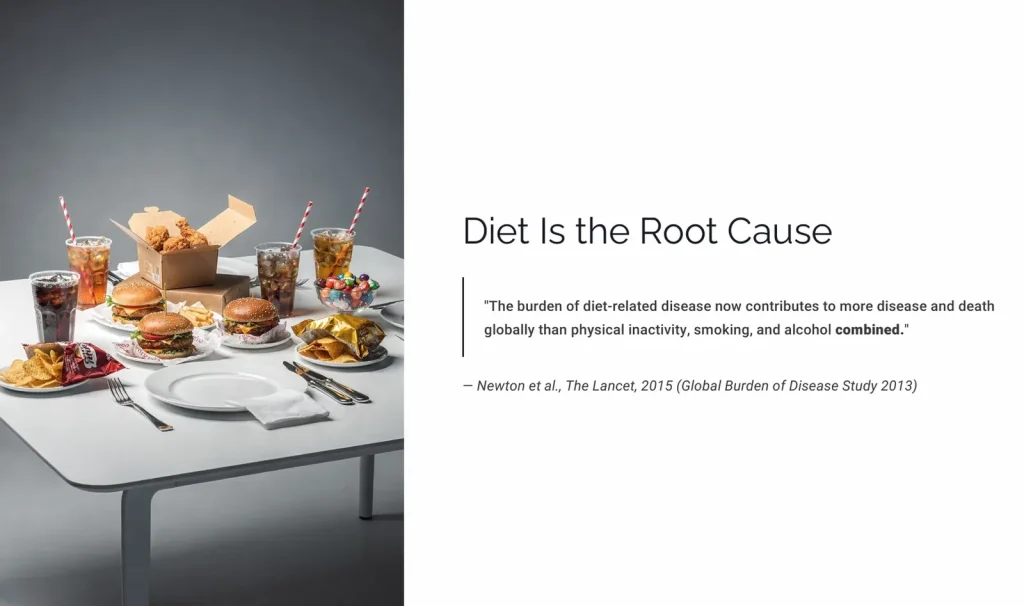
The Global Burden of Disease Study was analyzed in The Lancet in 2015. It found that poor diet adds more to disease and death than lack of exercise, smoking, and alcohol combined.1
That one finding reorders public health priorities. Huge, lasting, and truly successful effort went into tobacco control over forty years. Only a fraction of that has gone into diet, against a bigger burden of disease.

What did the 1977 dietary guidelines tell Americans to do?
In 1977 the United States issued its first Dietary Goals. The main instruction was to cut fat, with total fat held to around 30% of calories.
When you take fat off the plate, something has to replace those calories. What replaced it was carbs and industrial seed oil. Between 1961 and 2011, about 90% of the rise in American calorie intake came from carbs and polyunsaturated vegetable oils.
The advice also created a whole food category. “Low fat” processed food is, almost without exception, higher in sugar. Taking out fat takes out flavor and texture, and sugar is how food makers put both back.
The national obesity curve turns sharply upward within a few years of 1977. Correlation is not causation, and that must be said plainly. But it is a badly timed coincidence. And it happened while most people were doing what they had been told.

Was the low-fat advice backed by trials in 1977?
This is the part few people know.
A later analysis looked at the randomized trial evidence that was available before 1977. That was the evidence that existed when the fat limits were issued. It found that the trials did not support the fat advice that was made.2
The advice ran ahead of the data. Not against the data, exactly — ahead of it. It rested on an idea that seemed reasonable and had not yet been properly tested.
Professor John Ioannidis of Stanford is one of the most cited researchers in medicine. He has done more than almost anyone to expose weak methods within his own field. He has been blunt about the field that produced much of this evidence. He called nutrition research based on observing people a scandal that should go in the waste bin.
That is a strong opinion, not a study finding. Read it that way. But the core complaint is fair. Much of nutrition science finds links, not causes. It depends on what people say they ate. And it struggles to separate the effect of a food from the effect of the kind of person who chooses it.

Medicine’s own overtreatment problem
There is a related claim that spreads widely in this space, and I decline to repeat it.
You will hear that prescription drugs are the third leading cause of death. That estimate traces back to a 1998 analysis that drew on studies from the 1960s onward. It has been widely disputed. Careful current estimates place drug side effects somewhere around fourth to sixth as a cause of death worldwide. That is serious, but not what the popular version claims.
Here is the version we can defend: properly prescribed medication, taken as directed, causes real harm that is systematically undercounted. Two groups have called for real work on the harms of “too much medicine.” One is the Academy of Medical Royal Colleges. The other is the BMJ. The Choosing Wisely campaign exists to teach patients one question. Are there simpler or safer options than the prescription being offered?3
That is not an argument against medicine. It is an argument for asking whether the cause of the problem can be removed, instead of managed forever.
Why industry incentives matter without anyone being a villain
Researchers who studied tobacco’s history have shown in detail how that industry built doubt, paid for friendly science, and delayed rules. It did this for about fifty years after the first published evidence linking smoking to lung cancer.4
The parallel with today’s food industry is about structure, not conspiracy. A public company has a legal duty to make money for shareholders. It has no matching duty to your metabolic health. Given that, the outcome follows without anyone needing to act in bad faith.
Consider this. Current advice treats something like 22 teaspoons of added sugar per day as normal intake. Yet the body has no need for added sugar at all. There is no such thing as an essential sugar.

Why hasn’t standard diet advice worked for me?
None of this means your doctor is working against you. It means the information they trained on was tainted, and fixing a curriculum is slow work.
It also means this. If standard diet advice has not worked for you, you most likely did not follow it badly.
Frequently asked questions
Were the 1977 dietary guidelines based on evidence at the time?
Not on trial evidence for cutting fat. A later study looked at the trials done before 1977. They did not back the advice. The advice rested on an idea that sounded right but had not been properly tested.
Is it true that prescription drugs are the third leading cause of death?
That claim is weak, and I do not repeat it. It comes from a 1998 study of older data, and many experts dispute it. Careful estimates rank drug side effects about fourth to sixth worldwide. The point we can defend is that harm from medicine is real and undercounted. That is the basis of the Choosing Wisely campaign.
Does this mean I should stop taking my medications?
Absolutely not. Nothing here is a reason to change a prescription. The point is to ask your doctor whether a simpler or safer option exists, and whether the root cause can be treated. That is a conversation, not a solo decision. Do not start, stop, or change any medication without consulting your physician.
Is sugar actually necessary in the human diet?
No. There is no essential sugar in the diet. No chemical reaction in the body requires fructose from food. Every other class of major nutrient has essential forms — essential amino acids, essential fatty acids. Added sugar has none. Cutting it out causes no deficiency.
When did low-fat diets become a thing?
In 1977, when the United States issued its first Dietary Goals. The main instruction was to cut fat, with total fat held to around 30% of calories. That advice became policy before the randomized trials supported it. And it created a whole food category: “low fat” processed food. Food makers rebuilt it with sugar to restore the flavor and texture that taking out fat removed.
Why did Americans get heavier after the 1970s?
When fat came off the plate, carbs and industrial seed oil filled the gap. Between 1961 and 2011, about 90% of the rise in American calorie intake came from carbs and polyunsaturated vegetable oils. The national obesity curve turned sharply upward within a few years of 1977. Correlation is not causation. But it happened while most people were doing what they had been told.
Why are low-fat foods often higher in sugar?
Because taking out fat takes out flavor and texture, and sugar is how food makers put both back. The 1977 advice created the “low fat” processed food category. Those products are, almost without exception, higher in sugar. That matters because there is no such thing as an essential sugar. Yet current advice treats something like 22 teaspoons of added sugar a day as normal.
How do I get evaluated for the metabolic effects of all this?
Padda Institute Center for Interventional Pain Management is at 4477 Woodson Rd, Suite 100, St. Louis, MO 63134, next to St. Louis Lambert International Airport. A second location is at 12174 Natural Bridge Rd, St. Louis, MO 63044. We serve the St. Louis region across Missouri and Illinois. Call (314) 481-5000 or text (314) 886-5902, Monday to Friday, 8:00 AM to 5:00 PM.
Key takeaways
- Poor diet now adds more to disease and death than lack of exercise, smoking and alcohol combined.
- The 1977 fat limit was not backed by the trials that existed when it was issued.
- When fat came out of the diet, carbs and industrial seed oil took its place. They made up about 90% of the calorie rise from 1961 to 2011.
- The “prescription drugs are third leading cause of death” claim is disputed. The real concern is harm from medicine that is undercounted.
- Money explains the pattern. No one has to act in bad faith.
This article is educational and is not a substitute for evaluation, diagnosis, or treatment by a physician. Individual results vary. Do not start, stop, or change any medication without consulting your physician. To be evaluated, request an appointment or call (314) 481-5000.
References
- Newton JN, Briggs ADM, Murray CJL, et al. Changes in health in England, with analysis by English regions and areas of deprivation, 1990–2013: a systematic analysis for the Global Burden of Disease Study 2013. The Lancet. 2015;386(10010):2257–2274.
- Harcombe Z, Baker JS, Cooper SM, et al. Evidence from randomised controlled trials did not support the introduction of dietary fat guidelines in 1977 and 1983: a systematic review and meta-analysis. Open Heart. 2015;2(1):e000196.
- Malhotra A, Maughan D, Ansell J, et al. Choosing Wisely in the UK: the Academy of Medical Royal Colleges’ initiative to reduce the harms of too much medicine. BMJ. 2015;350:h2308.
- Brownell KD, Warner KE. The perils of ignoring history: Big Tobacco played dirty and millions died. How similar is Big Food? The Milbank Quarterly. 2009;87(1):259–294.
Get evaluated by a physician who treats the terrain, not just the signal
Chronic pain, metabolic disease and trauma feed each other. At the Padda Institute we check them together. Treating one alone falls short.
Or call or text us.
Medically reviewed by Dr. Gurpreet Singh Padda, MD, MBA, MHP — Board Certified in Anesthesiology, Pain Medicine, Interventional Pain Management, Addiction Medicine, and Obesity Medicine. Last reviewed July 2026.
Dr. Gurpreet Singh Padda, MD, MBA, MHP