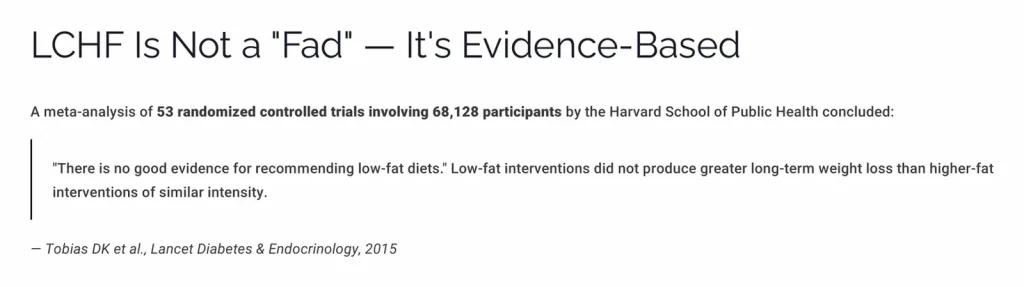
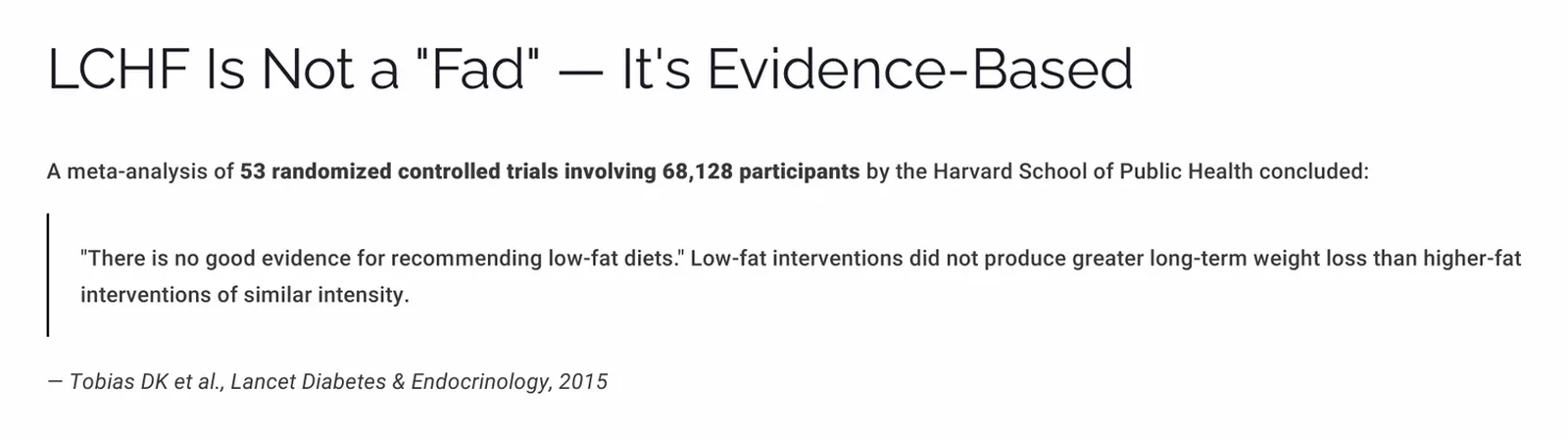
The trial evidence does not favor low-fat diets. Tobias and colleagues pooled 53 randomized controlled trials with 68,128 people. Every one ran a year or longer.
The finding: low-fat diets did not beat higher-fat diets of the same intensity for long-term weight loss. In the lead author’s own words, there is no good evidence for recommending low-fat diets.1
This article walks through that evidence and the saturated fat research that followed. It ends on the marker that predicts heart risk better than the one most people get tested.
Getting the citation right
That meta-analysis is Tobias and colleagues, published in Lancet Diabetes & Endocrinology in 2015.
It is worth naming precisely, because this study is wrongly credited all the time. It is often credited to Sackner-Bernstein and colleagues in PLoS One, also 2015. That is a truly different and much smaller analysis: 17 trials and 1,797 participants. Both papers exist, both are real, and they are not the same study.
If you want to read the 53-trial analysis yourself, search for Tobias.
Did a low-fat diet prevent heart disease in the Women’s Health Initiative?
If the low-fat idea were going to work anywhere, it should have worked here.
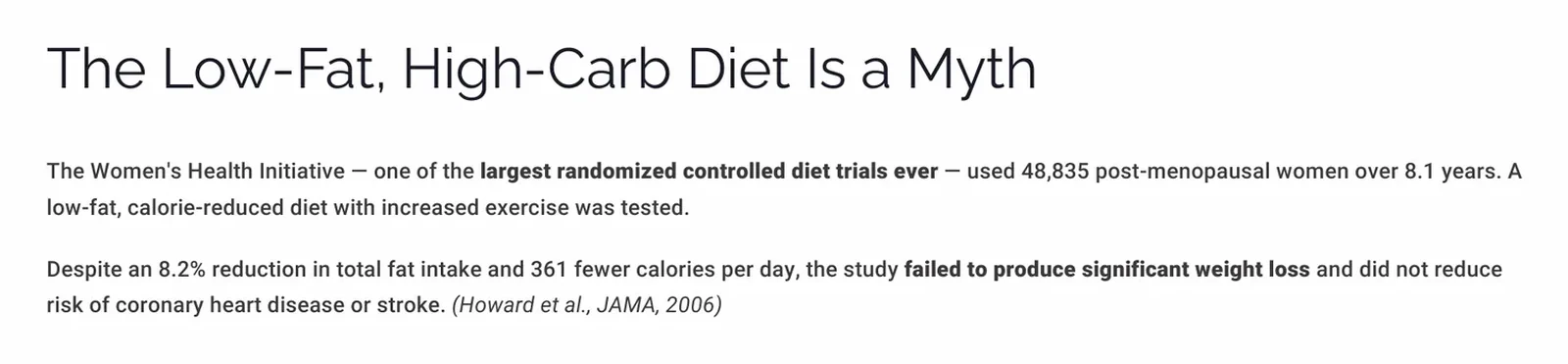
The Women’s Health Initiative diet trial enrolled 48,835 postmenopausal women. They ate a low-fat, low-calorie diet and moved more. The trial followed them for an average of 8.1 years.2
The plan was really carried out. Total fat intake fell by 8.2%. People ate 361 fewer calories per day. They kept that up for eight years — a remarkable feat in itself.
The outcome: no significant weight loss. No reduction in coronary heart disease. No reduction in stroke.
That was a large, well-funded test of the low-fat idea. People stuck with it. That was the result.
How does fat affect blood sugar and insulin compared with carbs?
The mechanism the guidance missed is simple.
Fat fills you up. Of the three main nutrients, it has the least effect on blood sugar and insulin. Protein has more effect. Carbs have by far the most.
Too much insulin, followed by insulin resistance, is the process that comes before type 2 diabetes. So advice to keep total fat below 30% of calories did worse than fail to help. It pushed a whole population toward the nutrient that drives insulin up. And it pushed them away from the one that reliably shuts appetite off.
Is saturated fat bad for you?
This is the part most people find hardest to accept, so it is worth citing carefully.
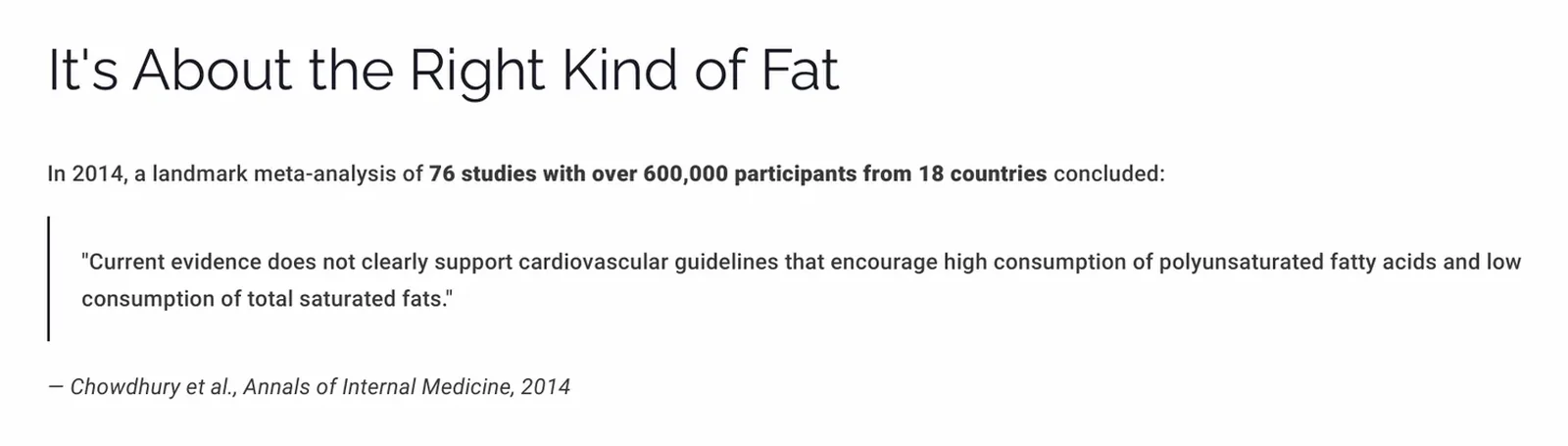
In 2014, a meta-analysis pooled 76 studies covering more than 600,000 participants across 18 countries. It found the evidence does not clearly back heart advice to eat lots of polyunsaturated fat and little saturated fat.3
The next year, a systematic review and meta-analysis in the BMJ looked at saturated fat. It was not associated with death from any cause. Nor was it tied to death from heart disease, total heart disease, ischemic stroke, or type 2 diabetes.4
And a randomized trial from 2015 tested diets that got saturated fat mainly from cheese and meat. They produced higher HDL cholesterol and apolipoprotein A-1 than a low-fat, high-carb diet. That is a less artery-clogging profile, not a worse one.5
None of that means saturated fat is a health food to chase. It means the claim that saturated fat drives heart disease has not held up in systematic review. Diet advice built on it needs a second look.
Is full-fat dairy linked to diabetes and weight gain?
Dairy fat is the clearest example. In population data, the more saturated fat from dairy in the blood — from cheese, yogurt, milk — the lower the risk of type 2 diabetes.6 More dairy fat, less diabetes.
A separate snapshot study looked at whole-fat dairy. People in the top third for intake had clearly lower odds of obesity (a statistically significant difference). That kind of study shows a link only. The cause could run the other way. And people who choose full-fat dairy may differ in other ways.
But notice the direction of every one of these findings. It is the opposite of what most patients were told.
The pattern underneath is this. Fat that comes inside real food acts differently. It is packed with the vitamins, minerals and antioxidants that evolved with it. Factory fat is pulled out, heated, deodorized and bottled.
What predicts heart disease risk better than LDL cholesterol?
If saturated fat is not the driver, what is?
Swapping saturated fat for omega-6 vegetable oils does reliably lower LDL cholesterol. What it does not reliably do is cut deaths from heart disease. Lowering the marker did not deliver the result. That should tell you something about whether the marker was ever the cause.
Total and LDL cholesterol are poor predictors of heart risk on their own. High triglycerides plus low HDL predict better. That combination is a known sign of insulin resistance. Worth knowing: the QRISK calculator used across the UK does not use LDL at all. It uses the total cholesterol to HDL ratio.
The most striking estimate comes from the Archimedes simulation model applied to national survey data. In young adults, preventing insulin resistance was estimated to prevent 42% of myocardial infarctions (heart attacks). Fixing high blood pressure came in at 36%. Low HDL was 31%. Body mass index was 21%. LDL was 16%.7
That figure comes from a math model, not a randomized trial, and that difference matters. But every arrow points the same way. Insulin resistance is the biggest single risk factor you can change. And it is the one tested for least.

Frequently asked questions
Does this mean I should eat as much saturated fat as I want?
No, and that is not what the evidence shows. Systematic reviews found saturated fat intake was not tied to death or heart disease. That means no harm at the levels studied, not a license to eat unlimited amounts. The more useful shift is toward whole foods and away from refined carbs and factory-extracted oils.
For why refined carbs and industrial seed oils are the bigger worry, read Sugar, Refined Grain and Seed Oil: The Mechanism Behind Each One.
Which meta-analysis is the one with 53 trials and 68,128 participants?
Tobias and colleagues, Lancet Diabetes & Endocrinology, 2015. It is often wrongly credited to Sackner-Bernstein in PLoS One. That is a different, smaller analysis of 17 trials and 1,797 participants.
If my LDL is high, does that mean I am fine to ignore it?
No. This article argues LDL predicts less on its own than the triglyceride-to-HDL pattern. It does not say LDL means nothing. Managing blood fats is a personal clinical decision. It depends on your full risk profile, family history and other conditions. Discuss it with your own physician, and do not start, stop, or change any medication without consulting them.
Is the 42% heart attack figure from a clinical trial?
No. It comes from the Archimedes simulation model applied to national survey data. It is a modeled estimate, not a measured trial result. It is shown here as a strong signal of how much insulin resistance matters. It is not a proven result. Individual results vary.
For how insulin resistance builds years before diabetes is diagnosed, read Insulin Resistance Comes Years Before Diabetes — and Your Glucose Test Will Miss It.
Does a low-fat diet help you lose weight?
Not better than a higher-fat diet. Tobias and colleagues pooled 53 randomized trials with 68,128 people, and every one ran a year or longer. Low-fat diets did not lead to more long-term weight loss than higher-fat diets of the same intensity. In the Women’s Health Initiative, women ate 361 fewer calories a day on a low-fat diet. They kept it up for about eight years. They saw no real weight loss.
Which is better, saturated fat or vegetable oil?
Swapping saturated fat for omega-6 vegetable oils reliably lowers LDL cholesterol. But it did not reliably lower deaths from heart disease. The pattern underneath: fat in real food, such as cheese, yogurt and milk, acts differently. Factory fat is pulled out, heated, deodorized and bottled. Saturated fats from dairy go with lower type 2 diabetes risk.
What is the triglyceride-to-HDL ratio, and why does it matter?
It compares your triglycerides with your HDL cholesterol. High triglycerides plus low HDL predict heart risk better than total or LDL cholesterol alone. That combination is a known sign of insulin resistance. One model looked at young adults. Preventing insulin resistance would prevent 42% of heart attacks. Fixing LDL would prevent 16%.
Where can I have my metabolic markers reviewed?
Padda Institute Center for Interventional Pain Management, 4477 Woodson Rd, Suite 100, St. Louis, MO 63134, next to St. Louis Lambert International Airport. A second location is at 12174 Natural Bridge Rd, St. Louis, MO 63044. We serve the St. Louis region across Missouri and Illinois. Call (314) 481-5000 or text (314) 886-5902, Monday to Friday, 8:00 AM to 5:00 PM.
For how the practice approaches metabolic disease, read Treating Metabolic Disease at the Dietary Root Cause.
Key takeaways
- The 53-trial, 68,128-participant meta-analysis is Tobias et al. 2015 — not the smaller study it is often mixed up with.
- The Women’s Health Initiative kept women on a low-fat diet for 8.1 years. It found no weight, heart or stroke benefit.
- Systematic reviews have not found saturated fat intake tied to death, heart disease, stroke or diabetes.
- Lowering LDL by swapping saturated fat for omega-6 oils did not cut deaths as predicted.
- The triglyceride-to-HDL ratio, a marker of insulin resistance, tracks risk better than LDL alone.
This article is educational and is not a substitute for evaluation, diagnosis, or treatment by a physician. Individual results vary. Do not start, stop, or change any medication without consulting your physician. To be evaluated, request an appointment or call (314) 481-5000.
References
- Tobias DK, Chen M, Manson JE, Ludwig DS, Willett W, Hu FB. Effect of low-fat diet interventions versus other diet interventions on long-term weight change in adults: a systematic review and meta-analysis. Lancet Diabetes & Endocrinology. 2015;3(12):968–979.
- Howard BV, Manson JE, Stefanick ML, et al. Low-fat dietary pattern and weight change over 7 years: the Women’s Health Initiative Dietary Modification Trial. JAMA. 2006;295(1):39–49.
- Chowdhury R, Warnakula S, Kunutsor S, et al. Association of dietary, circulating, and supplement fatty acids with coronary risk: a systematic review and meta-analysis. Annals of Internal Medicine. 2014;160(6):398–406.
- de Souza RJ, Mente A, Maroleanu A, et al. Intake of saturated and trans unsaturated fatty acids and risk of all cause mortality, cardiovascular disease, and type 2 diabetes. BMJ. 2015;351:h3978.
- Thorning TK, Raziani F, Bendsen NT, et al. Diets with high-fat cheese, high-fat meat, or carbohydrate on cardiovascular risk markers in overweight postmenopausal women. American Journal of Clinical Nutrition. 2015;102(3):573–581.
- Mozaffarian D. Saturated fatty acids and type 2 diabetes: more evidence to re-invent dietary guidelines. Lancet Diabetes & Endocrinology. 2014;2(10):770–772.
- Eddy D, Schlessinger L, Kahn R, Peskin B, Schiebinger R. Relationship of insulin resistance and related metabolic variables to coronary artery disease: a mathematical analysis. Diabetes Care. 2009;32(2):361–366.
Get evaluated by a physician who treats the terrain, not just the signal
Chronic pain, metabolic disease and trauma feed each other. At the Padda Institute they are checked together, because treating one alone falls short.
Or call or text us.
Medically reviewed by Dr. Gurpreet Singh Padda, MD, MBA, MHP — Board Certified in Anesthesiology, Pain Medicine, Interventional Pain Management, Addiction Medicine, and Obesity Medicine. Last reviewed July 2026.
Dr. Gurpreet Singh Padda, MD, MBA, MHP