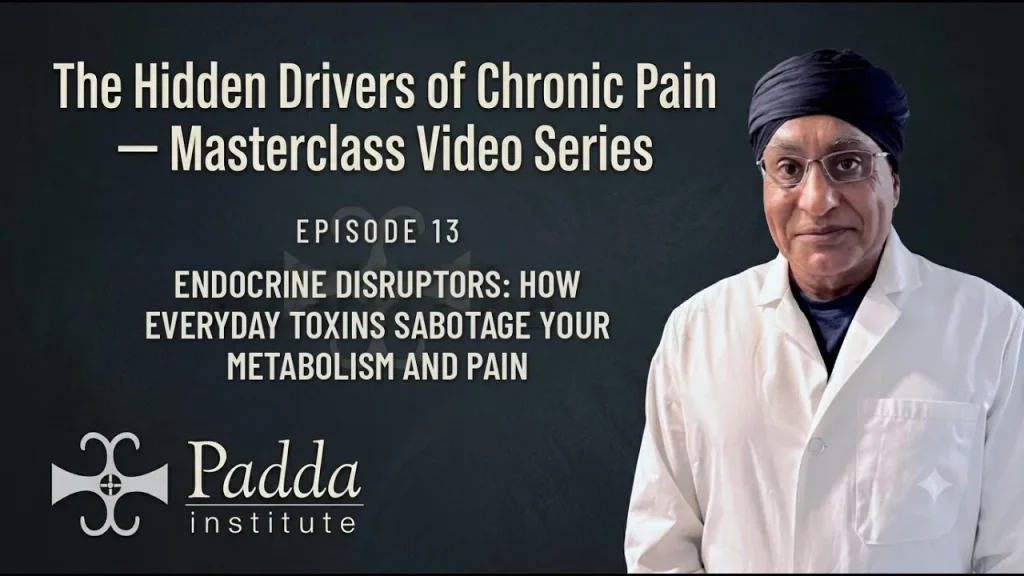
Endocrine disruptors are chemicals in everyday plastics, food-can linings, and personal care products, such as BPA and phthalates. They scramble your hormone signals. They push your metabolism toward insulin resistance and the wrong kind of fat storage. That metabolic state is what drives chronic pain.
Maybe you have cleaned up your diet and you are doing the work. Yet beating chronic pain is still harder than it should be. A hidden force may be part of the reason. Endocrine disruptors are chemicals in everyday plastics, food-can linings, and receipt coatings. They can slip into your body and scramble your hormone signals. This article explains what these chemicals do and why they push your body toward the metabolic state that drives pain. It also covers what you can do to lighten the load.
What are endocrine disruptors?
Endocrine disruptors are chemicals that mess with your hormone system. Two of the most common are BPA (bisphenol A), found in many plastics and in the linings of food and drink cans, and phthalates, found in soft plastics, food packaging, and countless personal care products. These chemicals can act as xenoestrogens. That means they copy or block your body’s own hormone signals. Almost everyone is exposed. These chemicals show up in the bodies of most people.
How do endocrine disruptors affect metabolism and pain?
Research has shown that these chemicals disrupt metabolic signals in ways that favor insulin resistance and push fat to build up in the wrong places. Some are even called obesogens, chemicals that push the body to store fat. This matters for pain because, as this series shows, insulin resistance drives pain, and excess visceral fat (belly fat around the organs) acts like an inflammation factory. In other words, these chemicals quietly push you toward the exact metabolic damage you are trying to reverse.
Is a single exposure to endocrine disruptors harmful?
No single exposure is a disaster. The problem is that it never stops. It adds up, day after day, drip by drip. Your body has to fight the whole load. Beyond the effects on metabolism, it is a constant toxic burden. Your body has to process and clear it. That can add to oxidative stress (cell damage from unstable oxygen) and inflammation. If you already live with chronic pain and a broken metabolism, this matters. Cutting this hidden burden removes one more force that works against healing.
Where the evidence stands
The research tying endocrine disruptors to metabolic health is now a large field. Lab and population studies link BPA and phthalates to insulin resistance, obesity, and a broken metabolism. Major science groups now name endocrine disruptors a real concern for metabolic health. The field is still growing. The evidence keeps pointing the same way.
What this means for evaluation at the Padda Institute
At the Padda Institute, we help you find and cut your biggest sources. We make practical changes in how you store food, what you drink from, and the products you use. We feed your body’s own cleanup systems through food. We also fix the nutrient gaps those systems need. And we treat what these chemicals cause next: insulin resistance and inflammation. We use the same full approach found across this series. We cannot make the modern world go away. But we can lighten the load your body carries by a lot.
Frequently asked questions
What are endocrine disruptors and where am I exposed to them?
Endocrine disruptors are chemicals that mess with your hormone signals. Two of the most common are BPA, found in many plastics and can linings, and phthalates, found in soft plastics, food packaging, and personal care products. They show up in the bodies of most people.
How could plastics and packaging affect my chronic pain?
Research suggests these chemicals disrupt metabolic signals in ways that favor insulin resistance and fat build-up in the wrong places. That is the same metabolic damage that drives pain and inflammation. The field is still growing, so treat it as one factor within the full picture. Individual results vary.
Should I take supplements or change medications to detox from these chemicals?
Support for your body’s cleanup is best done through nutrition and by fixing specific nutrient gaps. A physician who knows your case should guide it. Do not start, stop, or change any medication without consulting your physician.
What products contain BPA and phthalates?
BPA is found in many plastics and in the linings of food and drink cans. Phthalates are found in soft plastics, food packaging and countless personal care products. Receipt coatings are another everyday source. Almost everyone is exposed. These chemicals show up in the bodies of most people.
What are obesogens?
Obesogens are chemicals that push the body to store fat. Some endocrine disruptors get this name because they disrupt metabolic signals. That favors insulin resistance and fat build-up in the wrong places. Excess visceral fat (belly fat around the organs) acts like an inflammation factory. That is how these chemicals feed the metabolic state behind chronic pain.
How do you rid your body of endocrine disruptors?
Start by cutting the sources. Change how you store food, what you drink from and the personal care products you use. Then support your body’s own cleanup systems through nutrition, and by fixing the nutrient gaps those systems depend on. The harm adds up every day. So lowering your total exposure over time is what matters.
Where are you located and how do I book?
Padda Institute Center for Interventional Pain Management, 4477 Woodson Rd, Suite 100, St. Louis, MO 63134. Book at painmd.tv/appointment/ or call (314) 481-5000.
Key takeaways
- Everyday chemicals like BPA and phthalates can disrupt hormone and metabolic signals.
- Evidence links them to insulin resistance and inflammation, though the field is still growing.
- The harm adds up every day, so lowering total exposure over time is what matters.
- Next step: get a whole-picture exam at the Padda Institute that includes hidden chemical burden.
This article is educational and is not a substitute for evaluation, diagnosis, or treatment by a physician. Individual results vary. Do not start, stop, or change any medication without consulting your physician.
Find the source of your pain — not just the signal
Padda Institute Center for Interventional Pain Management builds a custom plan for each patient. It aims at the root cause. Interventional care and metabolic medicine, under one roof in St. Louis.
Or call or text us — 4477 Woodson Rd, Suite 100, St. Louis, MO 63134.
Msg & data rates may apply. Reply STOP to opt out, HELP for help. Text is not a secure channel — please don’t send medical or personal health information by text, and don’t use text for emergencies.
Medically reviewed by Dr. Gurpreet Singh Padda, MD, MBA, MHP — Board Certified in Anesthesiology, Pain Medicine, Interventional Pain Management, Addiction Medicine, and Obesity Medicine. Last reviewed July 2026.
Dr. Gurpreet Singh Padda, MD, MBA, MHP