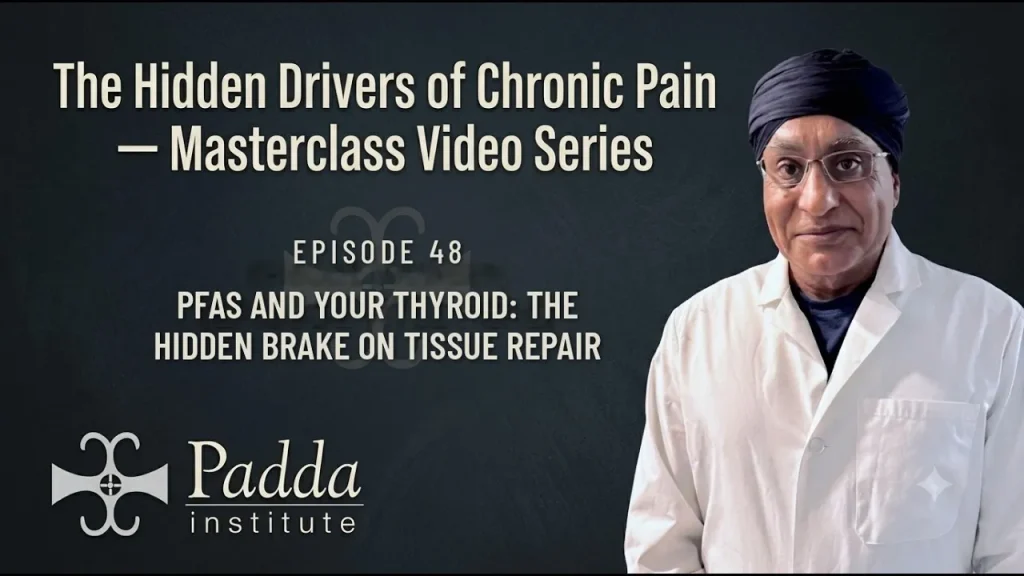
PFAS, the “forever chemicals” in nonstick pans, water-repellent gear, and food packaging, interfere with thyroid hormone. That hormone is your body’s thermostat. It sets the pace of tissue repair. When repair slows, injuries that should heal cleanly hang on and turn into chronic pain.
Do your injuries take forever to heal? Are you always the one whose recovery runs behind? There may be an outside cause no one checked for. This article explains how PFAS, a group of chemicals so hard to destroy they are nicknamed “forever chemicals,” can interfere with a thyroid hormone that sets the pace of your healing. The result is injuries that won’t clear up and a metabolism stuck in slow motion. Every point here comes from Dr. Padda’s video.
What are forever chemicals, and why do they build up?
PFAS—per- and polyfluoroalkyl substances—are a large family of man-made chemicals. They resist water, grease, and heat. That is why they show up in nonstick pans, water-repellent gear, food packaging, and countless other products. But that same toughness is the problem. They do not break down in nature or in the body, hence “forever chemicals.” They stay and bioaccumulate, which means they build up over time. Exposure is widespread. These chemicals show up in the blood of most people. It is one more steady, low-level exposure that most people carry without knowing.
How do PFAS affect your thyroid and healing?
Research indicates that PFAS can interfere with thyroid hormone transport and signaling. Thyroid hormone is your body’s thermostat. It sets the pace of energy use, tissue turnover, and repair all through your body. So when PFAS throw off thyroid hormone, especially at the tissue level, your metabolism slows and your cells repair more slowly. Here is the catch. This can weaken thyroid action even when standard thyroid blood tests look fairly normal. That is because the problem can sit in how the hormone is carried and how tissues read it, not in the blood level. The thermostat reads okay, but the house still runs cold.
Why do PFAS turn injuries into chronic pain?
Here is what that means for your pain. If PFAS slow your thyroid, they slow your tissue repair. Injuries that should heal cleanly hang on and become chronic. A muscle or joint injury gets stuck. That is not because the damage is severe. It is because the body’s healing engine has been throttled down. PFAS exposure is so common and lasts so long that it acts as a quiet, steady brake on healing. Standard pain care never looks for it, least of all when one thyroid lab number looks fine.
Looking for the brakes at the Padda Institute
The evidence is drawing serious attention. PFAS are well known as lasting pollutants that build up in the body. A large body of research has linked PFAS exposure to thyroid hormone disruption and changed thyroid function. Wider health effects are being actively studied, and regulators are growing more concerned. At the Padda Institute, we find out why your healing is slow instead of just accepting it. That includes your exposome (everything you are exposed to over your life) and a full look at your thyroid in context, not just one number. Where exposures like PFAS may play a part, we help you cut ongoing exposure with practical changes in what you use and eat. We also support your body’s ability to clear toxins and your thyroid function. Individual results vary.
Frequently asked questions
How could PFAS keep my injuries from healing?
Research indicates PFAS can interfere with thyroid hormone transport and signaling. Thyroid hormone sets the pace of tissue turnover and repair. When that pace slows, injuries that should heal cleanly can hang on and become chronic. That is not because the damage is severe. It is because the body’s healing engine has been throttled down. Individual results vary.
For another reason injuries fail to heal, an immune system tied up by hidden germs, read When Your Immune System Never Stands Down: Pathogen Burden and Injuries That Won’t Heal.
My thyroid labs were normal—could PFAS still be affecting me?
Possibly. Dr. Padda explains that PFAS can weaken thyroid action even when standard blood tests look fairly normal. That is because the problem can sit in how the hormone is carried and read by tissues, not in the blood level. That is why he checks thyroid function in full context, not just one number.
Should I take thyroid medication or a detox product to counter PFAS?
Do not start, stop, or change any medication without consulting your physician. Cutting PFAS exposure comes down to practical changes in what you use and eat. Any thyroid medicine or detox support should be decided with your physician as part of a full workup. Individual results vary.
For the wider group of hormone-disrupting chemicals and how to cut your exposure, read Endocrine Disruptors: The Hidden Chemicals Working Against Your Metabolism and Your Pain.
Can PFAS affect your thyroid?
Yes. Research indicates PFAS can interfere with thyroid hormone transport and signaling. Thyroid hormone is your body’s thermostat. It sets the pace of energy use, tissue turnover, and repair. When PFAS throw it off at the tissue level, your metabolism slows and cell repair lags. This can happen even when standard thyroid blood tests look fairly normal.
Where does PFAS exposure come from?
PFAS are used in nonstick pans, water-repellent gear, food packaging, and countless other products because they resist water, grease, and heat. They do not break down in nature or in the body, so they build up over time. Exposure is widespread. These chemicals show up in the blood of most people, who usually don’t know it.
What removes PFAS from your body?
PFAS do not break down in the body, so the practical goal is to stop adding to the load. At the Padda Institute, where PFAS may be slowing your healing, we help you cut ongoing exposure with changes in what you use and eat. We also support your body’s ability to clear toxins and your thyroid function. Individual results vary.
Where are you located and how do I book?
Padda Institute Center for Interventional Pain Management, 4477 Woodson Rd, Suite 100, St. Louis, MO 63134. Book at painmd.tv/appointment/ or call (314) 481-5000.
Key takeaways
- How it works: PFAS can interfere with thyroid hormone transport and signaling, which slows tissue repair.
- Evidence: PFAS are known pollutants that build up in the body. Research links them to thyroid disruption (an active area of study).
- Why it's missed: trouble at the tissue level can weaken thyroid action even when one blood test looks normal.
- Next step: check your thyroid in full context and cut exposure—start at painmd.tv/appointment/.
This article is educational and is not a substitute for evaluation, diagnosis, or treatment by a physician. Individual results vary. Do not start, stop, or change any medication without consulting your physician.
Find the source of your pain — not just the signal
Padda Institute Center for Interventional Pain Management builds a customized, root-cause plan for each patient. Interventional care and metabolic medicine, under one roof in St. Louis.
Or call or text us — 4477 Woodson Rd, Suite 100, St. Louis, MO 63134.
Msg & data rates may apply. Reply STOP to opt out, HELP for help. Text is not a secure channel — please don’t send medical or personal health information by text, and don’t use text for emergencies.
Medically reviewed by Dr. Gurpreet Singh Padda, MD, MBA, MHP — Board Certified in Anesthesiology, Pain Medicine, Interventional Pain Management, Addiction Medicine, and Obesity Medicine. Last reviewed July 2026.
Dr. Gurpreet Singh Padda, MD, MBA, MHP