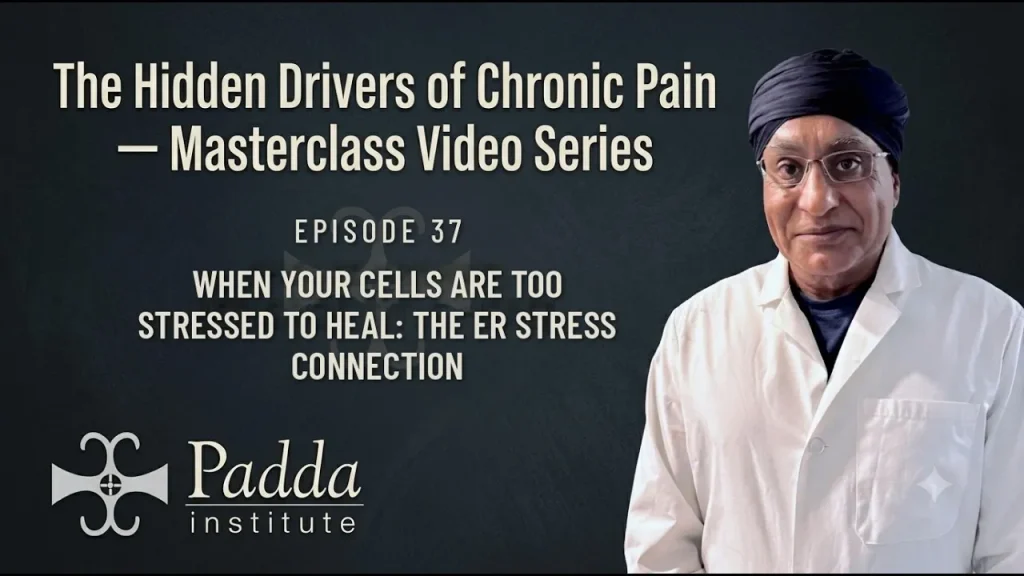
Endoplasmic reticulum (ER) stress keeps many painful tissues from healing. The ER is the protein factory inside your cells. When it gets overloaded, it sets off the unfolded protein response, a huge emergency that drains the cell. While that alarm keeps ringing, the cell pulls everything away from repair just to survive.
Maybe you have an injury or a sore spot that will not heal no matter what you try. The reason may sit inside your cells. Each cell has a factory called the endoplasmic reticulum . When it gets overloaded, it sets off a huge emergency that drains the cell. While that emergency runs, the cell pulls everything away from repair just to survive. This article is part of our Hidden Drivers of Chronic Pain series. It explains why so many tissues stay frozen and never repair.
The endoplasmic reticulum and its partnership with mitochondria
The endoplasmic reticulum, or ER, is a sprawling network inside your cells. It is a major factory, mainly for folding proteins into the right shapes. It is also a key hub for calcium signals. The ER and your mitochondria (the cell’s power plants) are physically tied together. They are partners. They trade signals and calcium all day, so they work as one linked unit. When one partner is in trouble, the other feels it. That link is central to what goes wrong here.
What is the unfolded protein response (UPR)?
When the mitochondria falter, calcium handling breaks down. The mitochondria and ER manage calcium together, so the ER senses the imbalance. Misfolded proteins pile up and sound an alarm. That alarm starts the unfolded protein response, or UPR. It is a huge, energy-hungry stress response across the whole cell. Its job is to restore order. It pauses normal production, clears the backlog, and handles the crisis. In the short term it protects the cell. But it is expensive, and it takes over the cell’s resources. While the UPR runs, the cell is in emergency triage. It pours energy into survival instead of its normal work.
Why can't stressed cells repair tissue?
Chronic pain patients are often stuck in constant, ongoing ER stress. The UPR is not a short emergency that ends. It is an alarm that never shuts off. While it keeps ringing, the cell’s resources keep getting pulled away from tissue repair. The tissue gets stuck. It cannot heal because its cells are always busy with their own inner emergency. This helps explain a pattern we see again and again: tissue that will not heal and seems frozen no matter what. At the cell level, it is too stressed to repair.
A more compassionate picture of tissue that won't heal
The science of ER stress and the unfolded protein response is well established and a major field of research. We understand how mitochondria and the ER are coupled, and how calcium handling breaks down. ER stress is more and more linked to metabolic disease, brain and nerve decline, and chronic pain. So if a painful tissue will not heal, here is a truer picture. Your cells have not given up. They are stuck in survival mode, pouring everything into an inner crisis with nothing left for repair. It is not refusal and it is not failure. It is triage.
How the Padda Institute approaches non-healing tissue
The goal is to lower the chronic cell stress that keeps your tissues locked out of repair. ER stress sits downstream of mitochondrial dysfunction. So the work is building the full foundation covered in this series. Restore mitochondrial health. Calm inflammation. Steady the metabolic environment to lower the constant ER stress. As that emergency stands down, cells can shift their resources from survival back to repair. In our practice, regenerative therapies are described as working better once cells are no longer stuck in crisis mode. Fix the biological soil first. Individual results vary.
Frequently asked questions
What is endoplasmic reticulum (ER) stress?
ER stress is a cell-wide emergency. It starts when the endoplasmic reticulum, the cell's protein-folding and calcium-signal center, gets overloaded. It sets off the unfolded protein response (UPR), a costly stress response that pauses normal work so the cell can survive. When it runs nonstop, the cell has little left for tissue repair.
To learn what happens when the ER’s mitochondrial partner breaks apart, read When Your Mitochondria Fragment: A Hidden Driver of Nerve and Muscle Pain.
Why won't my injured tissue heal?
In the mechanism shown in this video, cells stuck in ongoing ER stress pour their resources into survival instead of repair. That leaves tissue frozen and unable to repair. Your body has not given up. The cells are busy with an inner emergency. Fixing the stress underneath is what lets repair start again, and individual results vary.
Should I change my medications or supplements to reduce cellular stress?
Our approach focuses on restoring mitochondrial health, calming inflammation, and steadying the metabolic environment, not on any single product. Do not start, stop, or change any medication without consulting your physician. Individual results vary.
What causes endoplasmic reticulum stress?
It usually starts next door, in the mitochondria. The ER and your mitochondria are physically tied together and manage calcium together. So when the mitochondria falter, calcium handling breaks down. The ER senses that imbalance, misfolded proteins pile up, and the alarm goes off. That alarm is the unfolded protein response. In chronic pain it often never switches off.
What diseases are associated with ER stress?
ER stress and the unfolded protein response are well-established cell biology. ER stress is more and more linked to metabolic disease, brain and nerve decline, and chronic pain. In a pain practice it shows up most clearly as tissue that will not heal. The cells are stuck in constant survival mode, with nothing left for repair, no matter what treatment is piled on top.
How is endoplasmic reticulum stress treated?
By lowering the stress at its source instead of chasing the symptom. ER stress sits downstream of mitochondrial dysfunction. So the work is restoring mitochondrial health, calming inflammation, and steadying the metabolic environment. As the emergency stands down, cells can shift resources from survival back to repair. Regenerative therapies are described as working better once that biological soil is fixed. Individual results vary.
Where are you located and how do I book?
Padda Institute Center for Interventional Pain Management, 4477 Woodson Rd, Suite 100, St. Louis, MO 63134. Book at painmd.tv/appointment/ or call (314) 481-5000.
Key takeaways
- The endoplasmic reticulum and mitochondria are tied-together partners. When one struggles, the other feels it.
- Overloaded cells set off the unfolded protein response, which pulls energy from repair to survival.
- ER stress is well-established cell biology, more and more linked to chronic pain and tissue that will not heal.
- The goal is to fix the stress underneath so cells can repair. Start at painmd.tv/appointment/.
This article is educational and is not a substitute for evaluation, diagnosis, or treatment by a physician. Individual results vary. Do not start, stop, or change any medication without consulting your physician.
Find the source of your pain — not just the signal
Padda Institute Center for Interventional Pain Management builds a customized, root-cause plan for each patient. Interventional care and metabolic medicine, under one roof in St. Louis.
Or call or text us — 4477 Woodson Rd, Suite 100, St. Louis, MO 63134.
Msg & data rates may apply. Reply STOP to opt out, HELP for help. Text is not a secure channel — please don’t send medical or personal health information by text, and don’t use text for emergencies.
Medically reviewed by Dr. Gurpreet Singh Padda, MD, MBA, MHP — Board Certified in Anesthesiology, Pain Medicine, Interventional Pain Management, Addiction Medicine, and Obesity Medicine. Last reviewed July 2026.
Dr. Gurpreet Singh Padda, MD, MBA, MHP


