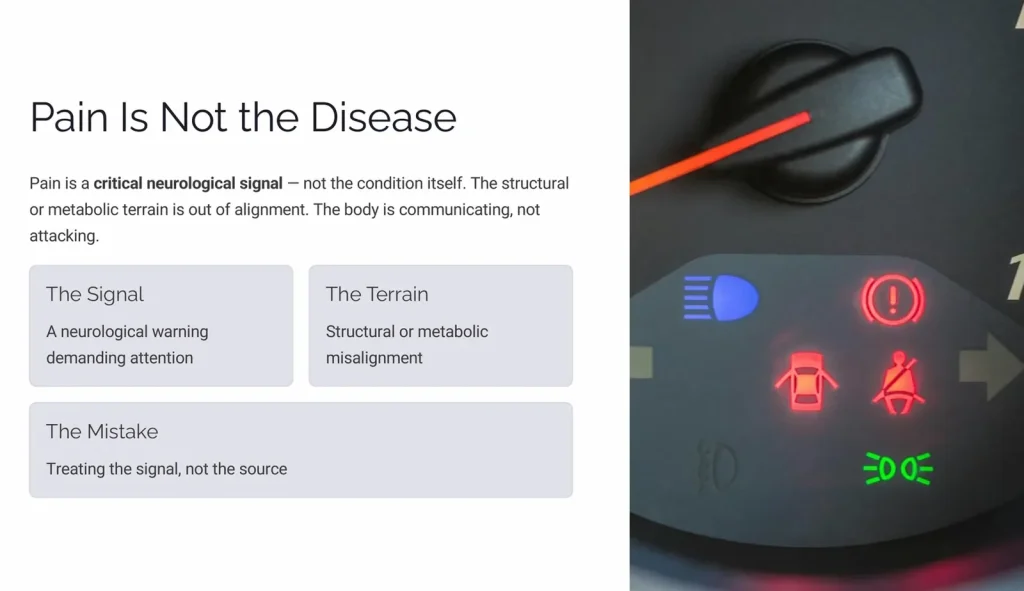
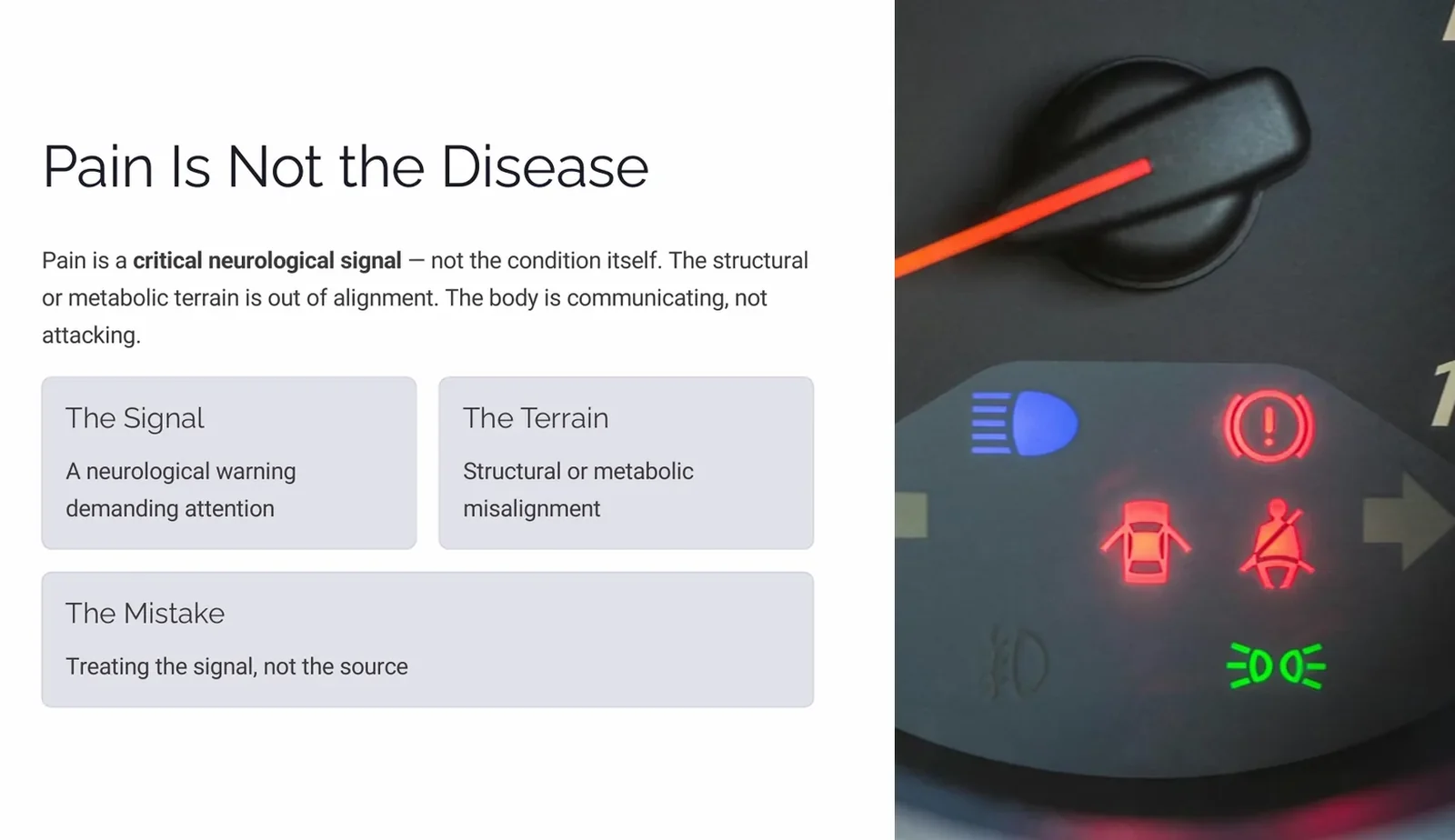
Pain is a neurological output your brain produces after weighing evidence. It is not a readout of damaged tissue and not the disease itself. Under the signal sits the terrain: inflammation, poor sleep, loads the body cannot bear, swinging blood sugar, nonstop stress. Treat the signal and leave the terrain alone, and every treatment works briefly before the pain returns.
Thirty years of practice have taught me something that sounds, at first, like a brush-off. It is not.
Pain is not the enemy. Pain is the message.
I do the injections, the ablations and the neuromodulation. So when I say treating pain directly is usually the wrong main target, know this: I am arguing against what I do for a living.
Why does pain keep coming back after treatment?
The signal. Pain is an output your brain makes after weighing evidence. It is not a direct readout from damaged tissue. That is why tissue damage and pain level match far more loosely than most people expect.
The terrain. Under the signal, something in the body’s structure or metabolism is off. Think inflammation, poor sleep, loads the body cannot bear, swinging blood sugar, nonstop stress.
The mistake. Treating the signal and leaving the terrain alone.
That mistake is why people cycle through pain clinics for years. Every treatment works briefly, then the pain returns, because nothing about the conditions making it has changed.
Is my body working against me?
There is a sentence I hear almost daily: my body is breaking down and working against me.
I want to replace it. Not as a pep talk, but because the new sentence is more accurate.
Your nervous system is not attacking you. It has spotted conditions it judges unsafe. It keeps turning up the volume until you respond. It is asking you to change the conditions it is reacting to.
So the more accurate sentence is: my nervous system is asking me to change something.
This matters in the clinic, because the words patients use about their bodies change the pain they feel, and that change can be measured. We cover this in more depth with central sensitization.
You are not broken
For patients told for years that their scans look terrible and nothing more can be done:
You are not broken. Your pain is an accurate body response to your current level of inflammation and stress. Given those inputs, the system makes exactly the output it was built to make. It is working correctly.
That is not a consolation prize. It is a strategic fact. A working system fed bad inputs is a very different problem from a broken system. The first one you can fix by changing the inputs.
What should you do after a pain injection?
This is the most misunderstood part of interventional pain care. It is also the part least often explained.
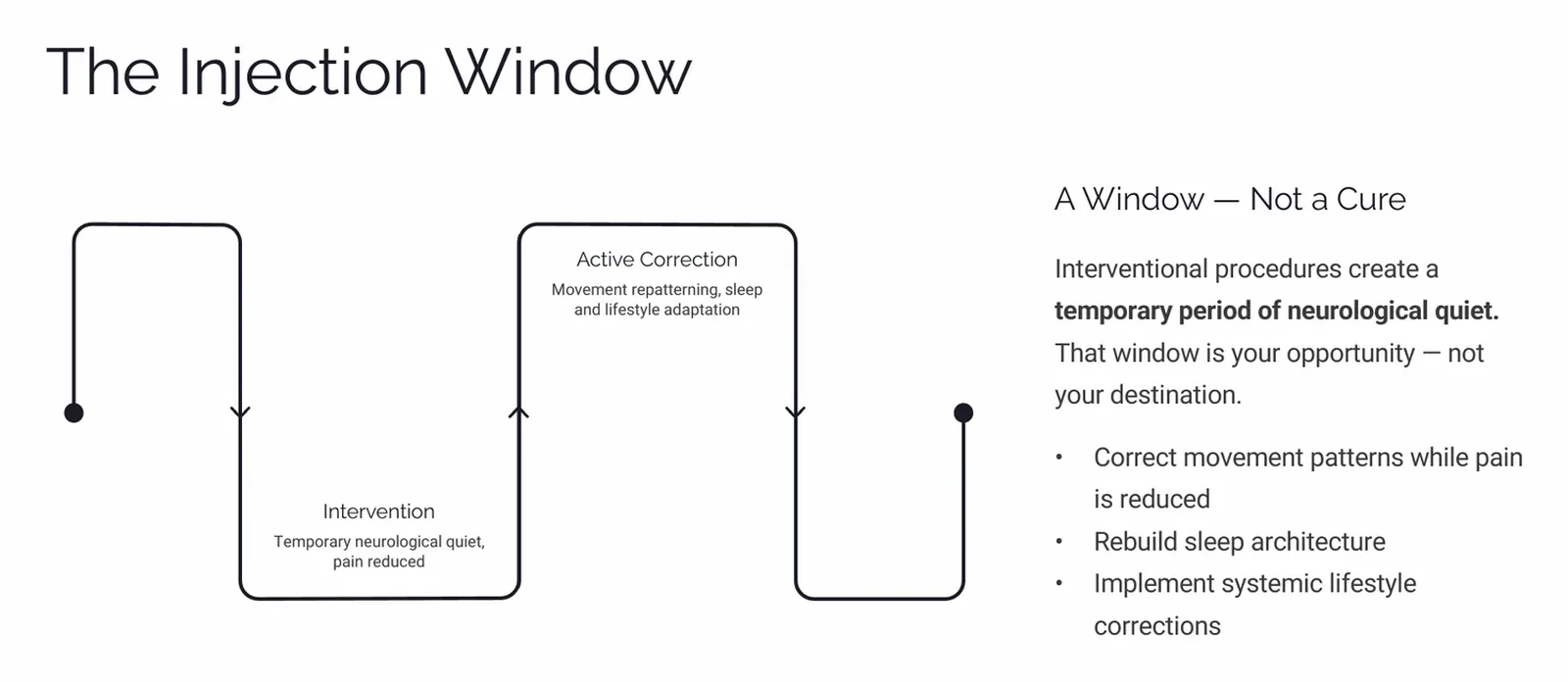
An interventional procedure buys a window of neurological quiet. Pain comes down. Protective guarding relaxes. The nervous system stops turning up the volume long enough for you to actually do something.
That window is your opportunity. It is not your destination.
Inside it, three things should happen:
- Correct movement patterns while you can move without setting off a flare
- Rebuild sleep architecture, because sleep is when the nervous system resets its threat alarms
- Implement the systemic changes: diet, stress control, activity. These lower your baseline inflammation
If you spend the window resting and waiting for the next injection, the pain returns. The procedure did not fail. The window was the whole point, and it closed unused.
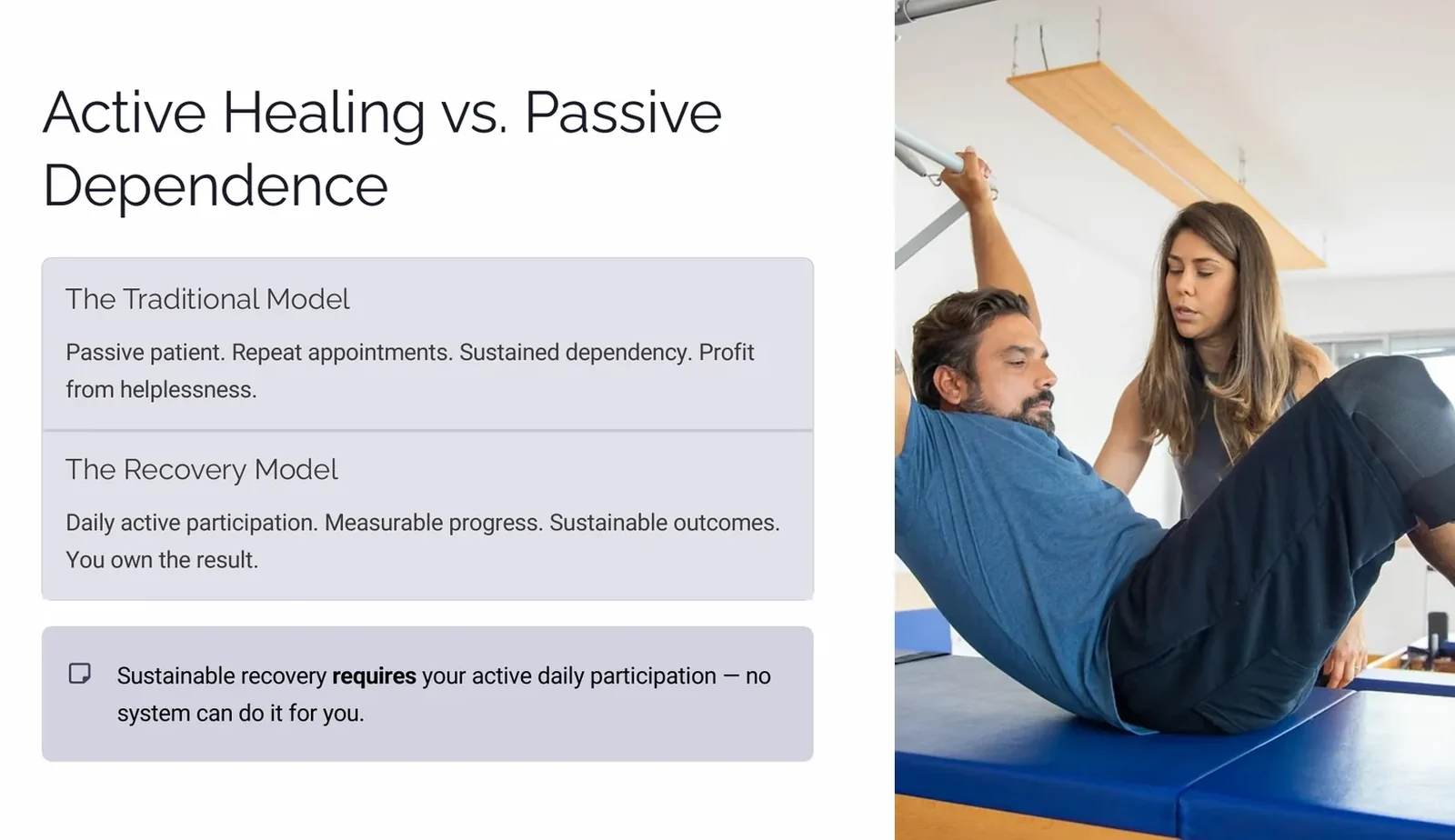
Active participation versus passive dependence
This leads to an uncomfortable comparison of two models of care.
In the traditional model, the patient is passive. Visits repeat forever, and dependence lasts. I will say the quiet part out loud. A patient who comes back every month forever is, in dollars, a better patient. That is a real incentive in this field, and it deserves naming.
In the recovery model, the patient takes part every day. Progress is measured, and the patient owns the result.
I want the second one, and it asks more of you. I can create the conditions. I cannot do the repetitions.
Why does pain move from one place to another?
One more principle.
We reject pain chasing: the endless hunt for whichever spot hurts most today. Treat the shoulder and the hip speaks up. Treat the hip and the low back follows. That is not a string of problems. It is one problem showing up in sequence.
Instead, find the main body-wide signal driving the chain and fix that.
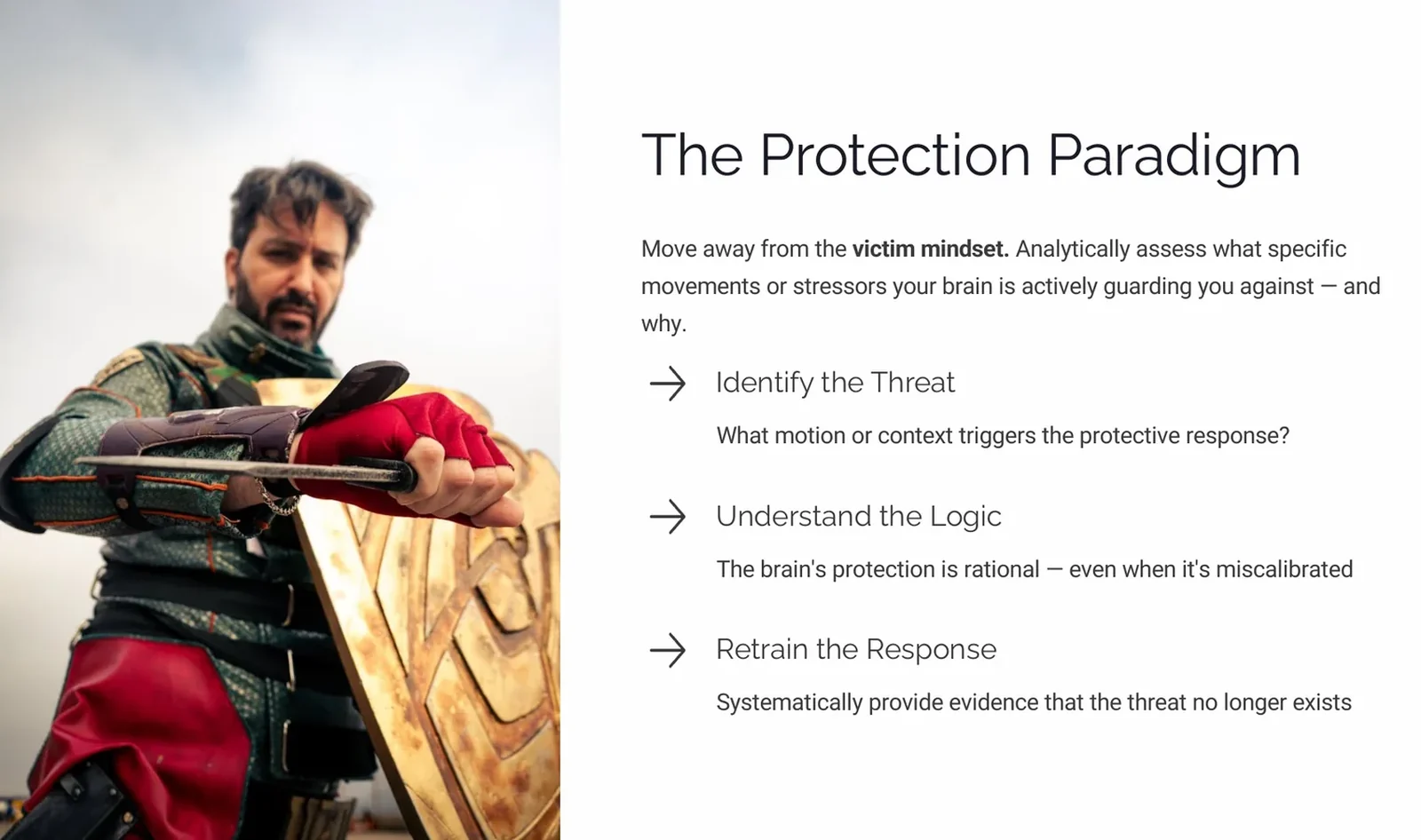
This means shifting from passive to analytical. Ask which movements or stressors your brain is guarding you against, and why:
- Identify the threat: which motion or setting sets off the protective response?
- Understand the logic: the brain’s protection makes sense, even when it is badly off target
- Retrain the response: step by step, give it proof the threat is gone
Your brain is not being irrational. It is working from out-of-date information.
Frequently asked questions
If pain is “just a signal,” does that mean it is not real or it is in my head?
No. This is the most important misunderstanding to clear up. Pain is always real and always made by the body. Calling pain an output of the nervous system, not a direct readout of tissue damage, describes where it is produced, not whether it is real. Central sensitization is measurable body science, not imagination.
Should I still have the injection if it is only temporary?
Often yes, if it is used correctly. A procedure creates a stretch of lower pain. In that stretch, movement retraining, sleep repair and lifestyle change become possible. Used that way, it is valuable. Used alone and repeated forever, it tends to buy less and less time. That decision belongs with your physician.
What if I cannot do the movement work because it hurts too much?
That is exactly what the window after a procedure is for. It is why the order of steps matters. Movement is modified, not avoided. That means smart changes to how you move, not total rest. A physician or physical therapist should set the starting point. The goal is a version you can do safely, not pushing through pain.
Does treating the metabolic side really change pain outcomes?
The case from the biology is strong. Inflammation makes the nervous system more sensitive and slows healing. That is the basis of how we practice. But it has not been proven in a randomized trial comparing procedures plus metabolic care against procedures alone. It is well-reasoned clinical practice, not a proven protocol. Individual results vary.
What exactly causes pain?
Pain is an output your brain makes after weighing evidence. It is not a direct readout from damaged tissue. Under that signal sits the terrain: inflammation, poor sleep, loads the body cannot bear, swinging blood sugar and nonstop stress. That is why tissue damage and pain level match far more loosely than most people expect.
Why does chronic pain never go away?
Usually because the conditions making it never changed. Treat the signal and leave the terrain alone, and every treatment works briefly before the pain returns. Your brain is also working from out-of-date information. Avoiding movement confirms its sense of threat. Modified movement, repeated, gives it proof the threat is gone.
How do you live with chronic pain?
Move from passive dependence to active participation. Stop chasing whichever spot hurts most today. Find the main signal driving the chain. Use any window of relief to fix movement patterns and rebuild sleep. Lower your baseline inflammation through diet, stress control and activity. And replace “my body is working against me” with “my nervous system is asking me to change something.”
Where is the practice located and how do I make an appointment?
Padda Institute Center for Interventional Pain Management, 4477 Woodson Rd, Suite 100, St. Louis, MO 63134, next to St. Louis Lambert International Airport, with a second location at 12174 Natural Bridge Rd, St. Louis, MO 63044, serving the St. Louis region across Missouri and Illinois. Call (314) 481-5000 or text (314) 886-5902, Monday to Friday, 8:00 AM to 5:00 PM.
Key takeaways
- Pain is an output the brain makes, not a direct readout of tissue damage.
- Treating the signal and ignoring the terrain is why relief keeps wearing off.
- A procedure buys a window of neurological quiet. That window is for movement, sleep and whole-body change.
- Avoiding movement confirms your brain’s sense of threat. Modified movement updates it.
- Chasing whichever spot hurts most starts a chain. Fixing the main signal does not.
This article is educational and is not a substitute for evaluation, diagnosis, or treatment by a physician. Individual results vary. Do not start, stop, or change any medication without consulting your physician. To be evaluated, request an appointment or call (314) 481-5000.
References
- Woolf CJ. Central sensitization: implications for the diagnosis and treatment of pain. Pain. 2011;152(3 Suppl):S2–S15.
Get evaluated by a physician who treats the terrain, not just the signal
Chronic pain, metabolic disease and trauma physiology reinforce each other. At the Padda Institute they are assessed together, because treating one alone underperforms.
Or call or text us.
Medically reviewed by Dr. Gurpreet Singh Padda, MD, MBA, MHP — Board Certified in Anesthesiology, Pain Medicine, Interventional Pain Management, Addiction Medicine, and Obesity Medicine. Last reviewed July 2026.
Dr. Gurpreet Singh Padda, MD, MBA, MHP