Persistent pain after total knee replacement is not one disease. It is a symptom with several drivers that overlap. Some are infection, loosening and nerve problems. Others are central sensitization and metabolic drivers. The work-up has to find which one dominates before anything is treated.
If you are dealing with persistent pain after total knee replacement, you are not “failing” your recovery. A systematic review looked at prospective studies in unselected patients. The share of patients reporting an unfavorable long-term pain outcome ranged from 10% to 34% after knee replacement.1 That range did not disappear because the incision closed.
What actually causes persistent pain after knee replacement?
The honest answer is that persistent pain after total knee replacement is not one disease. It is a symptom that several overlapping mechanisms can produce.
We usually sort the causes into four buckets, and your work-up should do the same.
- Mechanical or biological failure modes (infection, loosening, instability, poor alignment, implant wear, impingement, ongoing synovitis).
- Nerve and tissue interface problems (nerve pain patterns, painful scar or soft tissue, pain referred from the hip or spine, trapped nerves).
- Central sensitization and “pain loop” persistence (the nervous system turns up the volume, so normal movement or even mild inflammation feels like a threat).
- Metabolic and systemic pain drivers (poor sleep, diabetes physiology, weight-related inflammation, stress physiology, lost fitness).
In the clinic, the pattern matters, and it often looks like this. You can have “acceptable” imaging and still have lasting pain, because the signal pathway never shut off.
That is why we lean on the core idea of our chronic pain care, including hidden drivers of chronic pain. Pain is the signal, not the disease. What you do next depends on what the signal is doing.
How is persistent pain after knee replacement diagnosed?
You do not start with the biggest procedure. You start with the questions that tell you the most. Diagnosis is a sequence, not a single test.
The defensible sequence usually looks like this. It matters especially because persistent pain after total knee replacement can look alike across very different causes.
- History and timeline: When did the pain start? Did it change after PT milestones? Is it worse with weight-bearing, at rest, or at night? Is it sharp, burning, cramping, or electric?
- Rule out infection and mechanical complications: This usually means labs, imaging, and an orthopedic exam. If infection or loosening is a concern, interventional pain procedures are not the first move.
- Physical exam for stability and pain location: We check range of motion and swelling in the joint (effusion). We check ligament stability, how you walk, and where it is tender.
- Pain-source testing with targeted diagnostics: The goal is to find the main pain generator. Only then do we “treat the signal.” This is where nerve blocks can earn their place.
- Assess for central sensitization and neuropathic features: Is your pain out of proportion, widespread, or set off by light touch? Then the nervous system may be driving how strong it is.
- Screen for systemic and metabolic drivers: Diabetes physiology, insulin resistance, poor sleep, and low-grade inflammation can keep pain active.
This matches the logic behind the image-guided work-ups we use in interventional pain management and in chronic pain treatment. In both, we address the pain generator and central sensitization.
Can nerve blocks or radiofrequency ablation help pain after knee replacement?
Not every patient needs an interventional pain management procedure, or gains from one. But when the diagnostic logic is followed, persistent pain after total knee replacement can respond to targeted interventions.
The key rule is diagnosis first. Skipping the diagnostic step is how patients end up with procedures that were never going to work. That discipline matters in knee care, just as it does in the spine.
Genicular nerve block as a diagnostic step
Your main pain generator may sit around the knee joint. That pain travels on the genicular nerves (small sensory nerves around the knee). If so, a nerve block approach can clarify the target. A diagnostic block is not “treatment,” it is a question answered by your nervous system.
After a meaningful response to a diagnostic block, some patients qualify for longer-lasting options.
Genicular radiofrequency ablation for knee pain signals
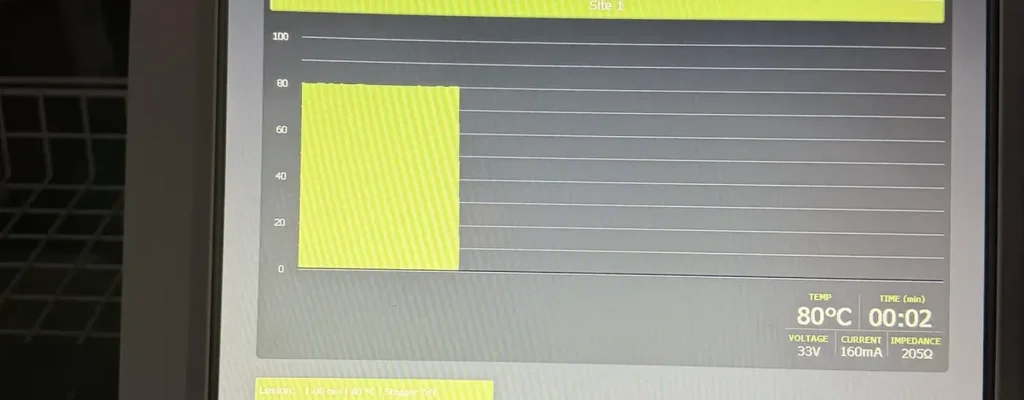
Radiofrequency ablation is one of the better-known interventional options for chronic knee pain. The goal is to interrupt pain signals by heating the targeted nerves (thermal lesioning).
The joint itself is untouched. Nothing is removed, replaced, or reconstructed. What changes is the message the knee is sending.
We prefer the same pattern we use elsewhere in interventional pain management: first, evidence that the nerve is the driver. Then, treatment that matches that driver.
To learn how this procedure is done and what evidence supports it, see genicular radiofrequency ablation.
When steroid injections or epidural steroid injection are not knee replacement “fixes”
Many patients come in asking about an epidural steroid injection approach or another steroid plan, because inflammation sounds like the obvious culprit. Steroids can help certain inflammatory or nerve root problems. But they are not a universal solvent for persistent pain after total knee replacement.
If your pain is coming from the knee itself, an epidural is usually not the right target. If the pain is coming from the spine, knee-focused treatments can waste time.
We treat central sensitization. That often means matching the injection to the correct anatomical driver, not to your fear.
Frequently asked questions
Why do I still have persistent pain after knee replacement even when my X-rays look fine?
Persistent pain after total knee replacement can remain even when imaging is “acceptable” on paper. The reason is that pain can be kept alive by nerve signals, central sensitization, and metabolic drivers. It is not just about how the hardware looks. A structured work-up should include a pain-source plan. It often starts with targeted diagnostic steps, not repeated blind procedures. See genicular nerve block for how this is evaluated.
Is a genicular nerve block or radiofrequency ablation worth it for persistent pain after knee replacement?
It can be worth it under two conditions. Your symptoms and exam suggest a peripheral knee pain generator, and diagnostic logic is used. In the right candidates, radiofrequency ablation follows a meaningful response to a nerve block step. That helps avoid “treating the signal” without evidence of the driver. See genicular radiofrequency ablation for how this is evaluated.
How long should I wait before I assume persistent pain after knee replacement is chronic pain?
Pain that persists for three months or longer is considered chronic pain. Many patients see symptoms settle and then plateau after that. Is your pain getting worse? Or is it staying severe well past the early recovery window? Then it is time for a diagnostic re-evaluation. See hidden drivers of chronic pain for how this is evaluated.
Can a spine problem cause persistent pain after knee replacement?
Yes. Pain referred from the hip or spine can mimic knee pain. Treating the wrong target can keep central sensitization running. This is one reason why interventional pain management evaluations stress diagnostic testing and anatomy matching. It is the same reasoning used in sciatica treatment. See electrodiagnostic testing for how this is evaluated.
What evidence supports chronic pain treatment approaches for persistent pain after knee replacement?
Evidence supports two points. A meaningful share of patients have chronic or persistent pain after TKA (total knee replacement). And timing and patient-reported pain patterns matter. But evidence is not a blank check. That is why we separate diagnostic steps from longer procedures. We also avoid claiming outcomes that studies do not actually establish. See counseling for chronic pain for how this is evaluated.
To discuss your own case, request an appointment through the appointment request form, call (314) 481-5000, or text (314) 886-5902. You can review the full range of pain treatments, read about the pain management doctors in St. Louis, or find both offices on the locations page.
Sources
- Beswick AD, Wylde V, Gooberman-Hill R, Blom A, Dieppe P. “What proportion of patients report long-term pain after total hip or knee replacement for osteoarthritis? A systematic review of prospective studies in unselected patients.” BMJ Open, 2012;2(1):e000435. doi:10.1136/bmjopen-2011-000435
Dr. Gurpreet Singh Padda, MD, MBA, MHP