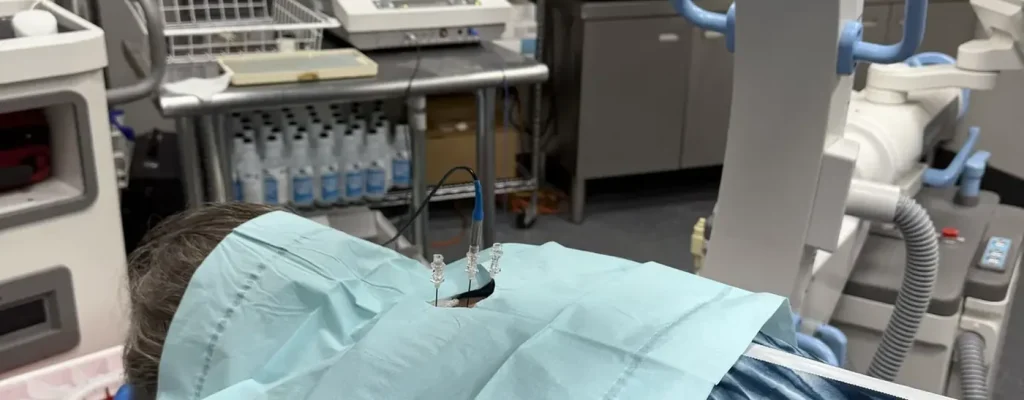
Provocative discography, or a discogram, injects contrast dye into a disc under fluoroscopy (live X-ray), then records it with CT. It tests whether that disc is the source of your pain. It settles one narrow question. It is not enough on its own to base treatment on. In 92 patients with chronic low back pain, it confirmed internal disc disruption (damage inside the disc) in 39%.1
One study looked at 92 patients in a row with chronic low back pain and no past lower back surgery. All of them had CT discography. The test criteria for internal disc disruption were fully met in 39%1. And none of the standard exam tests could tell those patients apart from the rest. That is a select group, not all back pain. It is exactly why discography keeps coming up when your pain cycles without a clear answer.
When is a discogram needed, and when is it not?
Picking the right patient is what makes it a sound test and not a costly detour. We do not use discography as a blanket test. We only consider it when the question is specific.
The same cited policy summary says lumbar provocative discography is medically necessary to check for disc disease in people with persistent, severe low back pain and abnormal interspaces on MRI. That applies after other tests have failed and when surgical intervention is being considered.
Also, discography is not advised as the only test behind a treatment choice. That matters because your plan has to pull together your symptoms, your exam, the mental factors that turn pain up, and how likely a given procedure is to hit the true pain source.
So the realistic expectation is not “discography proves everything.” The realistic expectation is “discography may clarify one piece of a difficult diagnostic puzzle.”
How is a discogram performed?
A discogram is invasive, meaning a needle goes into your body. We use fluoroscopy and sterile technique to guide the needle into the disc. Then we inject contrast dye in a controlled way.
One cited description of the procedure includes radiopaque contrasting materials (often 1 to 3 mL) injected into the disc between the vertebrae, followed by computed tomography (CT) to record it. Your exact steps can differ based on the facility’s imaging routine and the doctor’s preference.
Getting ready usually means holding certain medicines, confirming allergies, checking bleeding risk, and planning for watching you after the procedure. For the patient steps in one place, our service page outlines discogram testing, how to prepare, during the procedure, and after procedure.
What happens if a discogram shows the disc is causing your pain?
Discography is a fork in the road. It may suggest that one disc level is likely making the pain. If so, options may include targeted interventional pain care, a surgical consult, and structured rehab focused on movement control.
Disc pain also does not live alone. A patient can have disc pain and facet joint pain at the same time. Or disc pain plus central sensitization, where the nervous system turns up everything you feel. That is why we avoid the assembly line where you get “one test, one procedure” without a full workup.
When discography points away from the disc as the main source, we change course. For example, facet joint injection and other spine-targeted diagnostic blocks can help tell facet joint pain apart from discogenic low back pain.
If we are also checking other sources, you may want to read about facet joint injection and how that injection works as both a test and a treatment.
Frequently asked questions
Is provocative discography worth it?
It can be worth it only when it really changes a decision. That is usually in lasting, severe cases with abnormal disc levels, when surgery is on the table. Provocative discography for discogenic low back pain is invasive and not a stand-alone test. So the sound approach is to use it selectively, not routinely. See discogram testing for how this is evaluated.
What does a positive provocative discography result actually mean?
A positive result generally means the injection brought on your familiar pain at the targeted disc level. That backs the idea of disc-driven (discogenic) low back pain. But the result still has to fit your exam, your function, and whether other pain sources were ruled in or out. See what a discogram can establish for how this is evaluated.
How accurate is provocative discography compared with MRI?
Accuracy is complicated. MRI reading can give false positives and false negatives for internal disc disruption. Provocative discography for discogenic low back pain can add useful information. But it also has limits that keep it from replacing a doctor’s judgment. See facet joint injection for how this is evaluated.
What risks are associated with discogram testing?
Risks include infection, bleeding, disc irritation or injury, and a possible pain flare after provocative discography for discogenic low back pain. Any clinic offering the test should explain these risks clearly. It should also explain what happens if results are unclear. See epidural steroid injection for how this is evaluated.
How does provocative discography differ from nerve block or facet joint injection?
Provocative discography for discogenic low back pain targets the disc itself. It brings on symptoms with contrast under pressure. Nerve block or facet joint injection maps different pain sources and answers different questions. So they are not interchangeable. See failed back surgery syndrome for how this is evaluated.
What is discogenic back pain?
Discogenic back pain is low back pain that comes from damage inside a spinal disc. The disc itself is the pain source. In a study of 92 people with chronic low back pain and no prior spine surgery, 39% met the criteria for this internal disc disruption. It often sits alongside facet joint pain or central sensitization, so it is rarely the whole story.
How do I prepare for a discogram?
Getting ready usually means holding certain medicines, confirming any allergies, checking your bleeding risk, and planning for watching you after the procedure. The test is done with fluoroscopy and sterile technique, then documented with a CT scan. Our discogram service page walks through the steps before, during and after.
What if the discogram shows the disc is not the problem?
Then we change course instead of repeating the same path. A negative result points the search toward other pain sources. Facet joint injections and other targeted diagnostic blocks can tell facet joint pain apart from disc pain. We also check central sensitization as its own driver. The goal is still one clear answer about what is causing your pain before we choose treatment.
To discuss your own case, request an appointment through the appointment request form, call (314) 481-5000, or text (314) 886-5902. You can review the full range of pain treatments, read about the pain management doctors in St. Louis, or find both offices on the locations page.
Sources
- Schwarzer AC, Aprill CN, Derby R, Fortin J, Kine G, Bogduk N. “The prevalence and clinical features of internal disc disruption in patients with chronic low back pain.” Spine, 1995;20(17):1878–1883. Cross-sectional study, 92 consecutive patients. doi:10.1097/00007632-199509000-00007
Dr. Gurpreet Singh Padda, MD, MBA, MHP


