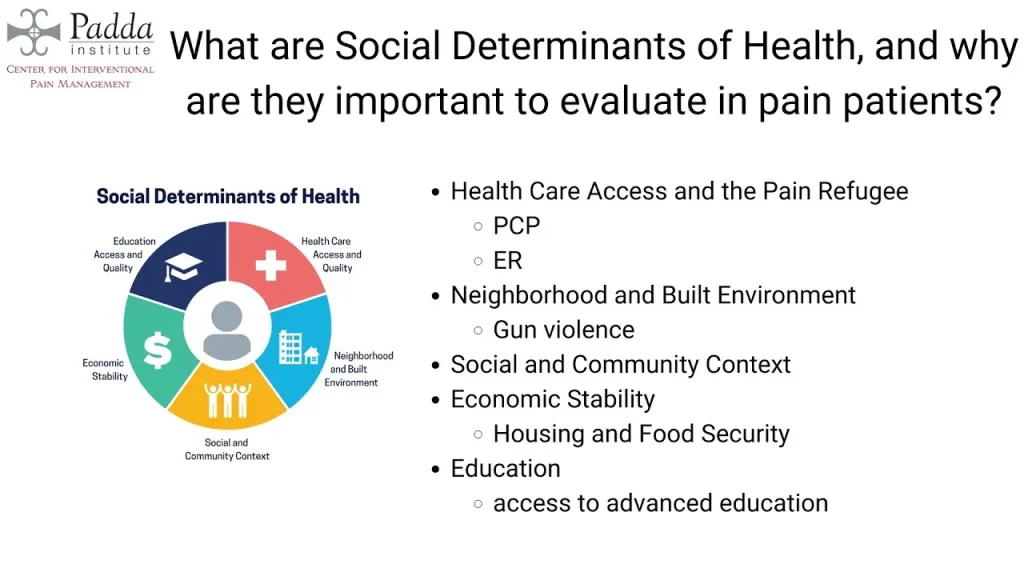
Your pain doctor asks about your neighborhood, your job and your church because those answers map your social determinants of health: access to care, neighborhood safety, community support, economic stability and education. These real-world conditions shape how you see your pain and your future. They also shape how well you do in the end.
If your pain doctor asks about your neighborhood, your job, or your church, the questions are not idle small talk. Dr. Padda explains that these side questions probe your social determinants of health—the real-world conditions that shape how you see your pain and your future, and how well you do in the end. This article walks through the five areas he asks about and why they matter. All of it comes from his talk.
How does access to health care affect chronic pain?
The first area is access to quality health care. Dr. Padda notes that most patients arrive already referred. That is because after the opioid crisis, many primary care doctors, emergency rooms, and orthopedic surgeons simply will not prescribe or manage complex pain. He estimates 75–90% of the patients he sees are these “pain refugees.” His point is not that they need a prescription. Often, if you treat the root biomechanical, psychosocial, or environmental cause, doses can be lowered or cut out over time.
How does your neighborhood affect your pain?
The second area is your neighborhood and built environment. Dr. Padda asks patients how safe their area is. Many have grown numb to it. They say their neighborhood is great, then mention hearing gunshots every night. He points to a study showing that in parts of St. Louis, living north of a certain point sharply lowers long-term survival. The reason is a constant risk of violence. Beyond the danger itself, an unsafe neighborhood keeps people from getting outside to walk, exercise, or get sun.
How do support, money and education shape pain?
Three more determinants round out the picture. Social and community support can collapse. He points to COVID lockdowns, when people could get alcohol delivered but could not reach their churches or friends. Economic stability suffers because pain raises the risk of divorce and of falling social and economic status. When one person has pain, he says the whole family unit is two-thirds more likely to become less economically productive. And education access matters. Chronic pain narrows your focus to today, so it is hard to invest in a better future.
How many pain patients face social determinants of health?
This is why the questions here go beyond your symptoms. Dr. Padda reports that in his clinic’s studies, more than 99% of patients have at least one or two of these social determinants, and about 70% have three or more—figures he notes may reflect his inner-city St. Louis practice, so each case is different. Once the team knows your access to care, your neighborhood, your support, your money, and your outlook, it can go after the real drivers of your pain. Not just the pain itself.
Frequently asked questions
Why does my pain doctor ask about my home, job, and neighborhood?
Dr. Padda explains that these questions uncover your social determinants of health. These are conditions like access to care, neighborhood safety, community support, economic stability, and education. They strongly shape pain outcomes. They may feel off topic, but they have a purpose, because they affect how you see your pain and your future. In his clinic, most patients have several of these factors at play. Each case is different.
What is a 'pain refugee'?
It is Dr. Padda's term for patients sent to him because their primary care doctor, emergency room, or surgeon will not manage their complex pain. He traces this pattern to the opioid crisis. He estimates 75 to 90% of the patients he sees fit this description. His aim is often to treat the root cause so that medication can be reduced or cut out over time.
Does this mean my pain medication will be changed?
Not necessarily. Dr. Padda's focus is on finding and treating the root cause. After that, some patients can lower or cut out doses. Do not start, stop, or change any medication without talking to your physician. Any change should be made with your doctor as part of a full plan. Results vary from person to person.
For why medication alone often does not resolve chronic pain, read Why Medications, Procedures, and Surgery May Not Fix Chronic Pain.
What are the 5 areas of social determinants of health?
Dr. Padda asks about five: access to quality health care, your neighborhood and built environment, social and community support, economic stability, and education access. Each one shapes how you see your pain and your future. An unsafe neighborhood keeps you from walking or getting sun. A lost support network leaves you alone. Money trouble or a narrowed focus makes it hard to invest in getting better.
What social issues affect health care for people in pain?
After the opioid crisis, many primary care doctors, emergency rooms and orthopedic surgeons stopped managing complex pain. So most patients now arrive already referred. Dr. Padda estimates 75 to 90% of the patients he sees are these pain refugees. Unsafe neighborhoods, being cut off from church and friends, and money strain on the whole family add to the problem.
Can an unsafe neighborhood make chronic pain worse?
Yes. Many patients say their neighborhood is great, then mention hearing gunshots every night. Dr. Padda points to a study showing that in parts of St. Louis, living north of a certain point sharply lowers long-term survival because of violence. Beyond the danger itself, an unsafe area keeps people from getting outside to walk, exercise or get sun. Recovery depends on all three.
Where are you located and how do I book?
Padda Institute Center for Interventional Pain Management, 4477 Woodson Rd, Suite 100, St. Louis, MO 63134. Book at painmd.tv/appointment/ or call (314) 481-5000.
Key takeaways
- Mechanism: social determinants—care access, neighborhood, support, money, and education—shape how you feel and recover from pain.
- Evidence status: a clinical framework Dr. Padda uses. The rates are what he sees in his own practice.
- Why it matters: an unsafe or isolating environment blocks the exercise, sun, and support that recovery depends on.
- Next step: expect these questions and answer them honestly—book at painmd.tv/appointment/.
This article is educational and is not a substitute for evaluation, diagnosis, or treatment by a physician. Individual results vary. Do not start, stop, or change any medication without consulting your physician.
Find the source of your pain — not just the signal
Padda Institute Center for Interventional Pain Management builds a customized, root-cause plan for each patient. Interventional care and metabolic medicine, under one roof in St. Louis.
Or call or text us — 4477 Woodson Rd, Suite 100, St. Louis, MO 63134.
Msg & data rates may apply. Reply STOP to opt out, HELP for help. Text is not a secure channel — please don’t send medical or personal health information by text, and don’t use text for emergencies.
Medically reviewed by Dr. Gurpreet Singh Padda, MD, MBA, MHP — Board Certified in Anesthesiology, Pain Medicine, Interventional Pain Management, Addiction Medicine, and Obesity Medicine. Last reviewed July 2026.
Dr. Gurpreet Singh Padda, MD, MBA, MHP