
Sugar, refined grain and industrial seed oil each harm metabolism by a different route. Refined carbohydrate raises blood sugar and the need for medication. Fructose worsens metabolic markers even when calories stay the same. And the linoleic acid in seed oils oxidizes (breaks down with oxygen) easily once it is stripped from the antioxidants that guard it in whole foods.
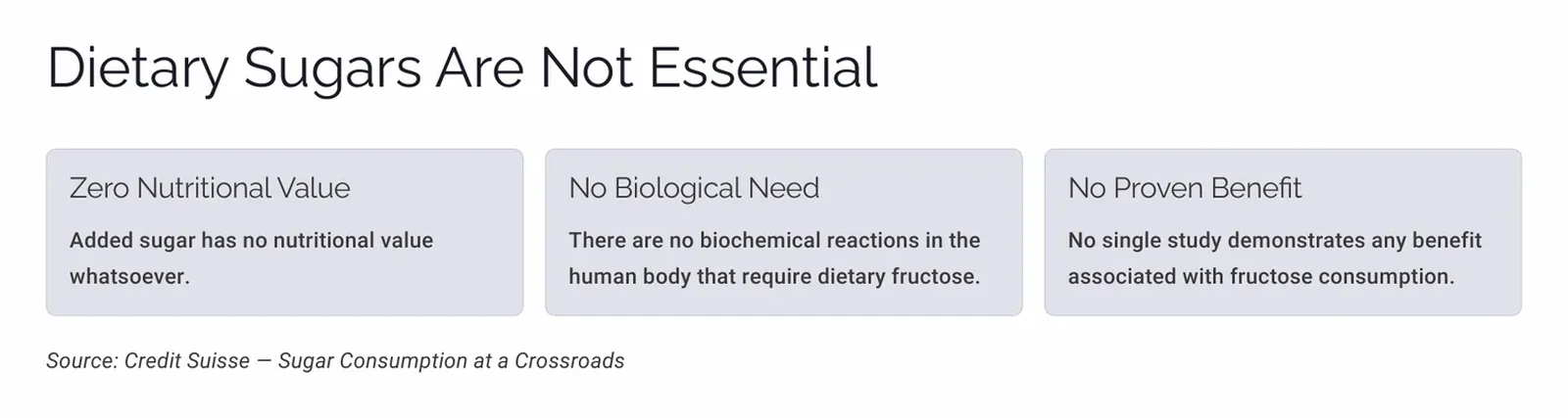
There is no such thing as an essential carbohydrate. No chemical reaction in the human body needs dietary fructose. Not one.
Every other class of major nutrient has essential forms. There are essential amino acids and essential fatty acids. Take those away and a person gets a deficiency disease. Added sugar has no essential form. You could cut it out entirely and develop no deficiency of any kind.
This article takes the three dietary drivers one at a time. It gives the mechanism for each. At the end, it gives an honest account of where this evidence is weaker than people usually claim.
Why is blood sugar a late warning sign?
Pre-diabetes and type 2 diabetes are diseases of insulin resistance. The order runs like this. First, the body makes too much insulin. Blood sugar rises later, once that backup system starts to fail.
So blood sugar is a late marker. Treating the sugar number without treating the insulin resistance under it is treating the smoke, not the fire.
Now set that beside standard diet advice for people with diabetes. It has long called for close to 55% of daily calories from carbohydrate, much of it starch. We tell people who process carbohydrate poorly to build their plate around it. Then we raise their medication when blood sugar climbs, just as the body’s chemistry predicts.
Refined carbohydrate raises blood sugar, raises the need for medication, and promotes weight gain. None of those three effects is in dispute.
Does cutting carbs lower blood sugar and diabetes medication?
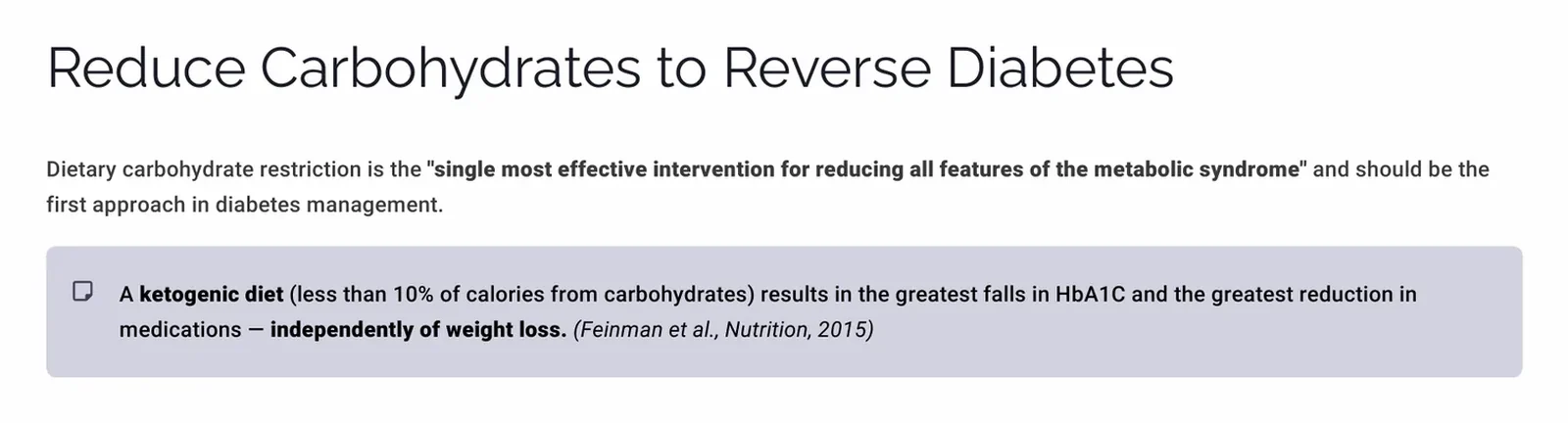
A 2015 position paper by Feinman and twenty-five co-authors argued that cutting dietary carbohydrate is the single most effective step for reducing the features of metabolic syndrome. It said this should be the first approach in managing type 2 diabetes.1
Below about 10% of calories from carbohydrate, a ketogenic range, the biggest drops in HbA1c (a three-month blood sugar average) and in medication needs are seen. And these drops happen independently of weight loss. The metabolic gain is not just a result of getting smaller. It comes from removing the input.
An honest caveat: this is a position paper. It is a careful argument built by a group of researchers, not a single randomized trial. Weigh it that way. The trial evidence behind it keeps getting stronger. But a position paper and an RCT are different things and deserve different trust.
A safety point that matters here. Cutting carbohydrate lowers blood sugar quickly. If you take insulin or a sulfonylurea, doing this without supervision risks hypoglycemia (low blood sugar). SGLT2 inhibitors carry a specific risk of euglycemic ketoacidosis. Medication doses often need to come down as the diet changes. Do not start, stop, or change any medication without consulting your physician.
Is sugar bad for you even when calories stay the same?
Robert Lustig holds that sugar adds to type 2 diabetes apart from its calories and apart from its effect on body weight.2
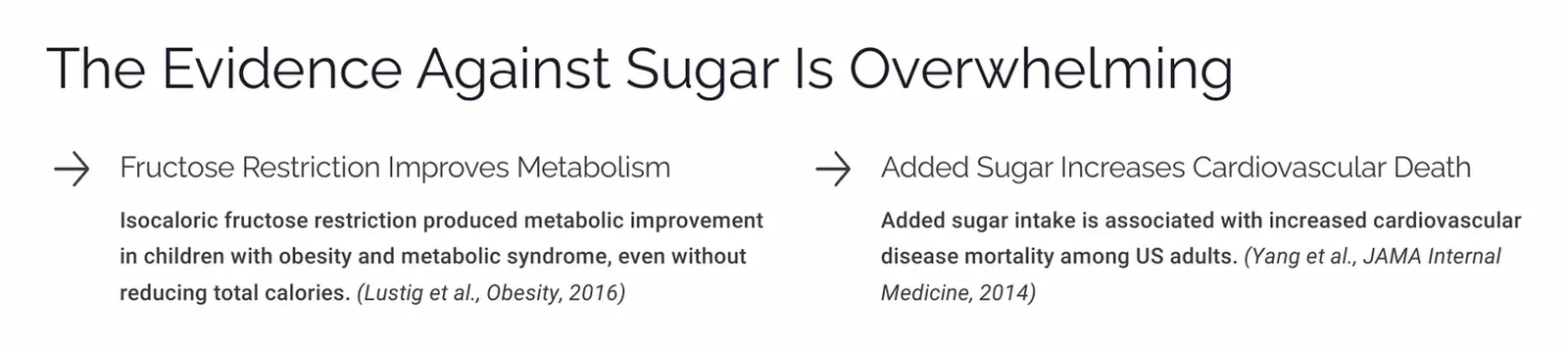
That is a strong claim, so look at the test behind it. Lustig’s group took children with obesity and metabolic syndrome. They cut fructose while keeping total calories the same. Same calories in. Weight held steady. The only thing changed was fructose. Within nine days, markers of metabolic health improved significantly.3
That is about as clean a test as nutrition research gets. When calories are fixed and one molecule is changed, whatever improves comes from that molecule.
Across whole populations, added sugar intake is associated with more deaths from heart and blood vessel disease among US adults. Higher intake went with higher death rates, step by step.4
Why are seed oils bad for you?
Industrial seed oils have been a real part of the human diet only since about 1917. Against two to three million years of human-ancestor eating, that is next to nothing.
The main concern is linoleic acid, the leading omega-6 fat in these oils. Linoleic acid is chemically fragile and oxidizes easily. That is why oils go rancid. And oxidation does not stop once you swallow.
Context matters a great deal. In whole foods like seeds, nuts, fish, and eggs, linoleic acid comes with vitamin E and other antioxidants that protect it. Extract it, heat it, deodorize it and bottle it, and that shield is gone. Meanwhile the fragile molecule gets concentrated.
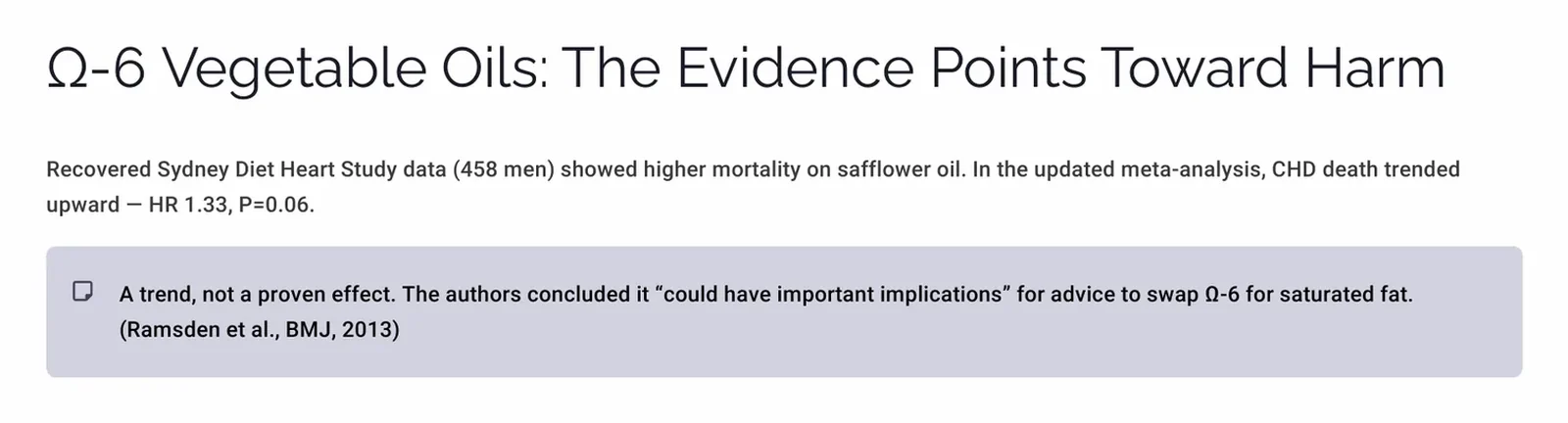
Ramsden and colleagues recovered lost data from the Sydney Diet Heart Study. In it, 458 men swapped saturated fat for safflower oil. Deaths in the oil group were higher than in controls. Those recovered data were then added to an updated meta-analysis of linoleic acid trials. The risk of death from coronary heart disease trended upward: hazard ratio 1.33, 95% confidence interval 0.99 to 1.79, P = 0.06.5
Look at deaths from every cause and the signal is plain: in the recovered Sydney data, 17.6% of the seed-oil group died against 11.8% of controls, a hazard ratio of 1.62. The Minnesota Coronary Experiment, recovered the same way, found cholesterol fell 13.8% on a seed-oil diet with no survival benefit. The authors concluded that the findings “could have important implications” for advice to swap omega-6 for saturated fat. The reviews that call seed oils harmless studied healthy people and left out the obese, insulin-resistant, diabetic and pain patients we treat.
What I will not claim about cancer
Older data suggested omega-6 oils were protective. But that data was confounded. It lumped omega-3 intake in with omega-6, and omega-3 was doing the work.
There are also older studies on cancer. The Los Angeles Veterans trial reported cancer deaths rising with omega-6 vegetable oil intake. Animal work shows omega-6 promoting tumors caused in the lab, while omega-3 holds them back.
Here I stop short of where this topic usually goes. You will hear “cancer is a metabolic disease” stated as settled. It is not. It is a serious minority theory still under active study. And the older cancer signals from these trials have not repeated cleanly.
What holds up is narrower and still worth acting on. Metabolic dysfunction and oxidized omega-6 products are plausible contributors to cancer risk. They are being actively studied. That is one more reason to remove these oils from your kitchen. A smaller true statement is worth more than a big one that cannot be defended.
The practical version, which foods to drop and in what order, is the eating protocol we teach in diet and metabolic health coaching for pain.
Frequently asked questions
Do I actually need any carbohydrate in my diet?
There is no established dietary need for carbohydrate. No biochemical reaction needs dietary fructose. That does not mean everyone should eat none. Carbohydrate tolerance varies widely from person to person. The real question is how much your metabolism handles well, and that is worth working out with a physician.
Is a ketogenic diet safe if I take diabetes medication?
Only with supervision. Cutting carbohydrate lowers blood sugar quickly. That can cause hypoglycemia if you take insulin or a sulfonylurea. SGLT2 inhibitors carry a risk of euglycemic ketoacidosis. Doses often need to come down as the diet changes. Do not start, stop, or change any medication without consulting your physician.
Is the evidence against seed oils strong enough to act on?
Yes. In Ramsden’s recovered Sydney Diet Heart Study data, men who swapped saturated fat for safflower oil died more often: 17.6% against 11.8% (hazard ratio 1.62). The updated meta-analysis put the coronary death hazard ratio at 1.33. The Minnesota Coronary Experiment found cholesterol fell 13.8% on a seed-oil diet with no survival benefit. Linoleic acid oxidizes easily, and the direction is the same across these trials.
Does sugar cause diabetes even if I am not overweight?
The isocaloric (same-calorie) fructose restriction study supports an effect apart from calories and weight. Metabolic markers improved in nine days with calories and weight held steady. Body weight is not the only pathway, though it is still an important one. Individual results vary.
Is it true that cancer is a metabolic disease?
That is a minority theory under study, not established fact. It should not be presented as settled. Metabolic dysfunction is a plausible contributor to cancer risk and is being actively studied. Any specific cancer question belongs with your oncologist.
Why are seed oils bad for you when seeds and nuts are fine?
Because the same linoleic acid acts differently inside and outside the food. In whole seeds, nuts, fish and eggs it comes with vitamin E and other antioxidants that protect it. Factory processing extracts it, heats it, deodorizes it and bottles it. That strips the shield away and concentrates a fragile fat that oxidizes easily. That is why bottled oils go rancid.
Should I stop using seed oils?
Yes. Removing industrial seed oils from your kitchen is the practice’s advice. They have been a real part of the human diet only since about 1917. Their linoleic acid oxidizes easily once it is stripped of its natural antioxidants. And oxidized omega-6 products are plausible contributors to disease. Whole foods such as seeds, nuts, fish and eggs still supply linoleic acid with its shield intact.
Why is everyone suddenly against seed oils?
Because recovered trial data changed the picture. Ramsden and colleagues recovered lost data from the Sydney Diet Heart Study. In it, 458 men swapped saturated fat for safflower oil, and deaths in the oil group were higher than in controls. Add a fat that oxidizes easily and has been in the human diet only since about 1917. The case for removing it is simple.
Where can I be evaluated for the metabolic side of this?
Padda Institute Center for Interventional Pain Management is at 4477 Woodson Rd, Suite 100, St. Louis, MO 63134, next to St. Louis Lambert International Airport, with a second location at 12174 Natural Bridge Rd, St. Louis, MO 63044. The practice serves the St. Louis region across Missouri and Illinois. Call (314) 481-5000 or text (314) 886-5902, Monday to Friday, 8:00 AM to 5:00 PM.
Key takeaways
- There is no essential dietary sugar. The body has no chemical need for fructose.
- Blood sugar is a late marker. Insulin resistance is the earlier and more treatable problem.
- Cutting carbohydrate brings the biggest drops in HbA1c and medication, apart from weight loss. This comes from a position paper, not a single trial.
- Cutting fructose while keeping calories and weight fixed improved metabolic markers in nine days.
- In the recovered Sydney Diet Heart data, the seed-oil group died more often: 17.6% against 11.8% (HR 1.62).
This article is educational and is not a substitute for evaluation, diagnosis, or treatment by a physician. Individual results vary. Do not start, stop, or change any medication without consulting your physician. To be evaluated, request an appointment or call (314) 481-5000.
References
- Feinman RD, Pogozelski WK, Astrup A, et al. Dietary carbohydrate restriction as the first approach in diabetes management: critical review and evidence base. Nutrition. 2015;31(1):1–13.
- Lustig RH. Sickeningly sweet: does sugar cause type 2 diabetes? Yes. Canadian Journal of Diabetes. 2016;40(4):282–286.
- Lustig RH, Mulligan K, Noworolski SM, et al. Isocaloric fructose restriction and metabolic improvement in children with obesity and metabolic syndrome. Obesity. 2016;24(2):453–460.
- Yang Q, Zhang Z, Gregg EW, et al. Added sugar intake and cardiovascular diseases mortality among US adults. JAMA Internal Medicine. 2014;174(4):516–524.
- Ramsden CE, Zamora D, Leelarthaepin B, et al. Use of dietary linoleic acid for secondary prevention of coronary heart disease and death: evaluation of recovered data from the Sydney Diet Heart Study and updated meta-analysis. BMJ. 2013;346:e8707.
Get evaluated by a physician who treats the terrain, not just the signal
Chronic pain, metabolic disease and trauma physiology reinforce each other. At the Padda Institute they are assessed together, because treating one alone underperforms.
Or call or text us.
Medically reviewed by Dr. Gurpreet Singh Padda, MD, MBA, MHP — Board Certified in Anesthesiology, Pain Medicine, Interventional Pain Management, Addiction Medicine, and Obesity Medicine. Last reviewed July 2026.
Dr. Gurpreet Singh Padda, MD, MBA, MHP