Waiting four, six, or eight weeks for pain treatment is not a scheduling matter: a body in sustained pain is changing, and measurably. Sustained pain costs deep sleep, which lowers pain threshold. It keeps cortisol high, which breaks down muscle. Longer-running pain tracks with reduced gray matter, and a longer first opioid episode predicts long-term use.
When someone in severe pain is told to wait four, six, or eight weeks for an appointment, that is usually treated as a scheduling matter. In the body, it is not. A body in sustained pain is not holding still while the line moves — it is changing, and several of those changes can be measured.
This article walks through what the published research says happens during that wait. It covers sleep, muscle, the brain, and the medication talk. Every figure below is cited to its primary source at the end.
▶ Watch the video:
What happens to your body when pain goes untreated?
Severe pain keeps the body’s stress system switched on: the sympathetic nervous system and the hypothalamic-pituitary-adrenal axis. The body raises cortisol. In short bursts that response is exactly right — it is how a person survives a real threat. Kept up for weeks, the same response stops protecting you and starts costing you.
Those costs are the subject of a large body of research, and they stack up. By the time a delayed appointment finally arrives, the clinical problem is often no longer the original problem alone.
Can losing deep sleep make pain worse?
Investigators at the University of Washington ran an unusually direct experiment. They recruited twelve healthy, middle-aged women who had no muscle discomfort to begin with. For three nights in a row, they selectively deprived them of slow-wave sleep. Whenever the delta waves that mark deep sleep appeared on EEG, a tone sounded until they went away. Total sleep time and sleep efficiency were left largely intact. Only the deep stage was disrupted.
After the third night, those healthy women showed a 24% decrease in musculoskeletal pain threshold, along with more discomfort, fatigue, less energy, and a greater inflammatory flare response in the skin.
The direction matters. This was not a study of people in pain who slept badly. These were people with no pain, made more pain-sensitive by losing one specific stage of sleep for three nights. Losing deep sleep does not just travel with pain — under test conditions it helps produce it.
Chronic pain reliably disrupts exactly that stage of sleep. So by week three of waiting, a clinician is no longer treating only the original injury or nerve problem. They are treating the original problem plus whatever the sleep loss has piled on top of it.
Can untreated pain cause muscle loss?
The same sustained cortisol response acts on skeletal muscle. High glucocorticoids (stress hormones like cortisol) slow the building of muscle protein and speed up its breakdown. This is well-mapped cell biology, reviewed in detail in the biochemical literature. It is not a guess.
Add the stillness that severe pain forces on you, and muscle mass and strength fall away together. Patients often apologize for this, as though getting weaker were a failure of will. It is not. When you report lost strength during a long wait, you are reporting a measurable change in the body with a known mechanism.
Can long-running pain show up on a brain scan?
Brain imaging work by Apkarian and colleagues, published in the Journal of Neuroscience, compared 26 people living with chronic back pain to matched control subjects. They used MRI and automated morphometry (computer measurement of brain structure).
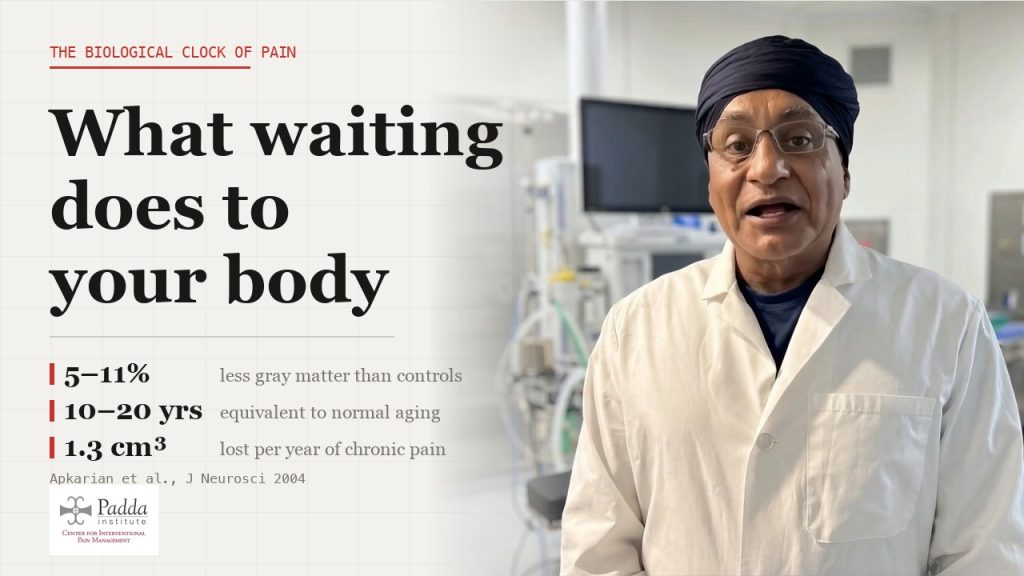
Patients with chronic back pain showed 5–11% less neocortical gray matter volume than the controls they were matched against. The authors put the size of it in a way that has stuck: it is equivalent to the gray matter volume lost in 10 to 20 years of normal aging.
The difference also tracked with how long the pain had been running — on the order of 1.3 cm³ of gray matter for every year of chronic pain. On voxel-based analysis, the loss was centered in the bilateral dorsolateral prefrontal cortex and the right thalamus. These regions help with working memory, planning and choices (executive function), and attention. They also help route sensory signals.
That matches what patients describe. Losing a thought. Walking into a room and forgetting why. Finding that easy decisions now wear you out. These are common reports during long waits, and they are not a character failure or an imagined symptom.
One honest caveat. This study compared groups at a single point in time and correlated the difference with pain duration. It establishes a strong association between longer-running chronic pain and reduced gray matter. A cross-sectional design of this kind cannot by itself prove the pain caused the loss. What it does establish is that chronic pain comes with structural brain differences that scale with duration — which is reason enough not to let the clock run longer than it has to.
Does waiting for treatment raise the risk of long-term opioid use?
When someone is left for weeks without a structural answer, medication often becomes the only thing getting them through the day. This is where the public conversation usually goes wrong, in one direction or the other. So it is worth being precise.
An analysis published in the CDC’s Morbidity and Mortality Weekly Report examined a large commercial prescription database. It asked a narrow question: among opioid-naive (never on opioids), cancer-free adults, what predicts still being on opioids a year after starting? The strongest signal was the length of the first episode. The chance of long-term use climbed with each added day of therapy, with the largest increments after the fifth day and again after the thirty-first.
That is not an argument for leaving pain untreated. Untreated severe pain carries its own risks, and several are described above. It is an argument for treating the structural cause early. That way, medication, if it is used at all, works as a bridge to a definitive treatment rather than becoming the treatment by default. Do not start, stop, or change any medication without consulting your physician.
The economic cost is not hypothetical
Gaskin and Richard, writing in the Journal of Pain, used the 2008 Medical Expenditure Panel Survey to estimate the total yearly cost of pain in the United States at $560 to $635 billion in 2010 dollars, affecting roughly 100 million adults. Lost worker output alone made up $299 to $335 billion of that.
For scale: by the same math, the yearly cost of pain was greater than that of heart disease ($309 billion), cancer ($243 billion), and diabetes ($188 billion). The authors called their own estimate conservative. It left out pain costs for nursing home residents, children, the military, and people in prison.
Those numbers are not there to alarm anyone. They measure, across the whole population, something each person goes through privately: waiting has a price, and it is not small.
The case for waiting lists, stated fairly
The other side of this deserves its strongest form. From a health-system view, waiting lists are not malice. They are triage under scarcity. Multi-week delays and authorization steps let institutions manage volume and control overhead. They also let problems that truly clear up on their own do so — and many problems really do resolve without treatment.
That logic is sound as system design. Where it fails is the single patient whose problem does not clear up on its own, and who is losing sleep, muscle, and clear thinking while the line moves. The longer someone stays out of work and out of function, the harder the return becomes — a pattern long known in occupational medicine. That is why we treat time as a clinical variable, not an administrative one.
When your pain belongs in an emergency room instead
Some pain is a true emergency. It belongs in an emergency department, not a pain clinic. Call 911 or go to the nearest emergency department for:
- Chest pain
- Stroke symptoms
- New loss of bladder or bowel control, numbness in the groin, or rapidly worsening leg weakness
- Fever together with severe spine pain
- Pain following a serious fall or collision
These need emergency imaging and stabilization. The Padda Institute is an interventional pain practice, not an emergency room.
Everything else here is about the far more common case. The pain is severe and urgent to the person living with it, but not immediately dangerous. Not sure which category you are in? The guide on what the emergency room can and cannot do for severe pain covers that decision in more detail.
What a same-day evaluation is actually for
The point of seeing someone quickly is not to hand out faster medication. It is to find the actual neuromuscular source of the signal and treat that source precisely. Then function comes back before the secondary changes pile up.
That means a diagnostic-first visit: history, examination, and, where needed, image-guided assessment to find the structure generating the pain. When a procedure is needed, we have a procedure suite and imaging on site. So it can often be done the same day rather than scheduled weeks out. That is the whole point of shortening the timeline.
Frequently asked questions
How long is too long to wait for pain treatment?
There is no single validated threshold, and any specific number would be made up. What the research does show is that the changes described above build up with time rather than appearing at a fixed cutoff. Sleep-related pain sensitization was measurable after three nights in an experimental setting. Gray matter differences scaled with years of pain. The practical point: severe pain that is not improving should be evaluated promptly, not watched for a set number of weeks.
Does chronic pain really change the brain?
Chronic back pain is associated with measurably less neocortical gray matter than in matched controls — 5 to 11 percent in the Apkarian study. The loss is centered in the dorsolateral prefrontal cortex and thalamus, and it scales with pain duration at roughly 1.3 cm³ per year. Because that study compared groups at one point in time, it shows a strong association rather than proving causation. It is enough to take the thinking problems patients report seriously. They are a physical finding, not something to dismiss.
Can lack of sleep actually cause pain, or is it just a consequence?
Both directions are real, but the causal arrow has been tested in one of them. Healthy women with no muscle pain were selectively deprived of deep slow-wave sleep for three nights in a row. Their musculoskeletal pain threshold dropped 24 percent, and they reported new discomfort and fatigue. Because the participants started without pain, that finding supports deep sleep loss contributing to pain, not only resulting from it.
Does this mean I should avoid pain medication?
No. Untreated severe pain carries its own documented harms, and this article is not an argument for enduring it. The MMWR analysis shows that the risk of long-term opioid use rises with the length of the first episode. The sharpest increases come after the fifth and thirty-first days. That argues for finding and treating the structural cause early, so medication does not become the long-term answer by default. Do not start, stop, or change any medication without consulting your physician.
What happens if chronic pain is left untreated?
It does not hold still. Sustained pain keeps cortisol high, and over weeks that response stops protecting you and starts costing you. Deep sleep is lost, which lowers your pain threshold. Muscle breaks down, and the immobility pain forces on you adds to the weakness. Longer-running pain tracks with reduced gray matter in regions tied to memory and attention. By the time a delayed appointment arrives, the problem is often no longer the original problem alone.
Is it normal to feel foggy and forgetful with chronic pain?
It is common, and it is not a character failure or an imagined symptom. Chronic back pain is associated with less gray matter in the dorsolateral prefrontal cortex and the thalamus. These regions help with working memory, attention and decisions. They also help route sensory signals. Patients describe losing a thought mid-sentence, walking into a room and forgetting why, or finding easy decisions exhausting. Those reports belong in your evaluation, not in the category of stress.
Do I need a referral to be seen quickly?
No. The Padda Institute holds same-day and emergency appointments open at its Woodson office in St. Louis, Missouri, next to St. Louis Lambert International Airport. You do not need to be an existing patient. Call (314) 481-5000 or text (314) 886-5902.
Key takeaways
- Sustained severe pain drives a long cortisol response that stops protecting you after the first days.
- Three nights of selective deep-sleep disruption lowered pain threshold 24% in healthy women. They started with no pain.
- High glucocorticoids slow muscle protein building and speed up breakdown. Add the stillness pain forces on you, and strength falls away.
- Chronic back pain is associated with 5–11% less neocortical gray matter than matched controls. The loss scales at about 1.3 cm³ per year of pain.
- Risk of long-term opioid use rises with the length of the first prescribing episode, sharply after days 5 and 31.
- Waiting lists are rational triage at the system level. They are a poor fit for the person whose problem will not clear up on its own.
- Chest pain, stroke symptoms, new bladder or bowel loss, groin numbness, worsening leg weakness, fever with spine pain, or pain after major trauma are emergencies. Call 911.
Severe pain that cannot wait weeks?
The Padda Institute holds same-day and urgent appointments at our Woodson office. No referral needed, and you do not need to be an existing patient. When a procedure is needed, we can often do it the same day.
Related reading
- Same-day & emergency visits — how urgent access works, and when to use the emergency room instead
- What the emergency room can and cannot do for severe pain — choosing the right door
- Interventional pain management — the diagnostic-first approach in full
- Why long-acting opioids can make pain worse — the receptor-level mechanism
Educational content only — not medical advice, and no doctor-patient relationship is created by this article. Individual results vary. Do not start, stop, or change any medication without consulting your physician. If you have symptoms of a medical emergency, call 911.
References
- Lentz MJ, Landis CA, Rothermel J, Shaver JL. Effects of selective slow wave sleep disruption on musculoskeletal pain and fatigue in middle aged women. J Rheumatol. 1999;26(7):1586–1592. PMID 10405949.
- Schakman O, Kalista S, Barbé C, Loumaye A, Thissen JP. Glucocorticoid-induced skeletal muscle atrophy. Int J Biochem Cell Biol. 2013;45(10):2163–2172. PMID 23806868.
- Apkarian AV, Sosa Y, Sonty S, Levy RM, Harden RN, Parrish TB, Gitelman DR. Chronic back pain is associated with decreased prefrontal and thalamic gray matter density. J Neurosci. 2004;24(46):10410–10415. PMID 15548656.
- Shah A, Hayes CJ, Martin BC. Characteristics of initial prescription episodes and likelihood of long-term opioid use — United States, 2006–2015. MMWR Morb Mortal Wkly Rep. 2017;66(10):265–269. PMID 28301454.
- Gaskin DJ, Richard P. The economic costs of pain in the United States. J Pain. 2012;13(8):715–724. PMID 22607834.
Medically reviewed by Dr. Gurpreet Singh Padda, MD, MBA, MHP, Padda Institute Center for Interventional Pain Management, St. Louis, Missouri.
Dr. Gurpreet Singh Padda, MD, MBA, MHP