If your legs start aching, cramping or going numb after a few minutes of walking, and the symptoms ease when you sit or lean forward over a shopping cart, that pattern points toward lumbar spinal stenosis. The relief when you lean forward is the useful clue. Pain from a narrowed spinal canal usually gets worse with standing or walking and better when you bend forward (flexion).1 Leg pain from the blood vessels does not act that way. That is why the question “does bending forward help?” is asked so early.
What is spinal stenosis?
Spinal stenosis happens when the spaces inside the spine narrow. It is most common in the lower back and neck. The narrowing puts pressure on the spine and nearby structures.1 For most people, symptoms start and get worse slowly over time. Some people have no symptoms at all.1
That last point matters when scans come up. Narrowing on a scan does not automatically explain your symptoms, because people who feel nothing have narrowing too.
What are the symptoms of spinal stenosis?
In the lower back
Lumbar symptoms include pain in the buttocks that spreads into the legs. It usually gets worse with standing or walking and better when you lean forward. Other symptoms are numbness, tingling or cramping in the legs and feet, which may get worse when standing or walking. Weakness in the legs and feet can also occur.1
People often describe a walking distance that shrinks over months. First it is comfortable for a block, then half a block, then only across a parking lot. Track that distance. It is a more honest measure of change than a pain score.
In the neck
Cervical (neck) stenosis may cause neck pain, numbness or tingling that runs down the arms into the hands, and weakness in a hand, arm or fingers.1 Hand symptoms from the neck are a different problem from a wrist problem, and the two are often confused.
Who gets spinal stenosis?
Anyone can get spinal stenosis, but the chance rises with age. It can also occur in younger people born with a narrow spinal canal or who have had a spine injury.1 Stenosis most often develops in the lumbar (low back) and cervical (neck) spine.1
How do you confirm stenosis is causing the leg pain?
Narrowing on scans is common and does not always cause symptoms. So the useful step is to test whether a specific level is causing your symptoms, rather than treating whatever the scan shows. A diagnostic block numbs one target and watches the result. Nerve conduction testing can tell a nerve root problem apart from a problem in a nerve farther out in the limb.
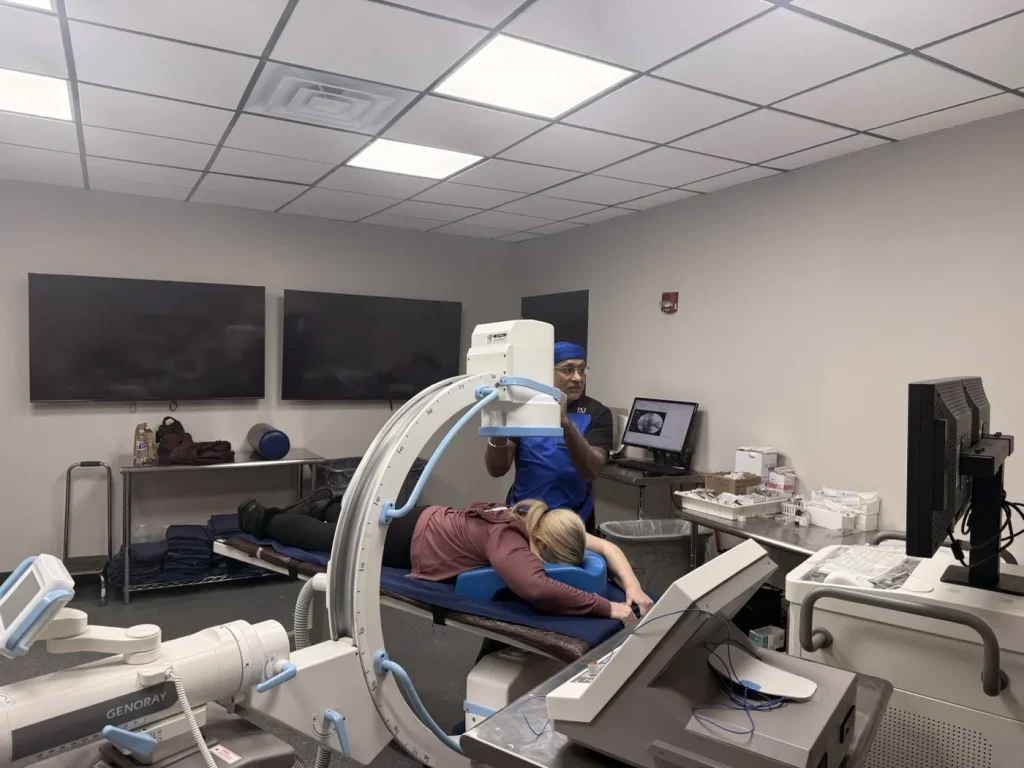
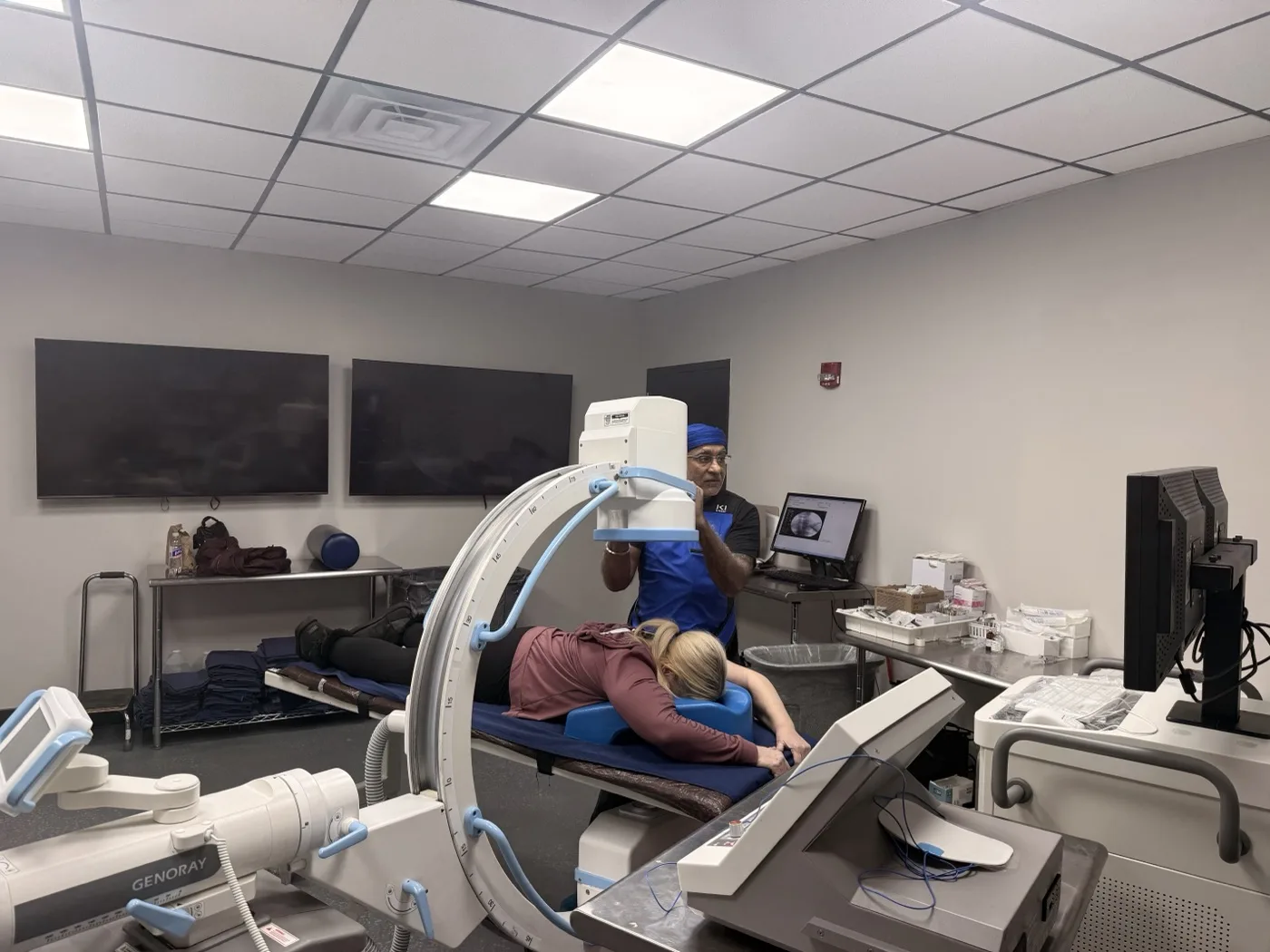
The practice’s approach to this is described under electrodiagnostic testing, selective nerve root block and epidural steroid injection. Where scarring from previous surgery is part of the picture, epidural lysis of adhesions and failed back surgery syndrome are the relevant pages.
Why scans alone cannot prove the cause is covered in what imaging can and cannot show about pain.
Frequently asked questions
Why does leaning forward on a cart make my legs feel better?
Bending forward (flexion) opens space in the lumbar canal. Stenosis symptoms typically get worse with standing or walking and better with leaning forward. That pattern is one of the more useful clues in your history. Evaluation options are described on the pain treatments page.
My scan shows stenosis. Does that explain my pain?
Not necessarily. Narrowing gets worse slowly, and some people with it have no symptoms at all. So a scan finding has to be matched to your symptom pattern and often tested directly. See what imaging can and cannot show about pain.
Is numbness in my hands coming from my neck?
It can be. Cervical stenosis may cause numbness or tingling that runs down the arms into the hands, along with weakness in a hand, arm or fingers. That is different from a wrist-level problem. Nerve testing can tell them apart — see electrodiagnostic testing.
Am I too young for this?
Not necessarily. Risk rises with age, but stenosis also occurs in younger people born with a narrow spinal canal or who have had a spine injury. You can arrange an evaluation through the appointment request form.
Do I have to have surgery?
That is a decision you make with your surgeon. It is not decided in advance. Image-guided options aimed at a confirmed target are described across the range of pain treatments.
What is the difference between neurogenic claudication and spinal stenosis?
Neurogenic claudication is the medical name for the walking pattern this page describes. It means aching, cramping or numbness in the buttocks and legs that comes on with standing or walking and eases when you sit or lean forward. Spinal stenosis is the cause behind it. It is a narrowing of the spaces inside the spine that puts pressure on the spine and its nerves. One is the symptom. The other is the narrowing that causes it.
Is leg pain when walking from my spine or from poor circulation?
The clue is what makes it stop. Leg pain from narrowing in the lower spine gets worse with standing or walking. It eases when you sit or bend forward, such as leaning over a shopping cart. Leg pain from the blood vessels does not act that way. That is why the question “does bending forward help?” is asked so early in an evaluation.
To have walking-related leg pain evaluated, request an appointment, call (314) 481-5000, or text (314) 886-5902.
Sources
- National Institute of Arthritis and Musculoskeletal and Skin Diseases. Spinal Stenosis: Symptoms, Causes & Risk Factors. National Institutes of Health. Accessed August 12, 2026. NIAMS — Spinal Stenosis
Dr. Gurpreet Singh Padda, MD, MBA, MHP