Trauma, as Dr. Padda defines it in clinic, is a permanent change in behavior that follows an aversive event: something happened that you wish had not happened. You measure it by how you act afterward. Not by how big the event was, or how scared you felt. And it is just as often driven by everyday stress that piles up as by disaster.
This article talks about trauma in plain, flat, technical words on purpose. That is a clinical choice. It is not coldness.
When a traumatic event is described precisely, its power over the nervous system is reduced. That is the method. It is not a way of saying that what happened to you was small.
Pain is a signal, not a sentence
Pain — physical or psychological — is not a verdict on your future. It is information that the body’s terrain has drifted out of balance, and terrain can be changed.
Three premises follow, and everything else rests on them:
- Your experience is valid and it is measurable. Those are not in tension.
- Signals that can be measured can be changed.
- You are capable of becoming a technician of your own recovery.
What qualifies as trauma?
Standard care often falls back on repeating the same steps: injections, drugs, referrals. Mostly, that is because insurance pays for them. That approach ignores the metabolic and nervous system imbalance that lets pain and trauma become chronic.
There is a second blind spot. People tend to save the word “trauma” for huge events: combat, assault, a terrible accident. In the clinic, trauma is just as often driven by everyday stress that piles up. A marriage ending. Money pressure that never lets up. Long stretches of being alone.
The terrain matters as much as the trigger. Two people can experience the same event and only one develops persistent symptoms, and the difference usually lies in the terrain rather than the event.
Defining the aversive stimulus
An aversive stimulus is an event that went against what you wanted. Something happened that you wish had not happened.
That is plain on purpose, and it does not shrink what happened. It is a technical redefinition meant to hand control back to you.
Strip the mystery and moral weight from a painful event and name it exactly. Then its emotional hold on the nervous system starts to weaken. The vaguer and bigger a thing stays, the more room it has to work on you.
This is the first step in what I call behavior reification: turning inner suffering into something you can see, measure and therefore change.
What is the behavioral definition of trauma?
Here is how I define trauma in clinic. I want to flag clearly that this is my own operational framework, not a DSM-5 criterion or a consensus clinical definition. It is how I make trauma tractable.
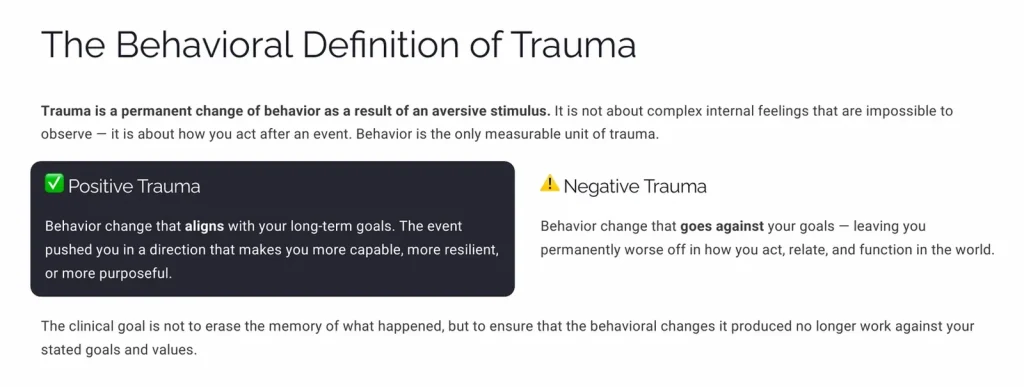
Trauma is a permanent change of behavior resulting from an aversive stimulus.
Not the inner feelings, which neither of us can see or measure directly. What counts is how you act afterward. Behavior is the unit we measure.
That definition leads to something most people find surprising. Trauma can run in either direction.
Positive trauma is behavior change that aligns with your long-term goals. The event moved you toward becoming more capable, more resilient, or more purposeful. This happens, and it is real.
Negative trauma is behavior change that runs against your goals. It leaves you worse off in how you act, relate and function.
The clinical goal is not to erase the memory. That is not achievable and arguably not desirable. The goal is that the behavioral changes it produced stop working against your own stated goals and values.
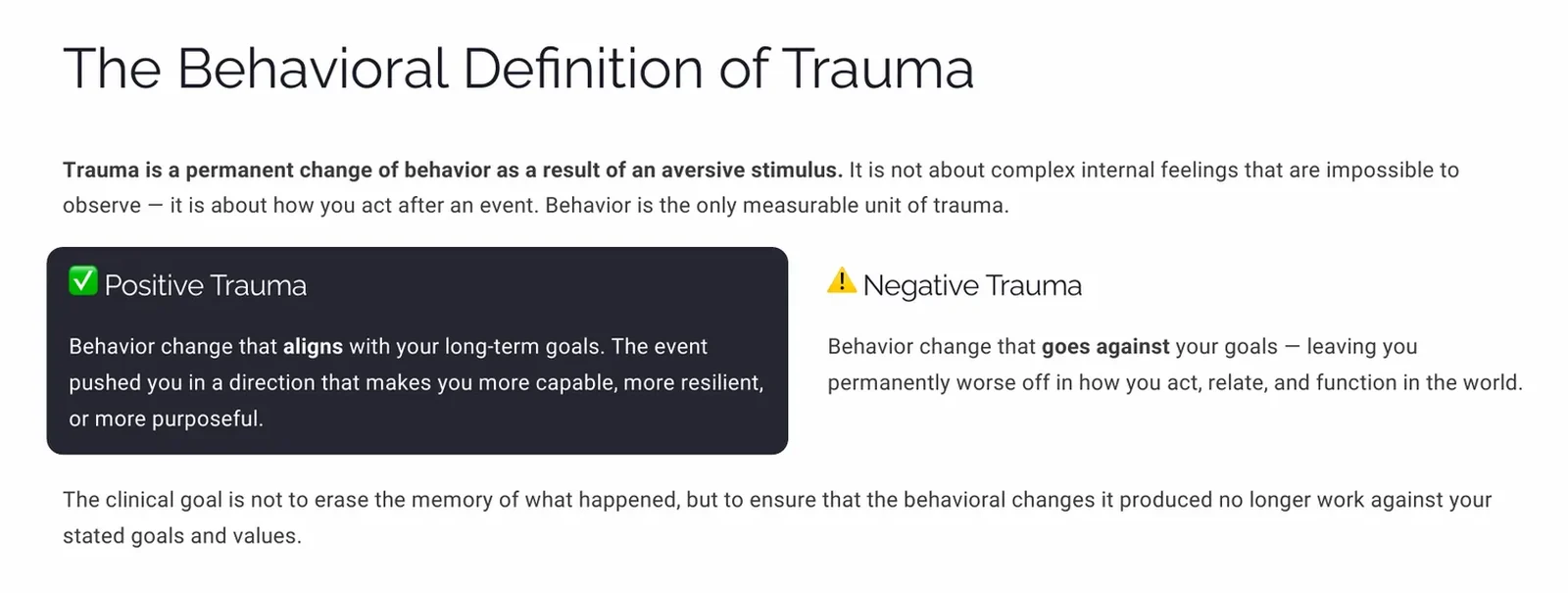
Every generation has tried to make trauma concrete
The history is a steady push toward things we can measure.
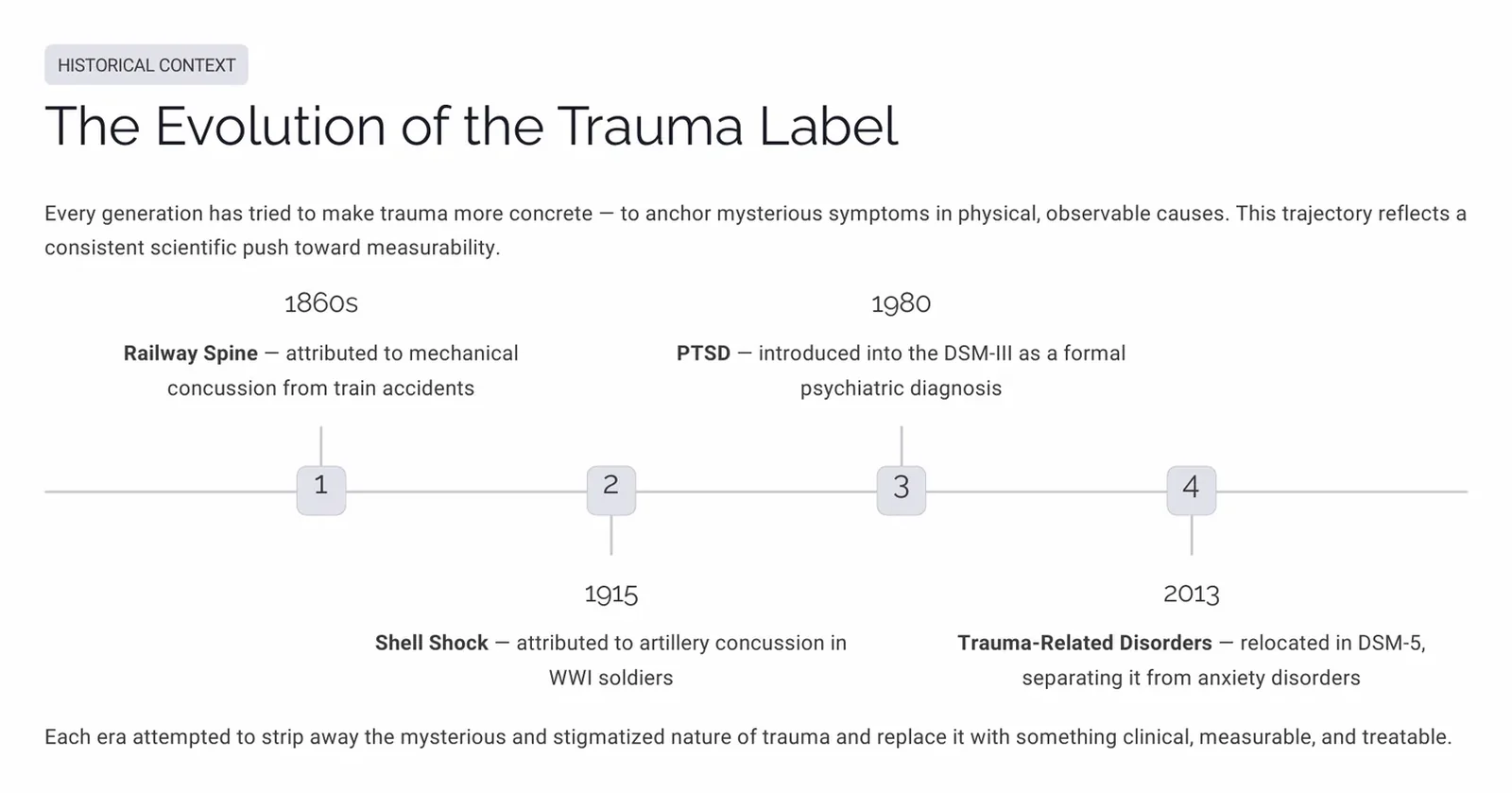
- 1860s — railway spine. Symptoms after train wrecks were blamed on the spinal cord being jarred.
- 1915 — shell shock. Symptoms in soldiers were blamed on the jolt of artillery blasts.
- 1980 — PTSD enters the DSM-III as a formal psychiatric diagnosis. Vietnam veterans pushed it there, along with the clinicians who refused to let their symptoms be dismissed.
- 2013 — DSM-5 moves it into its own category, trauma- and stressor-related disorders. That splits it off from the anxiety disorders.
Each era tried to swap something mysterious and shameful for something clinical, measurable and treatable.
The 2013 change almost nobody outside psychiatry knows about
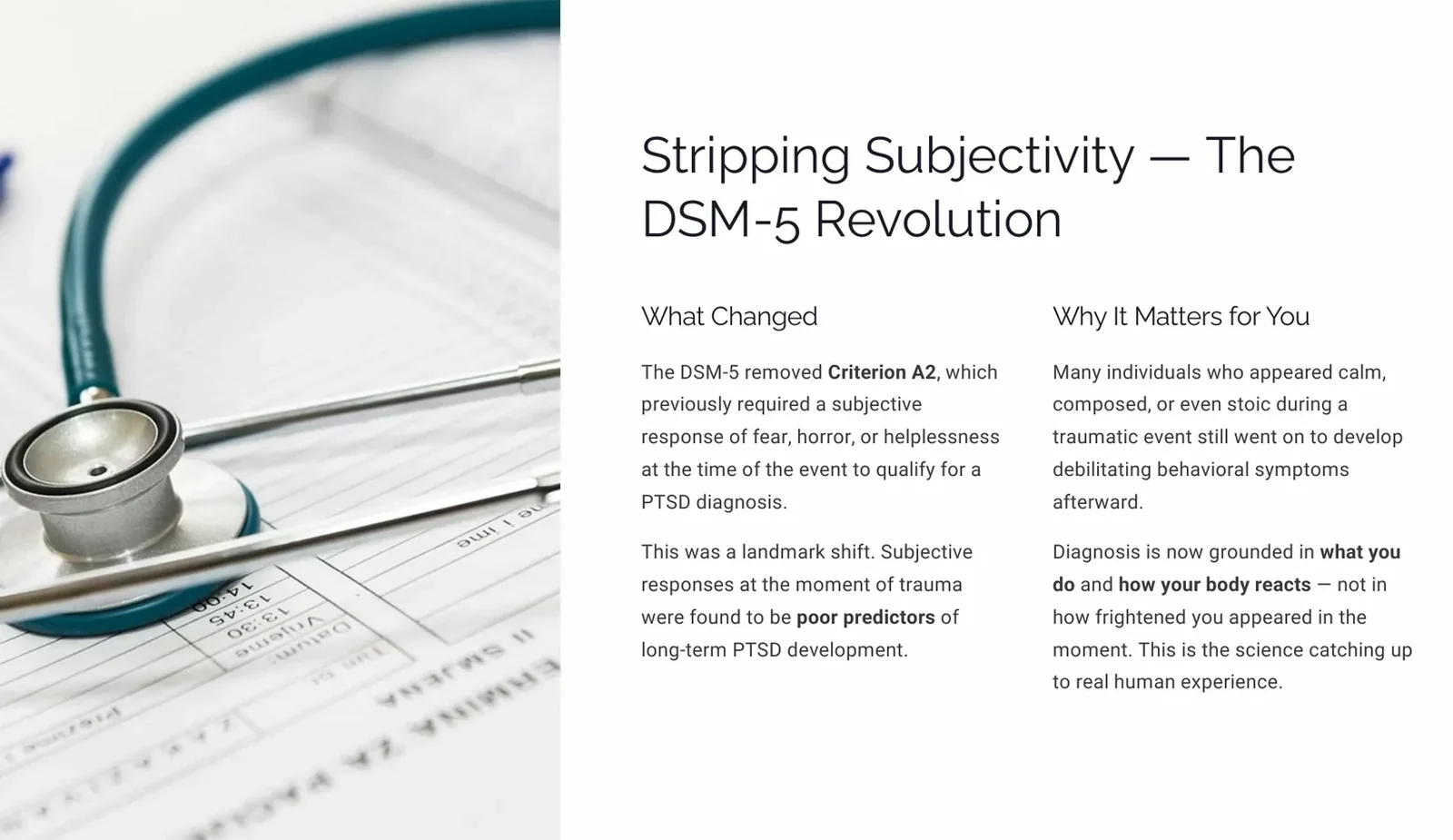
DSM-5 removed Criterion A2. Under the old rules, a PTSD diagnosis required that you felt fear, helplessness or horror at the time of the event.
That rule was dropped because how you felt in the moment turned out to be a poor predictor of who gets PTSD later.
Think about who the old rule left out. Soldiers, first responders and medical staff. And a great many ordinary people who stayed calm, even stoic, during the event, by training or by nature. Months later, many of them developed severe behavior symptoms.
Under the old criteria, their composure counted against them.
Diagnosis is now grounded in what you do and how your body reacts, not in how frightened you appeared at the time.
What are the signs of trauma?
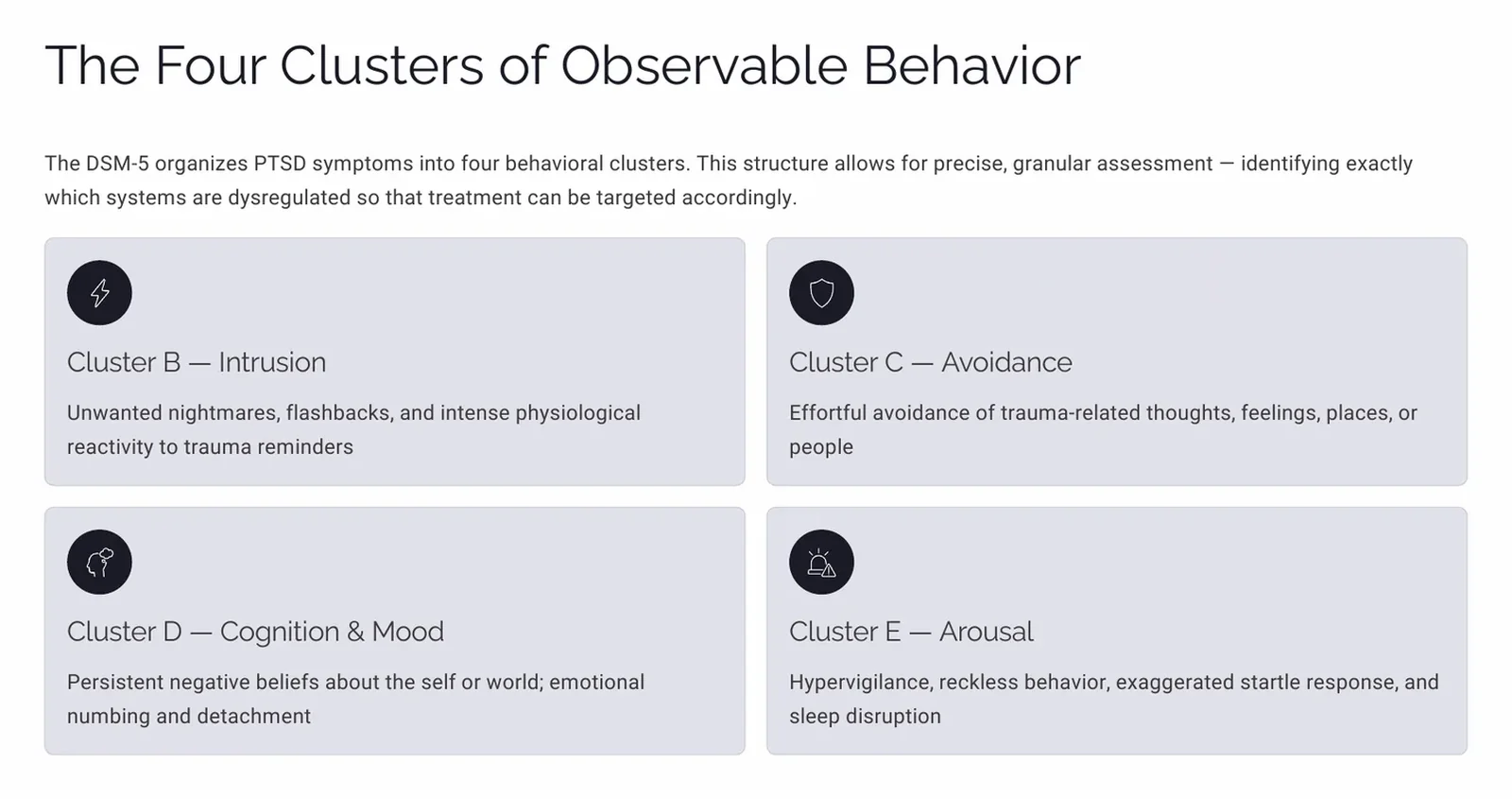
DSM-5 sorts symptoms into four behavior clusters. That allows exact assessment. It shows which systems are out of balance, so treatment can target them.
- Cluster B — Intrusion. Unwanted nightmares, flashbacks, and strong body reactions to reminders.
- Cluster C — Avoidance. Working hard to avoid thoughts, feelings, places or people tied to the trauma.
- Cluster D — Negative changes in thinking and mood. Lasting dark beliefs about yourself or the world, emotional numbness, feeling cut off.
- Cluster E — Arousal and reactivity. Always on guard, reckless behavior, jumping at small sounds, broken sleep.
All four are described in terms of observable behavior. That is what makes them targets rather than descriptions.
Frequently asked questions
Can I have PTSD if I stayed calm during the event?
Yes. DSM-5 removed Criterion A2 in 2013. That was the rule that you had to feel fear, helplessness or horror during the event. It was dropped because how you felt in the moment poorly predicted who got PTSD later. Many people who stayed calm or stoic at the time developed serious symptoms afterward.
Does trauma require a major catastrophic event?
No. Everyday stress that piles up, like a relationship ending, steady money pressure or being alone, causes lasting symptoms as reliably as huge events in clinical practice. The terrain a person lives in matters as much as the trigger itself.
Is “positive trauma” a recognized clinical term?
No, and it is important to be clear about that. The behavior-based definition of trauma used here, and the positive/negative split, are Dr. Padda’s own working framework for measuring trauma in clinic. They are not DSM-5 criteria or agreed-upon definitions. Related research on post-traumatic growth exists, but it is a separate body of work.
Does defining trauma by behavior mean my feelings do not matter?
No. It means behavior is what can be measured and tracked, so progress becomes visible instead of a guess. Feelings are real and matter in the clinic. They just can’t be seen from the outside. That makes them a poor yardstick for measuring how treatment is working.
Do I have trauma or am I overreacting?
Look at what you do, not at how big the event seems. By this behavioral definition, trauma is a lasting change in how you act, relate and function after something you wish had not happened. If that change runs against your own goals, it counts, whether the cause was combat or years of financial pressure. Tracking the behavior answers the question better than judging your feelings.
How do you deal with trauma?
Start by naming the event exactly and plainly. Stripping away its mystery weakens its emotional hold on the nervous system. Then turn the suffering into behavior you can see and track. The goal is not to erase the memory, which can’t be done. The goal is to stop the behavior changes it caused from working against your own goals and values.
Where can I be evaluated, and what if I am in crisis right now?
If you are in crisis, call or text 988 — the Suicide & Crisis Lifeline — or go to your nearest emergency department. For evaluation, Padda Institute Center for Interventional Pain Management is at 4477 Woodson Rd, Suite 100, St. Louis, MO 63134, next to St. Louis Lambert International Airport, with a second location at 12174 Natural Bridge Rd, St. Louis, MO 63044, serving the St. Louis region across Missouri and Illinois. Call (314) 481-5000 or text (314) 886-5902, Monday to Friday, 8:00 AM to 5:00 PM.
Key takeaways
- Exact, unemotional words about an event weaken its hold on the nervous system. That is the method, not dismissal.
- Everyday stress that piles up causes trauma as reliably as disasters do. The terrain matters as much as the trigger.
- Defining trauma by behavior change makes it measurable — this is Dr. Padda’s framework, not a DSM criterion.
- DSM-5 dropped the rule that you had to feel fear during the event, because it poorly predicted who got PTSD.
- The four clusters, intrusion, avoidance, thinking and mood, and arousal, are all defined by behavior. That makes them targets.
If you are in crisis, call or text 988 — the Suicide & Crisis Lifeline — or go to your nearest emergency department.
This article is educational and is not a substitute for evaluation, diagnosis, or treatment by a physician or qualified mental health clinician. Individual results vary. Do not start, stop, or change any medication without consulting your physician. If you are in crisis, call or text 988. To be evaluated, request an appointment or call (314) 481-5000.
References
- American Psychiatric Association. Diagnostic and Statistical Manual of Mental Disorders, Fifth Edition (DSM-5). Arlington, VA: American Psychiatric Publishing; 2013.
- Erichsen JE. On Railway and Other Injuries of the Nervous System. London: Walton and Maberly; 1866.
- Myers CS. A contribution to the study of shell shock. The Lancet. 1915;185(4772):316–320.
Get evaluated by a physician who treats the terrain, not just the signal
Chronic pain, metabolic disease and trauma physiology reinforce each other. At the Padda Institute they are assessed together, because treating one alone underperforms.
Or call or text us.
Medically reviewed by Dr. Gurpreet Singh Padda, MD, MBA, MHP — Board Certified in Anesthesiology, Pain Medicine, Interventional Pain Management, Addiction Medicine, and Obesity Medicine. Last reviewed July 2026.
Dr. Gurpreet Singh Padda, MD, MBA, MHP