PTSD recovery can be measured, and you cannot improve what you cannot measure. This article makes recovery measurable. It covers three parts of resilience you can check in yourself and the proven tool used to track change. It also covers the one factor that predicts long-term distress better than how bad the event was.
What parts of trauma resilience can you actually measure?
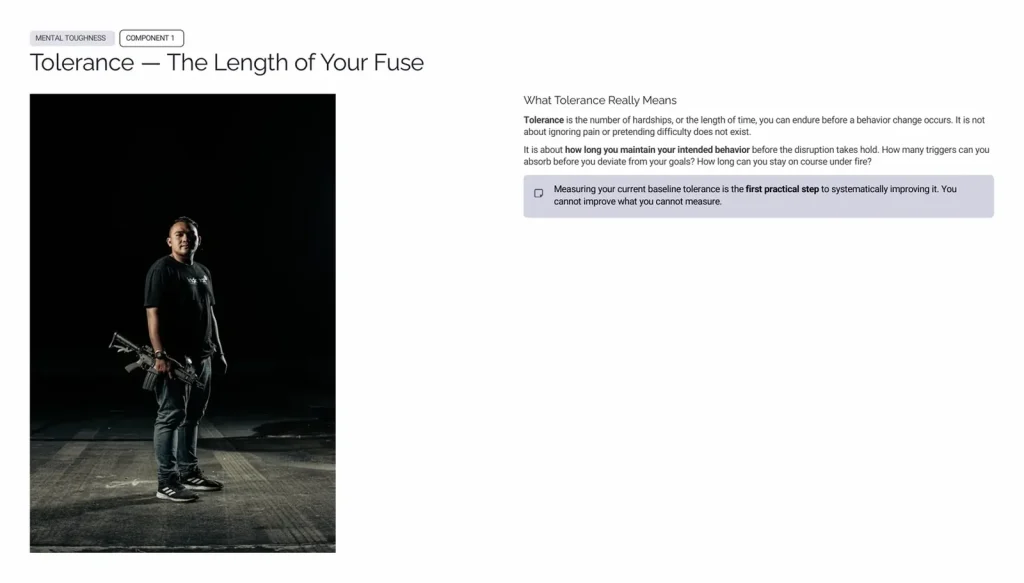
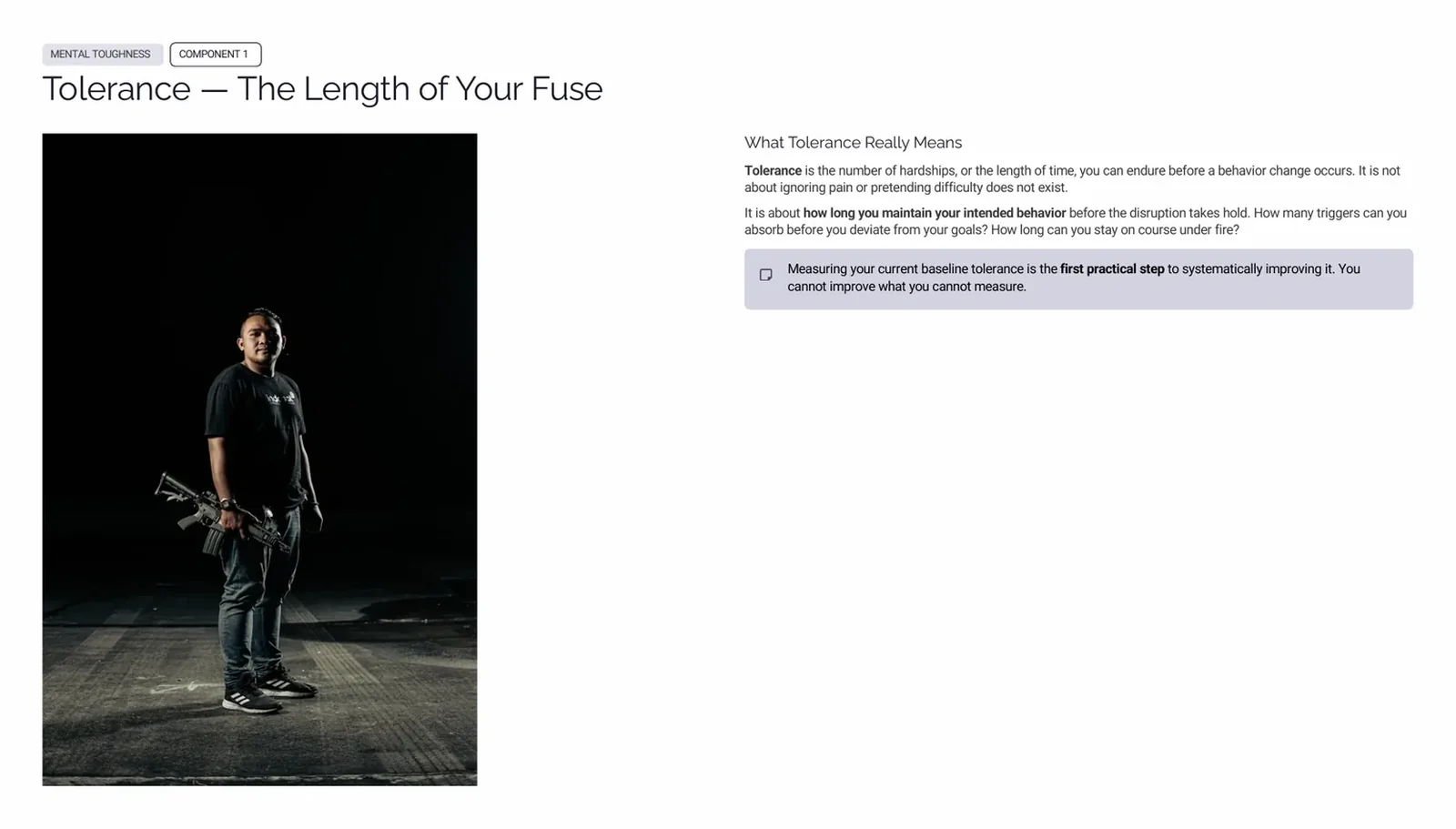
Tolerance — the length of your fuse. Tolerance is how many hardships, or how much time, you can take before your behavior changes.
It is not about ignoring pain or pretending hard things do not exist. “Mental toughness” is often used to mean bottling it up, and bottling it up is not this. Tolerance is how long you keep up the behavior you intend before disruption takes hold. How many triggers can you absorb before you stray from your goals?
Notice this can be counted. And measuring where you start is the first practical step to improving it. “I need to be tougher” is not something you can act on. “I currently deviate after the second trigger” is.
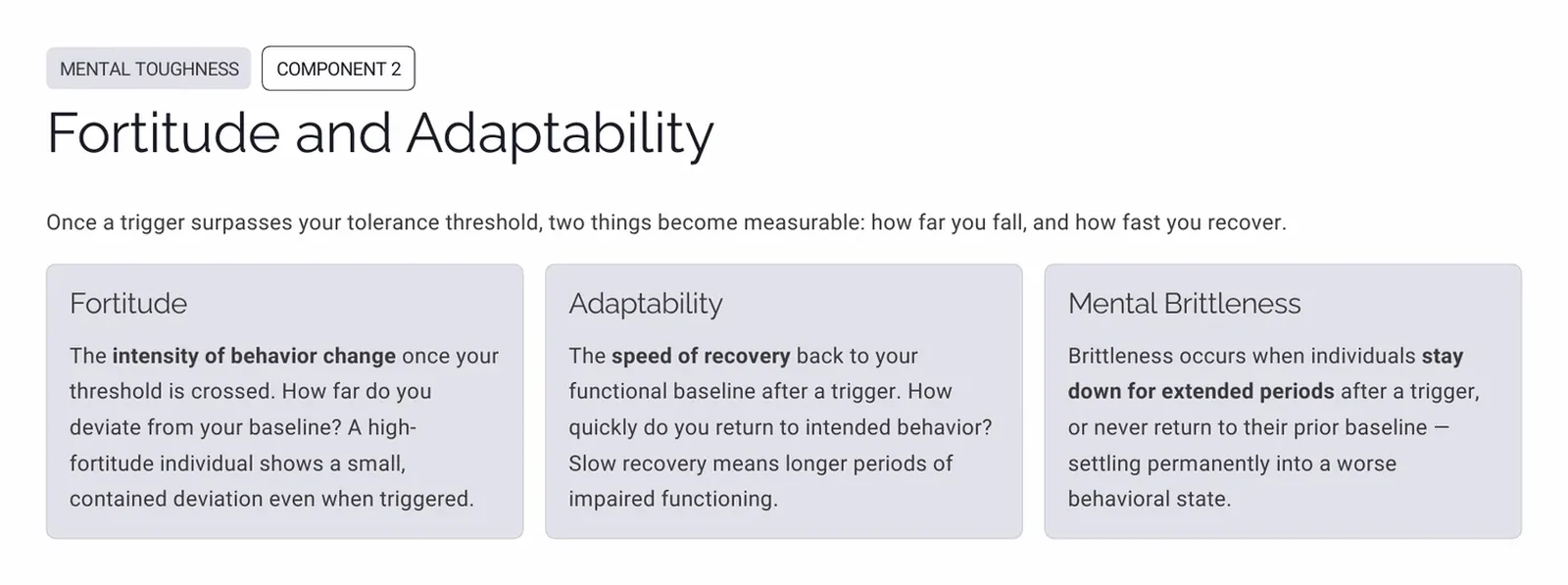
Fortitude — how far you fall. Once a trigger passes your tolerance limit, fortitude is how big the behavior change is. A person with high fortitude shows a small, contained slip even when truly triggered. They are not unaffected. The effect just has limits.
Adaptability — how fast you return. This is how fast you recover back to your normal level of function. Slow recovery means longer stretches of poor functioning. If triggers come faster than you recover, you never get back to baseline.
The failure mode is brittleness. That means staying down for long stretches after a trigger. Or never returning to your old baseline and settling for good into a worse state.
Three numbers. How long before you break, how far you fall, how fast you come back. All three can be trained.
How do you interpret PCL-5 scores?
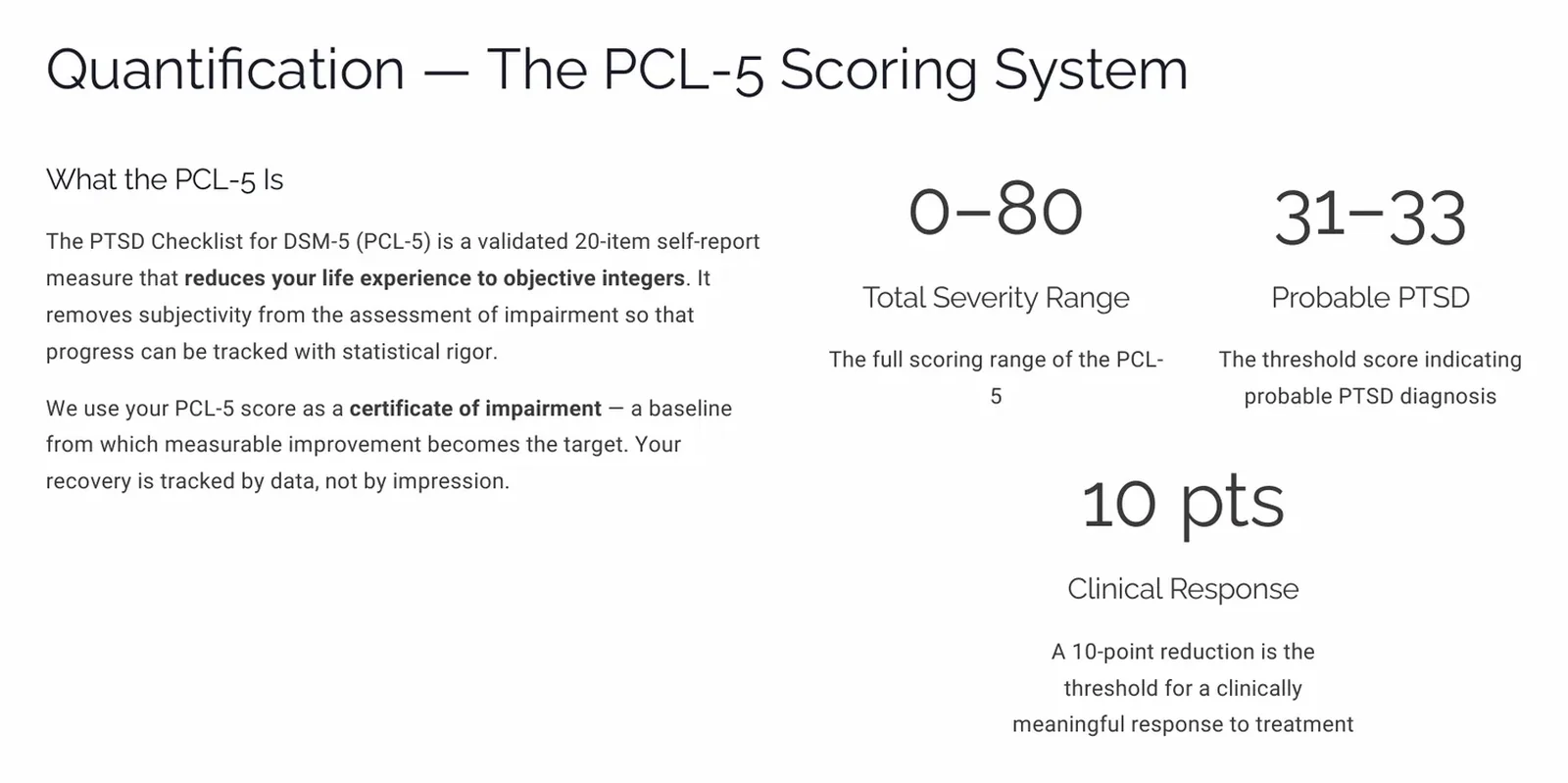
The PTSD Checklist for DSM-5 (PCL-5) is a proven 20-item self-report questionnaire. It turns lived experience into hard numbers. That sounds cold, but in practice it is freeing.<sup>1</sup>
- Total severity range: 0 to 80.
- A score in the 31 to 33 range indicates probable PTSD.
- A change of 5 to 10 points is reliable change — real, not measurement noise.
- A change of 10 to 20 points is clinically significant change.
In the clinic, a PCL-5 score works as a starting point. Measurable improvement from there becomes the target.
Here is why this matters more than it sounds. Without a number, you judge recovery by how you feel today. And how you feel today depends a lot on whether you slept. With a number, you can have a bad week and still see that you have dropped fourteen points since March. Data outlasts mood.
One key limit: the PCL-5 is a screening and tracking tool, not a diagnosis. A diagnosis needs an exam by a qualified clinician.
What is event centrality, and why does it predict PTSD distress?
Event centrality is how much you see a traumatic event as a defining, central part of who you are and your life story. High centrality means the event has become the lens every other experience is filtered through.
Research consistently shows that event centrality is often a better predictor of long-term distress than the objective severity of what happened.<sup>2</sup>
That is worth reading twice. How central the event is to who you are predicts your suffering better than how bad the event was.
A core goal of treatment is to lower that centrality. It is easy to hear this as an insult. So let me be precise about what it does and does not mean.
It does not mean playing down what happened. It does not mean the event was unimportant. It means restoring a broader, more balanced sense of who you are. Then the event becomes one chapter in your story, not the title of the book.
This is also the most hopeful finding in this series, because identity is easier to work on than history. You cannot change what happened. You can change how much of you it takes up.
How does PTSD treatment actually work?
Two mechanisms drive proven trauma treatment.
Habituation. When you face a feared trigger again and again in a truly safe setting, your body’s response fades. It happens naturally and predictably. The nervous system learns firsthand that the alarm is false.
Note the word genuinely. Exposure in an unsafe setting does not produce habituation. It produces more trauma. The safety has to be real. That is why this work is structured and supervised, not made up as you go.
Inhibitory learning. New safety memories are made. They do not erase the old fear memory. Instead, they compete with it and hold back its effect on behavior. The new memory says: this cue is safe now. With enough repetition, the safety memory wins.
That second mechanism carries something patients need to hear: you do not have to delete the memory to recover. It will still be there. It just stops driving your behavior.
Therapy is not talking through feelings forever. It is structured retraining of brain pathways, so that threatening cues are relearned as safe.
Does EMDR work, and do we know why?
Two questions usually get blurred together here. Does it work? And do we know why?
On efficacy: yes. EMDR has strong trial evidence and is recommended in major clinical guidelines for PTSD. That part is settled.
On mechanism, be appropriately skeptical. The Adaptive Information Processing model offers a theory. It says distress comes from memories that were never processed. They are stored in broken, state-bound pieces. They never joined the brain’s wider network of knowledge, so they stay raw, reactive and stuck in the present tense. EMDR is thought to move these memories from the reactive event-memory system into the organized fact-memory system. That turns “this is happening to me now” into “this happened in the past.” Side-to-side stimulation is thought to make attention more flexible and calm the amygdala, the brain’s alarm center.<sup>3</sup>
That is a theory, and researchers still truly disagree about the mechanism. That is fine. Aspirin was used for decades before anyone understood prostaglandins. Whether it works and why it works are separate questions. Only one of them has to be settled before you benefit.
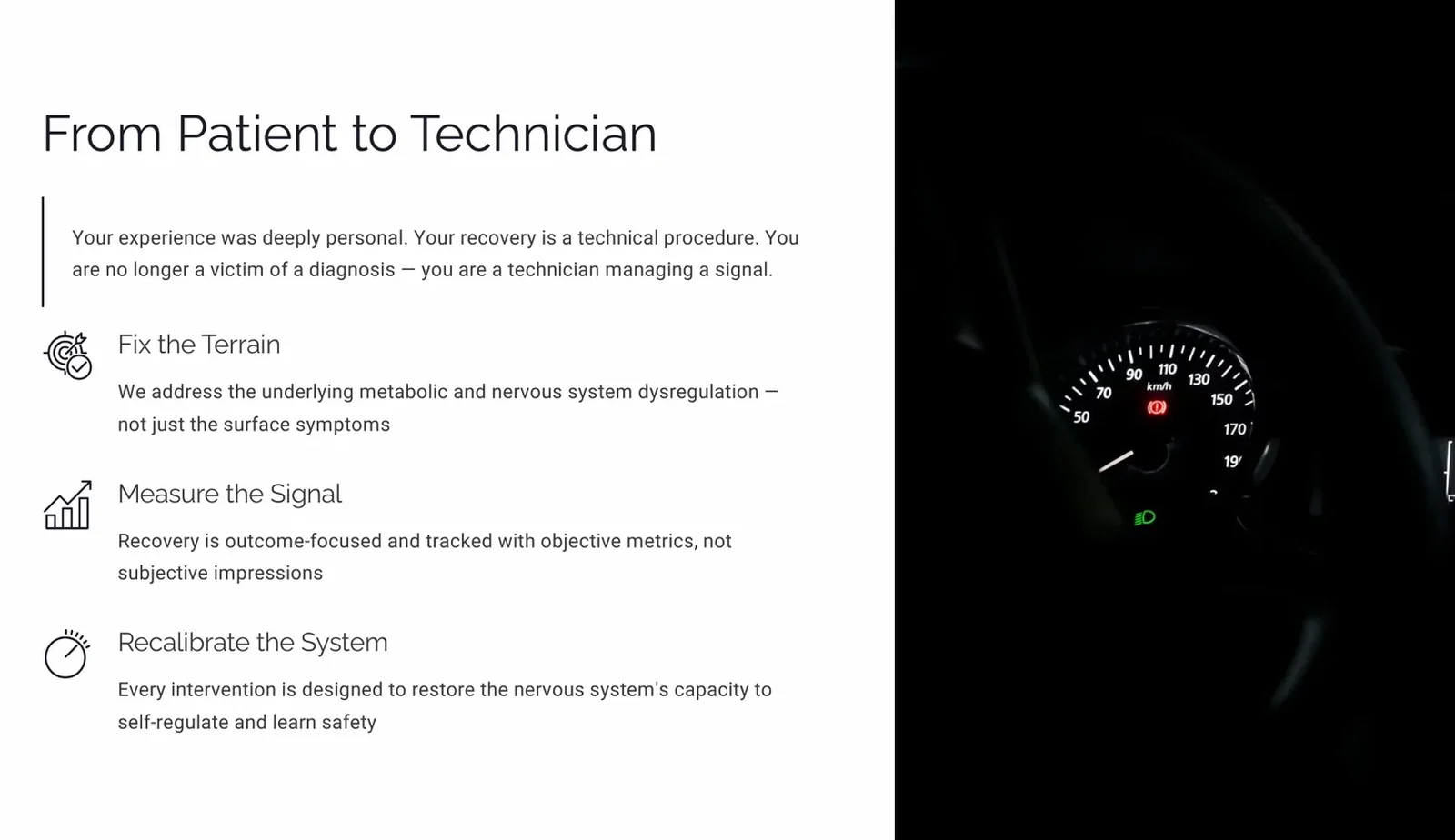
From patient to technician
Your experience was deeply personal. Your recovery is a technical procedure. Those do not conflict — the second is how you honor the first.
Three commitments follow. Fix the terrain: treat the metabolic and nervous system imbalance underneath, not surface symptoms. Measure the signal: track recovery with hard numbers, not impressions. And recalibrate the system: design every step to restore the nervous system’s own power to calm itself and learn safety.
That last one is the goal. Not a nervous system someone else controls — one that runs itself again.
Frequently asked questions
What PCL-5 score means I have PTSD?
A total score in the 31 to 33 range on the 0 to 80 scale points to probable PTSD and calls for a clinical exam. The PCL-5 is a proven screening and tracking tool, not a diagnosis. A diagnosis needs a qualified clinician who can weigh your history and rule out other causes.
How much does my score need to drop to count as real improvement?
A change of 5 to 10 points is reliable change. That means the difference is unlikely to be measurement noise. A change of 10 to 20 points is clinically significant change. Tracking the number over months tells you far more than any single reading.
Does reducing “event centrality” mean pretending the event was not important?
No. That reading is understandable but wrong. It means restoring a broader sense of who you are, so the event is one chapter, not the whole book. What happened is still real and still significant. The goal is that it stops being the lens you see everything else through.
Do I have to forget what happened in order to recover?
No. Inhibitory learning makes new safety memories that compete with the fear memory and hold it back, instead of erasing it. The old memory stays. It just stops driving your behavior. Recovery does not need deletion, which is lucky, because deletion is not an option.
Does EMDR actually work, and where can I be evaluated?
EMDR has strong trial evidence and is recommended in major PTSD guidelines, though researchers still disagree about how it works. Whether it is right for you is a clinical decision. If you are in crisis, call or text 988. For evaluation, Padda Institute Center for Interventional Pain Management is at 4477 Woodson Rd, Suite 100, St. Louis, MO 63134, next to St. Louis Lambert International Airport. A second location is at 12174 Natural Bridge Rd, St. Louis, MO 63044. We serve the St. Louis region across Missouri and Illinois. Call (314) 481-5000 or text (314) 886-5902, Monday to Friday, 8:00 AM to 5:00 PM.
What does PCL-5 stand for?
PCL-5 stands for the PTSD Checklist for DSM-5. It is a proven 20-item self-report questionnaire. That means you answer the questions yourself. Your answers add up to one total severity score between 0 and 80. That number is what lets you track recovery over months. The checklist screens for PTSD and tracks change. It does not diagnose PTSD by itself.
What is the highest score you can get on the PCL-5?
The highest possible total is 80. Scores run from 0 to 80, so a higher number means worse symptoms. A score in the 31 to 33 range already points to probable PTSD. That leaves a lot of room above that line. The room is useful, because a drop of 10 to 20 points counts as clinically significant change you can really see.
What does a PTSD score of 70 mean on the PCL-5?
On the 0 to 80 scale, 70 sits far above the 31 to 33 range that points to probable PTSD. It signals severe symptoms and is a clear reason to get a clinical exam, because the checklist screens but does not diagnose. It also becomes your baseline. From there, a drop of 5 to 10 points is reliable change. A drop of 10 to 20 points is clinically significant.
Key takeaways
- Tolerance, fortitude and adaptability can be measured and trained. Brittleness is the failure mode.
- PCL-5 runs 0 to 80, with 31 to 33 indicating probable PTSD; 5 to 10 points is reliable change, 10 to 20 clinically significant.
- Event centrality often predicts long-term distress better than how bad the event really was.
- Habituation needs real safety. Inhibitory learning builds competing safety memories without erasing the old one.
- EMDR’s results are backed by guidelines, even though how it works is still debated.
If you are in crisis, call or text 988 — the Suicide & Crisis Lifeline — or go to your nearest emergency department.
This article is educational and is not a substitute for evaluation, diagnosis, or treatment by a physician or qualified mental health clinician. Individual results vary. Do not start, stop, or change any medication without consulting your physician. If you are in crisis, call or text 988. To be evaluated, request an appointment or call (314) 481-5000.
References
- Weathers FW, Litz BT, Keane TM, Palmieri PA, Marx BP, Schnurr PP. The PTSD Checklist for DSM-5 (PCL-5). National Center for PTSD, US Department of Veterans Affairs; 2013.
- Berntsen D, Rubin DC. The Centrality of Event Scale: a measure of integrating a trauma into one’s identity and its relation to post-traumatic stress disorder symptoms. Behaviour Research and Therapy. 2006;44(2):219–231.
- Shapiro F. Eye Movement Desensitization and Reprocessing (EMDR) Therapy: Basic Principles, Protocols, and Procedures. 3rd ed. New York: Guilford Press; 2018.
Get evaluated by a physician who treats the terrain, not just the signal
Chronic pain, metabolic disease and trauma feed each other. At the Padda Institute they are checked together, because treating one alone falls short.
Or call or text us.
Medically reviewed by Dr. Gurpreet Singh Padda, MD, MBA, MHP — Board Certified in Anesthesiology, Pain Medicine, Interventional Pain Management, Addiction Medicine, and Obesity Medicine. Last reviewed July 2026.
Dr. Gurpreet Singh Padda, MD, MBA, MHP