Three brain structures explain most of what post-traumatic stress does to a person. The amygdala is an alarm that will not switch off. The hippocampus is a map that lost its timestamps, so an old threat feels like now. The medial prefrontal cortex is a set of brakes that cannot engage. The part of you that knows you are safe lives in a system that is not hooked up to the alarm right now.
Two common claims about this brain science are overstated. That includes the talk this article is drawn from. Both are corrected below. And one of the fixes is considerably kinder than the version usually told.
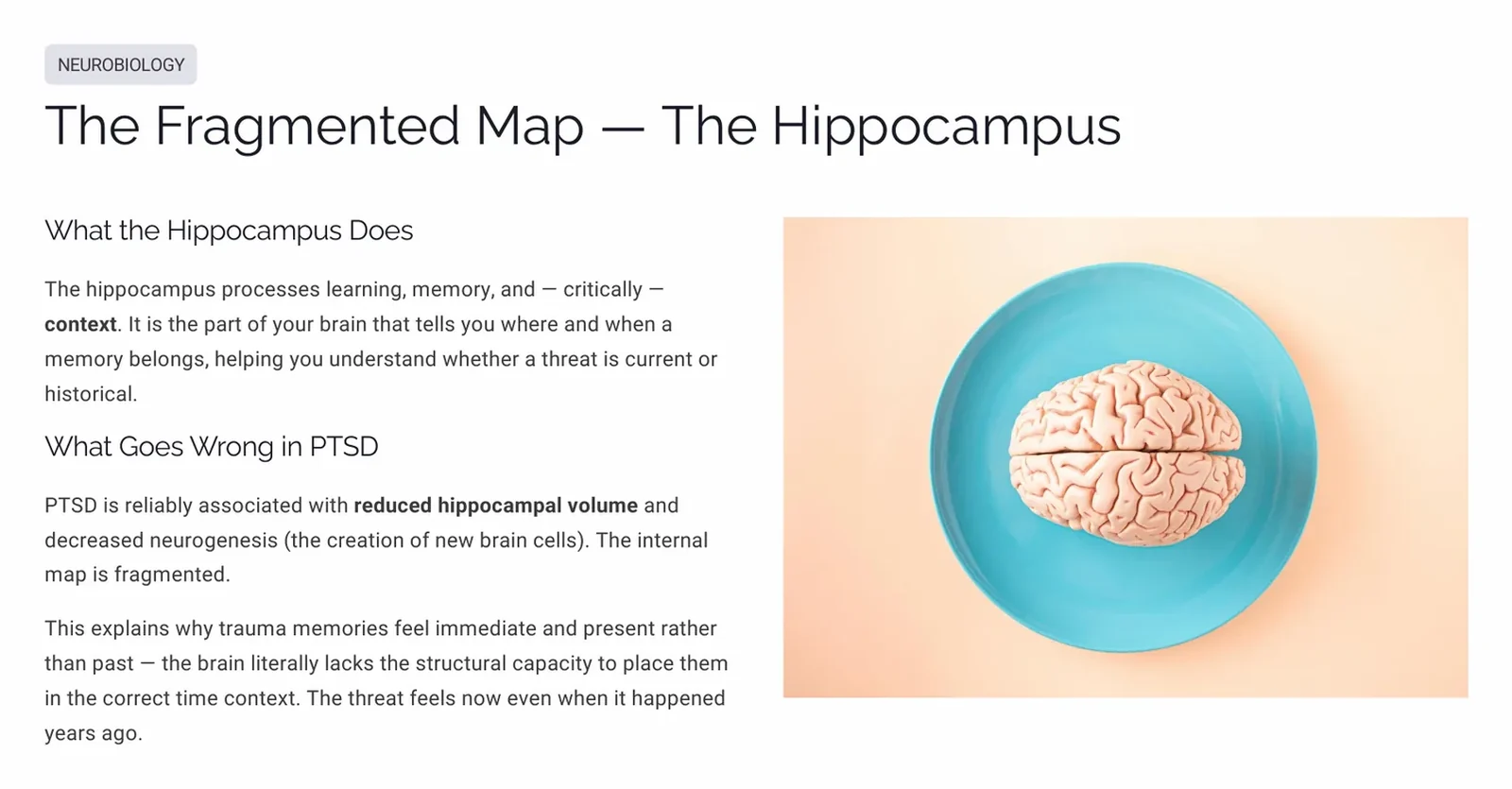
What does PTSD do to the amygdala?
The amygdala is where the brain handles fear. It is your built-in alarm. It is built to fire when it spots a threat and to get the body ready to respond. That is a feature, not a defect.
In PTSD, the amygdala becomes chronically over-responsive.<sup>1</sup> It fires not only at reminders of the trauma but at neutral, everyday things. The alarm is stuck in the on position.
Think about the energy cost. An alarm that never shuts off burns fuel. It wears the whole body out. It floods the body with low-level threat signals around the clock. Patients call this an exhaustion that sleep does not fix. They are describing something real.
Body-wide inflammation often keeps this alarm running. That inflammation is the bridge between the mental health picture and the metabolic one.
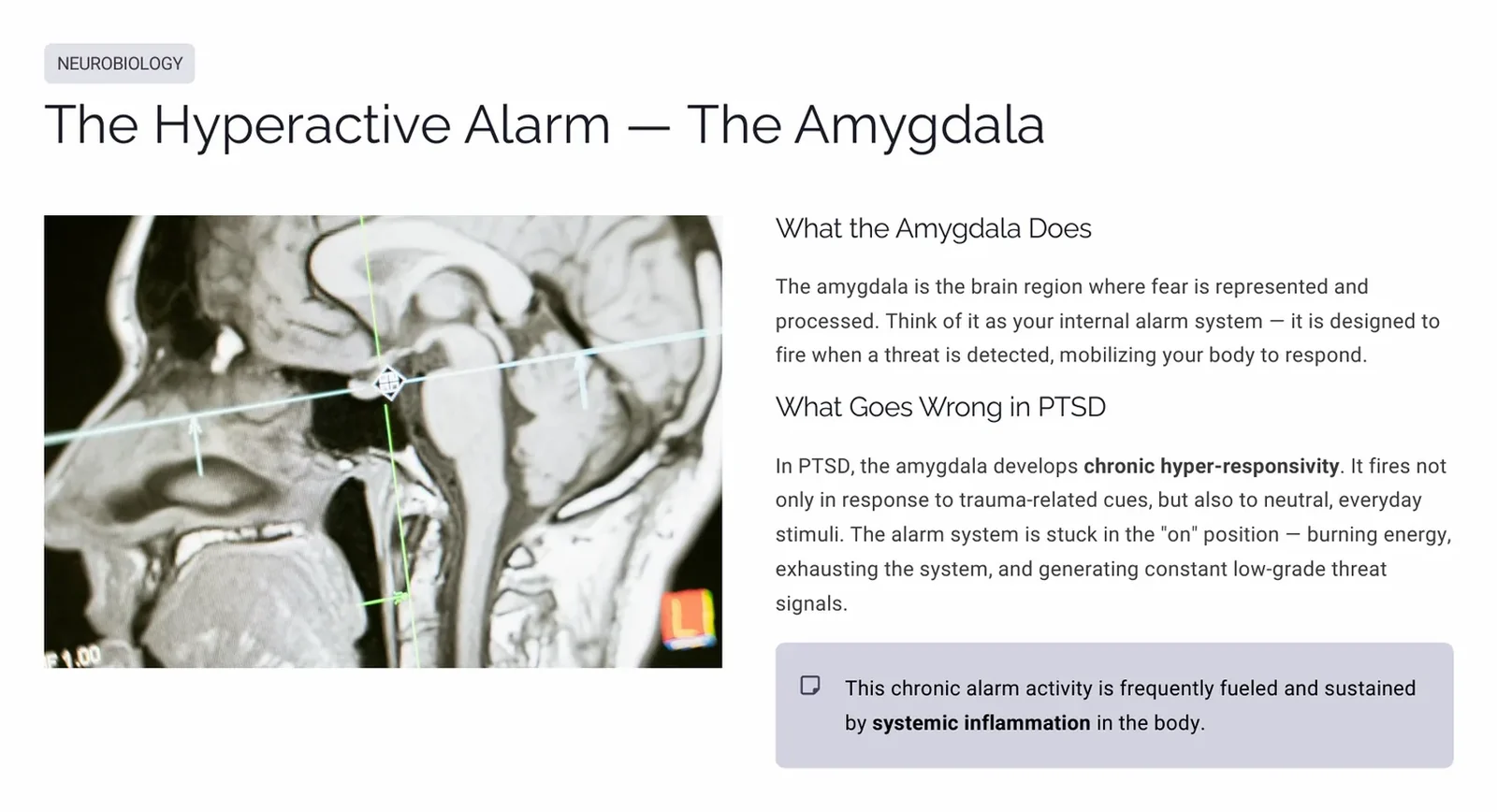
Does PTSD shrink the hippocampus?
The hippocampus handles learning, memory, and, most important, context. It is the part that tells you where and when a memory belongs.
PTSD is reliably associated with a smaller hippocampus and less growth of new nerve cells (neurogenesis). This helps explain the hallmark of traumatic memory. It feels present and happening now, not past. The time-and-place tag that would file it as then does not work right, so the threat feels like now even when it happened decades ago.
Here is the correction, and it matters. Most people explain this as trauma shrinking the hippocampus. The evidence is more interesting than that.
Gilbertson and colleagues studied 40 pairs of identical twins. In each pair, only one twin saw combat. They found smaller hippocampi in the veteran with PTSD and in his unexposed identical twin.<sup>2</sup> That indicates a smaller hippocampus is, at least partly, a pre-existing vulnerability factor rather than purely damage done by the event.
Why does that matter to you? Because it means your brain was not destroyed by what happened to you. Some people are simply built to be more at risk. That is a risk profile, and risk profiles can be managed.
Why can’t the prefrontal cortex calm the alarm in PTSD?
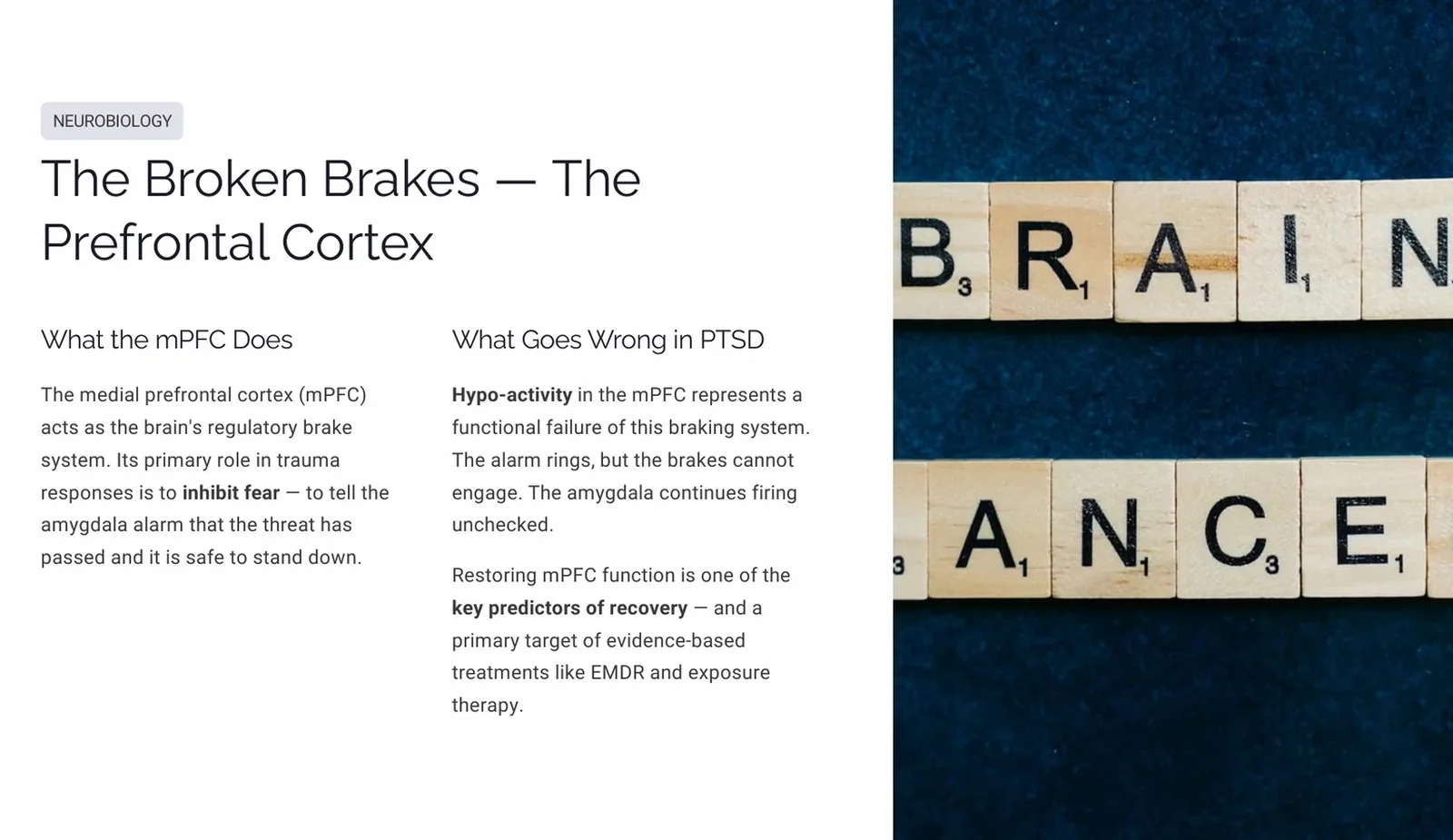
The medial prefrontal cortex acts as the brake. Its job in trauma is fear inhibition. It tells the amygdala the threat has passed and it is safe to stand down.
In PTSD, the medial prefrontal cortex is under-active.<sup>1</sup> The braking system fails. The alarm rings and the brakes cannot engage.
Put the three together and you have someone whose wiring cannot feel safe, no matter what they know in their head.
That is why “you’re safe now” does not help. The patient already knows. The knowing lives in a system that is not currently connected to the alarm.
Restoring prefrontal function is one of the key predictors of recovery. It is a main target of evidence-based treatment.
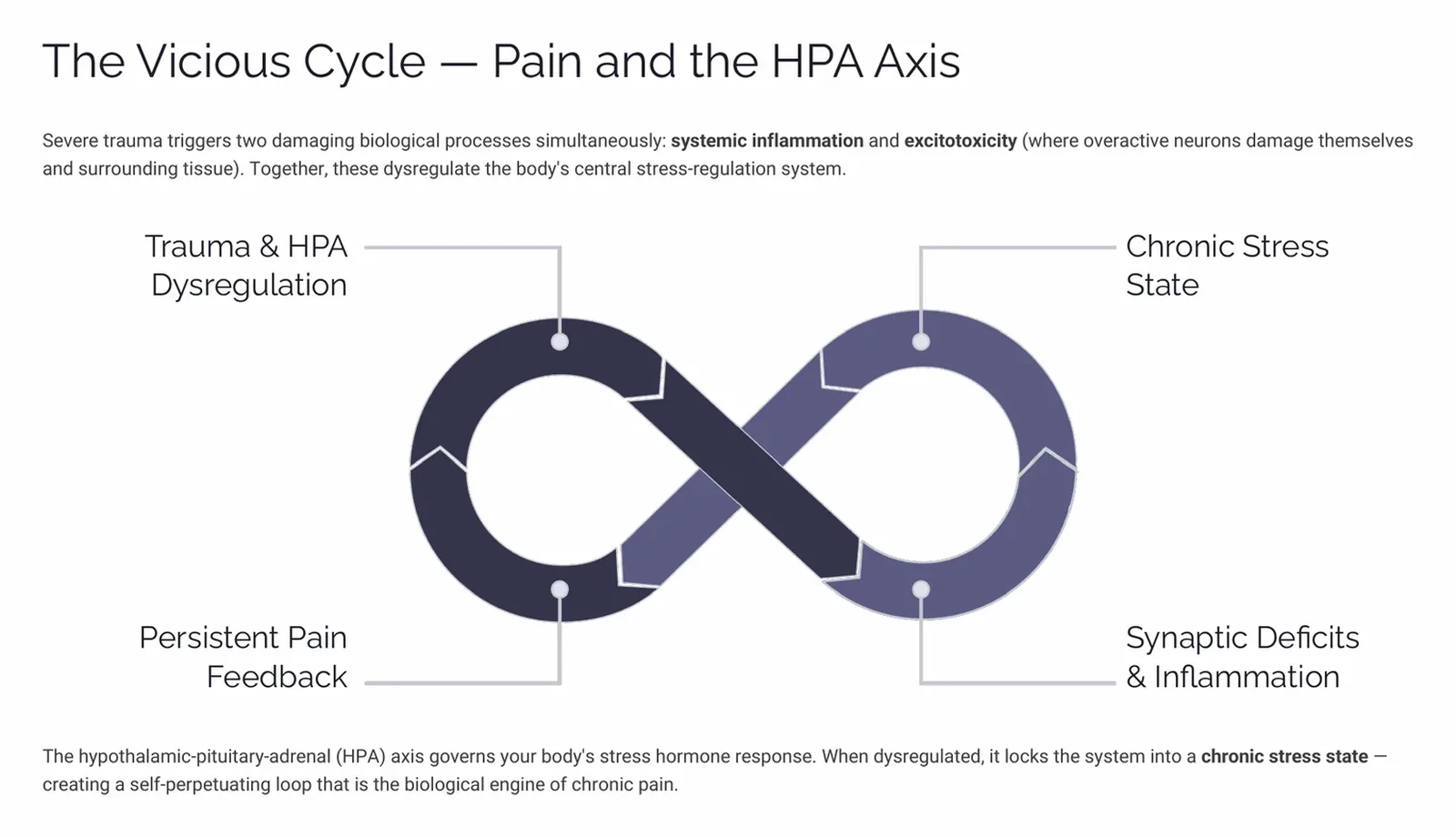
The loop that sustains itself
Severe trauma sets off two harmful processes at once. One is body-wide inflammation. The other is excitotoxicity, where overactive nerve cells damage themselves and the tissue around them.
Together these throw off the hypothalamic-pituitary-adrenal (HPA) axis. That system runs the stress hormone response.
The cycle runs: trauma and a thrown-off HPA axis → a chronic stress state → weak nerve connections and inflammation → ongoing pain feedback → back into the chronic stress state.
Notice that this loop no longer needs the original event. It runs on itself. This is why “just move on” is not just unkind. It misses how the machine works. There is nothing left to move on from. The loop is the problem.
Does PTSD lower cortisol?
You will often hear that PTSD comes with low cortisol, not high. The story is that the system is worn out from overwork.
The real evidence is more limited. A meta-analysis of 37 studies compared 828 people with PTSD against 800 controls. It found no overall difference in cortisol.<sup>3</sup> Lower cortisol showed up only in certain subgroups: women, people with a history of physical or sexual abuse, and afternoon measurements.
So it is a real finding in certain groups. It is not a sign found in all PTSD. The “adrenal exhaustion” explanation is also not the best-supported cause.
What is solid is the inflammation. PTSD consistently shows high levels of pro-inflammatory cytokines (immune signal molecules), including interleukin-1β and interleukin-6. A meta-analysis confirmed it.<sup>4</sup> These molecules directly affect mood, thinking, how you feel pain, and sleep.
Which means this is not “all in your head.” It is measurable chemistry, and some of it is modifiable.
Why do light and noise feel unbearable with PTSD?
One last piece, and it ties this straight to chronic pain.
A healthy nervous system gets used to things. Repeat a harmless signal, and the system learns to tune it out. That is why you stop hearing the refrigerator.
In PTSD that process does not work right. The nervous system never decides the repeated signal is safe. So it responds at full alarm every time.
At the same time, it develops stress sensitization. The autonomic nervous system (the part that runs on autopilot) overreacts to new or intense signals. After a stress response, it does not reset lower. Instead, the trigger point for the next response drops. The system becomes more reactive with each activation.
This explains something patients report all the time and are rarely believed about: being oversensitive to light, noise and touch. Their attention gets used up on signals the nervous system cannot correctly label as unimportant.
Frequently asked questions
Does trauma permanently shrink my hippocampus?
The link between PTSD and a smaller hippocampus is strong. But which one causes which is not settled. A study looked at identical twins where only one twin saw combat. It found smaller hippocampi in both the affected veteran and his unexposed twin. That indicates this is at least partly a pre-existing vulnerability rather than purely damage from the event.
Is low cortisol a reliable sign of PTSD?
No, and this is often overstated. A meta-analysis of 37 studies found no overall cortisol difference between people with PTSD and controls. Lower cortisol showed up only in certain subgroups: women, those with a history of physical or sexual abuse, and afternoon samples. It is not a diagnostic marker.
Why does telling myself I am safe not stop the symptoms?
Because knowing and controlling the alarm happen in different systems. Fear inhibition depends on the medial prefrontal cortex telling the amygdala to stand down. That pathway is under-active in PTSD. The knowledge is intact. The connection that would act on it is not. This is a wiring problem, not a failure of insight or effort.
Is the inflammation in PTSD actually measurable?
Yes. PTSD consistently shows high levels of pro-inflammatory cytokines, including interleukin-1β and interleukin-6. A meta-analysis has confirmed it. These molecules affect mood, thinking, how you feel pain, and sleep. That is why the mental health and metabolic pictures are treated together, not apart.
How does PTSD affect the brain?
PTSD changes how three brain systems work together. The amygdala is the brain’s alarm. It becomes over-responsive and fires even at neutral, everyday things. The hippocampus files memories by time and place. It loses that context, so an old threat feels like it is happening now. The medial prefrontal cortex is the brake that tells the alarm to stand down. It becomes under-active. The result is a person who cannot feel safe, even when they know they are.
Does PTSD cause permanent brain damage?
Not in the way it is usually told. A smaller hippocampus is linked to PTSD. But a study of identical twins also found it in the twin who never saw combat. That points to a risk factor present before the trauma, not damage the event caused. Your brain was not destroyed by what happened to you. Restoring prefrontal function is one of the key predictors of recovery, and some of the inflammation involved is modifiable.
What not to say to someone with PTSD?
Two common phrases miss the mechanism. “You’re safe now” does not help, because the person already knows it. That knowledge lives in a brain system that is not hooked up to the alarm right now. “Just move on” is not only unkind. It misses how the machine works. The loop of stress, inflammation and pain keeps running without the original event. Take what they describe as real physiology, how the body actually works, including exhaustion and sensitivity to light and noise.
Where can I be evaluated, and what if I need help now?
If you are in crisis, call or text 988 — the Suicide & Crisis Lifeline — or go to your nearest emergency department. For evaluation, Padda Institute Center for Interventional Pain Management is at 4477 Woodson Rd, Suite 100, St. Louis, MO 63134, next to St. Louis Lambert International Airport, with a second location at 12174 Natural Bridge Rd, St. Louis, MO 63044, serving the St. Louis region across Missouri and Illinois. Call (314) 481-5000 or text (314) 886-5902, Monday to Friday, 8:00 AM to 5:00 PM.
Key takeaways
- An over-responsive amygdala means the alarm fires at neutral things, at a real energy cost.
- A smaller hippocampus is at least partly a pre-existing vulnerability, not purely damage from the event.
- An under-active medial prefrontal cortex is why knowing you are safe does not calm the alarm.
- The trauma–inflammation–pain loop sustains itself without the original event.
- Low cortisol shows up only in subgroups. It is not a sign of all PTSD. The high inflammatory cytokines are the solid finding.
If you are in crisis, call or text 988 — the Suicide & Crisis Lifeline — or go to your nearest emergency department.
This article is educational and is not a substitute for evaluation, diagnosis, or treatment by a physician or qualified mental health clinician. Individual results vary. Do not start, stop, or change any medication without consulting your physician. If you are in crisis, call or text 988. To be evaluated, request an appointment or call (314) 481-5000.
References
- Etkin A, Wager TD. Functional neuroimaging of anxiety: a meta-analysis of emotional processing in PTSD, social anxiety disorder, and specific phobia. American Journal of Psychiatry. 2007;164(10):1476–1488.
- Gilbertson MW, Shenton ME, Ciszewski A, et al. Smaller hippocampal volume predicts pathologic vulnerability to psychological trauma. Nature Neuroscience. 2002;5(11):1242–1247.
- Meewisse ML, Reitsma JB, de Vries GJ, Gersons BPR, Olff M. Cortisol and post-traumatic stress disorder in adults: systematic review and meta-analysis. British Journal of Psychiatry. 2007;191:387–392.
- Passos IC, Vasconcelos-Moreno MP, Costa LG, et al. Inflammatory markers in post-traumatic stress disorder: a systematic review, meta-analysis, and meta-regression. The Lancet Psychiatry. 2015;2(11):1002–1012.
Get evaluated by a physician who treats the terrain, not just the signal
Chronic pain, metabolic disease and trauma physiology reinforce each other. At the Padda Institute they are assessed together, because treating one alone underperforms.
Or call or text us.
Medically reviewed by Dr. Gurpreet Singh Padda, MD, MBA, MHP — Board Certified in Anesthesiology, Pain Medicine, Interventional Pain Management, Addiction Medicine, and Obesity Medicine. Last reviewed July 2026.
Dr. Gurpreet Singh Padda, MD, MBA, MHP