Bloating and fatigue are the two symptoms most likely to end with an organism taking the blame. A panel arrives with a name highlighted, and a protocol follows. A year or two later, the symptoms haven’t changed, and the gut flora is thinner than when it started. The organisms on those reports live in most people who feel perfectly well. What the protocol changed was the room they live in.
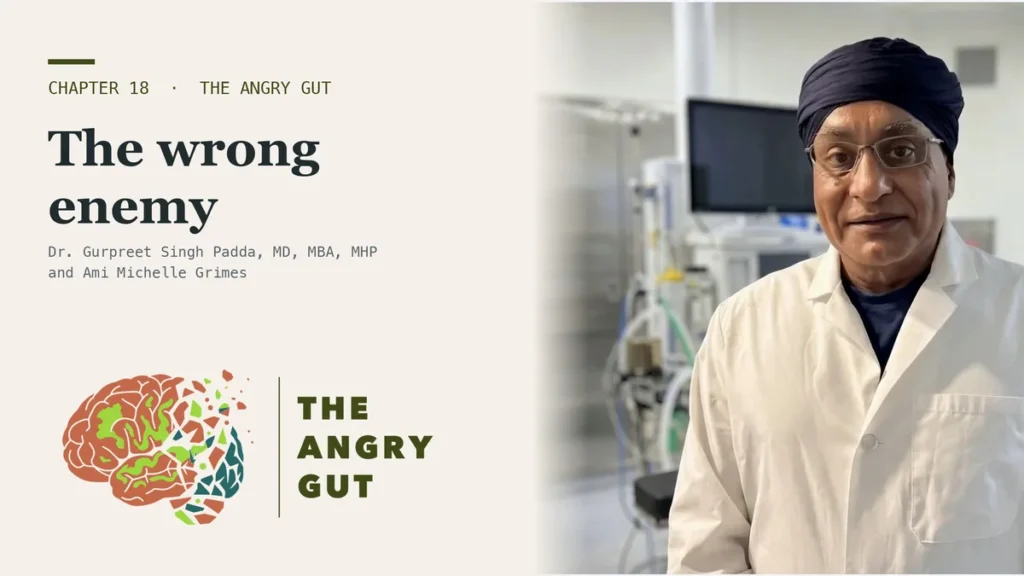
Watch The Wrong Enemy on Your Stool Report for the ten-minute version of this argument, drawn from The Angry Gut, by Dr. Gurpreet Singh Padda, MD, MBA, MHP, and Ami Michelle Grimes. Below is what an interventional pain practice does with it, because a depleted gut does not stay a digestive problem for long.
A species list is a photograph, not a job record
A panel that lists species names who is there. It can’t report what anyone is doing. The first brain reshuffles its population meal by meal. Signals along the vagus nerve and whatever arrives in the food stream drive it. So a list of names tells you who showed up one morning. The work shows up elsewhere: in metabolites, in the immune response they trigger, and in gases on a breath test. An international panel of sixty-nine specialists reviewed the at-home versions of these panels. It found no proven value for them in clinical practice.
Bloating and fatigue, and the organisms most people already carry
Start with the yeast, because it sells the most protocols. In a healthy cohort from the Human Microbiome Project, Candida albicans turned up in 80.8% of stool samples, and baker’s yeast in 96.8%. A positive result describes the species. It does not diagnose the person.
I wrote antifungals for reports like that for years, because I was taught that is what a highlighted line meant. The trial that changed my mind was the only one of its kind. Nystatin was tested, randomized and double-blind, against placebo for the symptom cluster patients now bring me. Whole-body symptom scores improved 25% on the active drugs and 23% on placebo alone. The drug cleared the vaginal symptoms it is actually approved for and did nothing else. That is what a real indication looks like.
The protozoan story runs stranger. Among 296 healthy Malian children, those carrying Blastocystis had significantly richer and more varied bacteria than those without it. Where yeast truly turns dangerous, the order runs opposite to the folklore. Among transplant patients, eight developed a fungal blood infection. Six of the eight first showed a single Candida species above 50% of their gut fungi, after a heavy loss of bacteria. The fungus does not empty the room. It moves in once the room is empty.
Why a thinned gut matters to a sensitized nervous system
This is what makes it a pain problem. Bacteria that make butyrate push the cells lining the colon to burn oxygen. That keeps the lining’s surface airless. Wipe out those producers, and oxygen and nitrate leak into the gut. Then the organisms that grow are the ones built to breathe them. That chain was mapped in mice, so read it as mechanism.
The human end of it is a mortality cohort, a study that tracked deaths. It followed 7,211 Finnish adults for up to 15 years. A diversity score was not significantly associated with dying, at a corrected P value of 0.17. The mix of species was. The amount of Enterobacteriaceae carried a hazard ratio of 1.14. The top quarter had a 34% higher risk of death than the bottom quarter. Those are the organisms that fill a thinned room. Picture a patient whose nervous system already turns up every inflammatory input. Adding a self-renewing source of that input is not neutral. It is the same logic as treating insulin before treating the joint, and part of why a clean scan and severe pain are not a contradiction.
What one course costs, measured rather than asserted
Researchers gave one ordinary antibiotic, at random, to healthy volunteers. It cut stool diversity for as long as 4 months with clindamycin and as long as 12 months with ciprofloxacin. The butyrate producers took the heaviest losses. The damage to function was quieter and larger. A month after that clindamycin course, 512 predicted gene functions had shifted, 11% of all of them. Amoxicillin is the unsettling case. It left diversity statistically unchanged and still moved 272 predicted functions up and 434 down. A census can look normal while the job list has been rewritten. These are predictions from gene data in small groups, so trust the direction more than the size.
Recovery is partial. Twelve men got three last-resort antibiotics for four days. They looked near baseline within 1.5 months. Yet nine species that every one of them carried before were still missing in most of them at day 180. And the dose-response should trouble anyone counting courses. Across 6,104,245 people, every extra course raised the rate of inflammatory bowel disease, with ratios from 1.11 to 1.15 across the age groups.
The fair objection: sick people get antibiotics, so some of the drug’s apparent effect is really the illness. When researchers compared antibiotics before birth and later asthma within families, a hazard ratio of 1.28 in the full cohort fell to 0.99 between siblings. Part of that story is family. The argument still holds, because the volunteers who lost their butyrate producers were healthy. The drug was the only thing that changed.
Antibiotics are not the only culprits, either. Acid reflux pills (proton pump inhibitors), diabetes drugs and antipsychotics also break down the gut’s defense against invaders. Those are three of the most prescribed drug classes in medicine, and none is labeled a gut drug. Read an ordinary pain patient’s drug list and count.
The antibiotic is a bridge, and the bridge is not the failure
If there is a real pathogen, we write the prescription without hesitating. What fails is the plan on the far side. People cross again and again, because nothing was ever built there. The drugs these patients usually get don’t earn what is claimed for them. In the two key irritable bowel trials, rifaximin brought adequate relief to 40.7%, against 31.7% on placebo. That is roughly one patient helped in eleven. For bacterial overgrowth, the pooled clearance rate is 59%. Across the randomized trials, it showed no significant difference from placebo or active control. Herbal options are not gentler, only thinner on evidence.
Notice who those trials enrolled: irritable bowel without constipation, scrubbed of everything else. That strips out the patient who has a pain syndrome, a metabolic syndrome and a mood disorder all at once. That is exactly the patient in my exam room. So the evidence here rests on mechanism and practice. I would rather name that than pretend a trial answered a question it shut out.
What we measure, and what the rebuild asks of you
We stop counting names and start measuring activity. That means hydrogen and methane on a breath test, an inflammation marker, and an honest record of a week of food. Then the work is adding. Fermentable plant food most days feeds the producers that keep the colon surface airless. That is the body-based reason food beats a capsule here. Sleep belongs in the same prescription. The first brain answers to vagus nerve signals, and those signals depend on how you live. The fuel that lining runs on comes from those same bacteria, and the next part of the series turns from adding to subtracting: what the first brain does when you stop feeding it.
For the full evidence, the companion Deep Dive lists every study named here with its complete numbers. It also covers what each one does not show and the questions worth asking your physician.
Cultivate the good and the bad runs out of room. That costs real food, real sleep and the patience to stop buying the next war. Another protocol costs another year and a thinner room to fight from.
Frequently asked questions
Can candida overgrowth cause bloating and fatigue?
The symptoms are real. The test that names the yeast cannot explain them. Four out of five people in a healthy cohort carried Candida albicans in stool, and much of what a fungal panel reports is food from the past few days. When bloating and fatigue persist, the better question is what the whole community is doing and what else is feeding the inflammatory load. Normal test results are often exactly what a condition predicts.
Do antibiotics make chronic pain worse?
No single course has been shown to cause pain. What has been measured is the terrain. One ordinary course cut stool diversity for months and thinned the butyrate producers. In a Danish population of millions, each extra course carried a higher rate of inflammatory bowel disease. In a body already carrying a heavy inflammation load, that cost is worth counting before the next prescription. Inflamed tissue changes what a nervous system is reacting to.
Should I treat Blastocystis hominis if a stool test found it?
That decision belongs to the physician who knows your immune status, not to a panel. In healthy children, carriage came with richer flora than in the children without it. The honest limit sits in an Italian series, where it was found in 22.3% of immunocompromised patients against 6.8% of immunocompetent ones. In a well person, treating it can mean treating a marker of the thing you were building. Deciding when a test earns its place is its own subject.
How long does the gut take to recover after antibiotics?
Longer than the prescription, and not fully. In men given last-resort antibiotics, the gut community looked close to baseline within about six weeks. Yet species every man carried before were still missing in most of them half a year later. Volunteers tested often ended up stable, but different from where they began. The census returns faster than the residents do. Repopulating a gut you had to empty is a separate piece of work.
Is a probiotic capsule the right move after a course of antibiotics?
Tested head to head against doing nothing, probiotics slowed the return of a person’s own gut community and left it incomplete. That person’s own banked stool restored it within days. A capsule of a stranger’s organisms is not the same as feeding your own. Do not start, stop or change anything prescribed on your own. Work the order through with your physician. Pain-sensing nerves in the gut wall are part of this circuitry.
Bring the report and the list of what you have already taken
If you live with chronic pain and your gut has been treated as a separate errand, we read the two together: what has already been killed, and what is left to build on. Bring every protocol you have finished, not just the most recent one.
Request an appointment, or call or text us.
Sources
- Nash, A. K., Auchtung, T. A., Wong, M. C., Smith, D. P., Gesell, J. R., Ross, M. C., Stewart, C. J., Metcalf, G. A., Muzny, D. M., Gibbs, R. A., Ajami, N. J., & Petrosino, J. F. (2017). The gut mycobiome of the Human Microbiome Project healthy cohort. Microbiome, 5(1), 153. https://doi.org/10.1186/s40168-017-0373-4
- Dismukes, W. E., Wade, J. S., Lee, J. Y., Dockery, B. K., & Hain, J. D. (1990). A randomized, double-blind trial of nystatin therapy for the candidiasis hypersensitivity syndrome. The New England Journal of Medicine, 323(25), 1717-1723. https://doi.org/10.1056/NEJM199012203232501
- Kodio, A., Coulibaly, D., Koné, A. K., Konaté, S., Doumbo, S., Guindo, A., Bittar, F., Gouriet, F., Raoult, D., Thera, M. A., & Ranque, S. (2019). Blastocystis colonization is associated with increased diversity and altered gut bacterial communities in healthy Malian children. Microorganisms, 7(12), 649. https://doi.org/10.3390/microorganisms7120649
- Salosensaari, A., Laitinen, V., Havulinna, A. S., Meric, G., Cheng, S., Perola, M., Valsta, L., Alfthan, G., Inouye, M., Watrous, J. D., Long, T., Salido, R. A., Sanders, K., Brennan, C., Humphrey, G. C., Sanders, J. G., Jain, M., Jousilahti, P., Salomaa, V., … Niiranen, T. (2021). Taxonomic signatures of cause-specific mortality risk in human gut microbiome. Nature Communications, 12(1), 2671. https://doi.org/10.1038/s41467-021-22962-y
- Zaura, E., Brandt, B. W., Teixeira de Mattos, M. J., Buijs, M. J., Caspers, M. P. M., Rashid, M.-U., Weintraub, A., Nord, C. E., Savell, A., Hu, Y., Coates, A. R., Hubank, M., Spratt, D. A., Wilson, M., Keijser, B. J. F., & Crielaard, W. (2015). Same exposure but two radically different responses to antibiotics: Resilience of the salivary microbiome versus long-term microbial shifts in feces. mBio, 6(6), e01693-15. https://doi.org/10.1128/mBio.01693-15
- Palleja, A., Mikkelsen, K. H., Forslund, S. K., Kashani, A., Allin, K. H., Nielsen, T., Hansen, T. H., Liang, S., Feng, Q., Zhang, C., Pyl, P. T., Coelho, L. P., Yang, H., Wang, J., Typas, A., Nielsen, M. F., Nielsen, H. B., Bork, P., Wang, J., … Pedersen, O. (2018). Recovery of gut microbiota of healthy adults following antibiotic exposure. Nature Microbiology, 3(11), 1255-1265. https://doi.org/10.1038/s41564-018-0257-9
- Faye, A. S., Allin, K. H., Iversen, A. T., Agrawal, M., Faith, J., Colombel, J.-F., & Jess, T. (2023). Antibiotic use as a risk factor for inflammatory bowel disease across the ages: A population-based cohort study. Gut, 72(4), 663-670. https://doi.org/10.1136/gutjnl-2022-327845
- Örtqvist, A. K., Lundholm, C., Kieler, H., Ludvigsson, J. F., Fall, T., Ye, W., & Almqvist, C. (2014). Antibiotics in fetal and early life and subsequent childhood asthma: Nationwide population based study with sibling analysis. BMJ, 349, g6979. https://doi.org/10.1136/bmj.g6979
- Ducarmon, Q. R., Zwittink, R. D., Hornung, B. V. H., van Schaik, W., Young, V. B., & Kuijper, E. J. (2019). Gut microbiota and colonization resistance against bacterial enteric infection. Microbiology and Molecular Biology Reviews, 83(3), e00007-19. https://doi.org/10.1128/MMBR.00007-19
- Pimentel, M., Lembo, A., Chey, W. D., Zakko, S., Ringel, Y., Yu, J., Mareya, S. M., Shaw, A. L., Bortey, E., & Forbes, W. P. (2011). Rifaximin therapy for patients with irritable bowel syndrome without constipation. The New England Journal of Medicine, 364(1), 22-32. https://doi.org/10.1056/NEJMoa1004409
Dr. Gurpreet Singh Padda, MD, MBA, MHP