Agitation in a person with dementia is often untreated pain. When a sedative is given to quiet that behavior instead of to treat a medical symptom, federal nursing-home rules call it a chemical restraint. A woman who pushes the aide away and cries out when turned gets charted as agitated. Nobody asks whether she hurts.
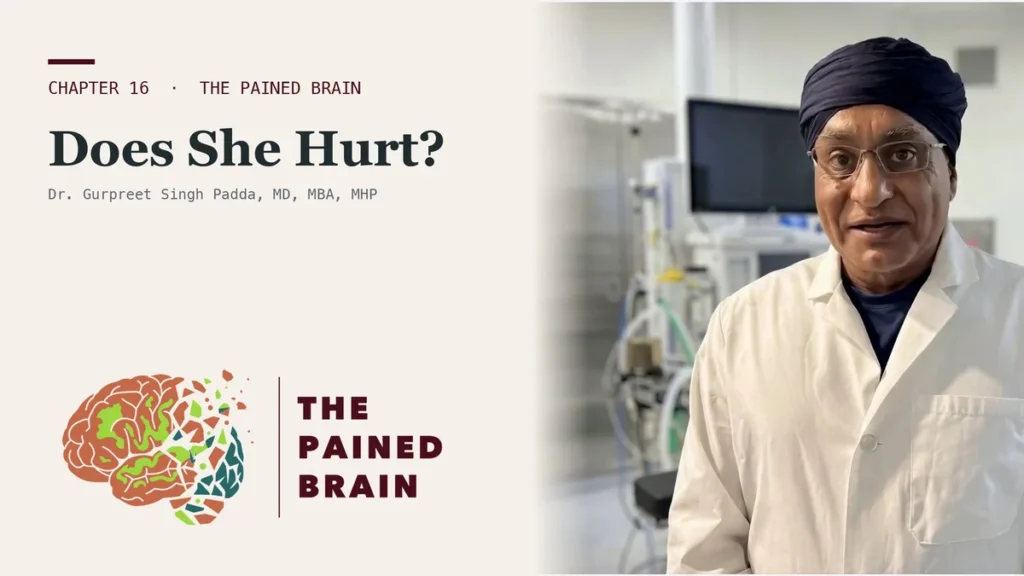
An older woman with dementia who pushes the aide away and cries out when she is turned is usually charted as agitated. The response is often a sedative, and when a drug is given to quiet behavior rather than to treat a medical symptom, federal nursing-home rules have a name for it: a chemical restraint. Chapter 16 of The Pained Brain, the video above, by Dr. Gurpreet Singh Padda, MD, MBA, MHP, and Dr. KrisJay Fucanan, MD, asks the question the medication list rarely asks. Does she hurt?
How much pain goes uncounted in nursing homes
The familiar up-to-80-percent figure comes from a 1999 review, and its catch is the lesson. Studies that asked residents or read their charts found pain in 49 to 83 percent. Studies that counted only who received a painkiller found 27 to 44 percent.
Modern federal data show where the undercount hides. Across 8.6 million admissions, pain was recorded in 68.9 percent of residents with little or no cognitive impairment (memory and thinking loss). In those with severe impairment, it was 32.9 percent. When the two methods were compared, residents’ own reports showed moderate to severe pain in 9.60 percent. Staff watching them found it in 34.04 percent. Advanced dementia does not cut pain in half. It cuts reporting in half, and the chart keeps only what is reported.
Signs of pain in dementia patients that get read as behavior
Pain that can’t be put into words shows up as guarding, fighting care and calling out at night. The clearest test of that link is a Norwegian trial across 60 nursing-home units and 352 residents with dementia and agitation. An eight-week, step-by-step pain plan cut agitation by 17 percent. And 69 percent of treated residents needed nothing stronger than acetaminophen. When the painkillers were stopped, the agitation crept back.
When 95 residents got scheduled acetaminophen, chosen for low quality of life and not for pain, it did nothing. Treating pain works. Treating everyone as if they hurt does not. Untreated pain also throws off thinking. After a hip fracture, sudden confusion (delirium) was nine times as likely in clear-thinking patients with severe pain. It was 5.4 times as likely in those getting under 10 milligrams of morphine equivalents a day.
What a chemical restraint costs
In inspector guidance, a chemical restraint is a drug given for discipline or for staff convenience when no medical symptom calls for it. A sedating drug given for a symptom nobody diagnosed fits that. Among 90,786 veterans with dementia, there was one extra death within 180 days for every 26 people given haloperidol and every 50 given quetiapine. In a randomized trial of stopping these drugs, 24-month survival was 46 percent in patients who stayed on their antipsychotic. In those switched to placebo, it was 71 percent.
The system measured one drug class, and the sedation moved elsewhere. Antipsychotic use among long-stay residents has fallen 40.6 percent since late 2011. But the drop began before the national campaign. Meanwhile, mood-stabilizer use climbed to 20.1 percent of residents, mostly gabapentin. In 2021, 85.0 percent of gabapentin starts in nursing homes had no approved reason. That is the money and rule driver in plain view. A quality score rewards a lower number on one line. Thin staffing rewards a quiet floor. And neither pays for the time it takes to examine a resident who can’t talk.
Polypharmacy in the elderly and a body that clears drugs slowly
The aging liver clears most drugs 10 to 40 percent more slowly. Kidney filtering falls 0.5 to 1.0 milliliters per minute each year. Body fat rises as muscle falls, so drugs that dissolve in fat build up. The aging brain is also more sensitive at any blood level. Taking five or more prescriptions rose from 23.5 percent to 44.1 percent of older Americans over two decades.
Pain drugs belong on that list. In a matched Medicare arthritis cohort, starting an opioid instead of an anti-inflammatory carried 4.47 times the fracture risk. Gabapentin-type drugs raised the odds of hip fracture 1.30-fold after adjustment. But a self-controlled study across many countries found fracture risk was highest in the 90 days before the drug started. That points at the pain, not the pill. None of this is a reason to stop a drug on your own. It is a reason to ask the prescriber for a review that starts with a blood pressure taken standing up. One medication list, one person, one fall walks through that talk.
What was never diagnosed
The fracture often sits on a scan already taken for something else. Two radiologists re-read 1,481 routine chest and belly CT scans. 11.5 percent of patients had a broken spine bone (vertebral fracture). Only 14.7 percent of those fractures made it into the report’s summary. On belly CT in patients over 60, radiologists reported 30 percent of compression fractures. Why a cough can break an osteoporotic spine explains how.
The rest of the terrain gets read just as loosely. Muscle loss with age (sarcopenia) raised the odds of chronic pain 1.52-fold. In Swedish nursing homes, 82 percent of residents were low in vitamin D. Whether that low level causes pain is unclear, and megadoses carry their own fall and fracture risk. Among Americans over 65, 29.2 percent have diabetes and 48.8 percent prediabetes. Days in nursing homes ran at a median of 54 lux of light. Only 10.5 minutes were above the 1,000 lux that helps set the body clock, and pain control runs on that clock. The old body also signals quietly. 12.6 percent of heart attacks came with no chest pain, in patients who were older and more often women. Less reported pain is not proof of less disease.
The procedure is not the aggressive option
The frailty objection holds for planned surgery. Among 1,284 people aged 90 or older given a knee replacement, 18 percent had a major complication, against 5.2 percent in their sixties. It does not hold for image-guided procedures. Across 16,638 fluoroscopically guided (live X-ray) epidurals in a row, there were no immediate major side effects. In patients over 65 getting an epidural, grip strength predicted a good response, an odds ratio of 1.142 per kilogram. Psoas muscle size did not. For a broken hip, nerve blocks across 49 trials cut pain with movement by 2.5 points within thirty minutes. They prevented one case of delirium for every 12 patients treated. And they got patients out of bed 10.8 hours sooner.
Humility belongs here. Vertebroplasty is disputed. One sham-controlled trial of fractures under six weeks old found 44 percent of treated patients below a pain score of 4 at two weeks, against 21 percent. But the Cochrane pooling found 0.7 points of benefit at one month, below the level that matters. Cutting drugs alone does not reliably prevent falls in people living at home. And stopping drugs cuts both ways. Among older adults, fast opioid tapering lowered overdose but raised death from any cause 1.28-fold. Raising the dose raised it 1.51-fold. Stewardship is harm reduction: the lowest dose that keeps function, not a race to zero. Why an abrupt taper is also harm makes that case in full.
What families can ask for
If a parent with dementia has become agitated, ask whether pain was checked by watching her, not by a question she can’t answer. Ask whether any recent scan, even one for a cough, was checked for a fracture. Ask for a standing blood pressure, a drug review, a vitamin D level and a hemoglobin A1c. Ask what each sedating drug is treating. Then ask what would replace the sedative. Options include scheduled acetaminophen, an anti-inflammatory rubbed on the skin, a targeted procedure where a pain source is found, and daylight plus movement. That is because the body clock needs light, and muscle needs load. Work every drug change through the prescriber. What repeated steroid injections cost is the prior argument, and why a dose is not a diagnosis comes next. The studies behind every number are in the Deep Dive to Chapter 16, with what each one does and does not show.
Frequently asked questions
What is a chemical restraint in a nursing home?
Federal rules give nursing-home residents the right to be free from chemical restraints. That means a drug given for discipline or staff convenience, not for a medical symptom that needs it. A drug with a sedating effect that is not treating a diagnosed symptom counts. Antipsychotics used for agitation in dementia carry a boxed warning about death. That makes the diagnosis behind the prescription essential. Why stacked sedating drugs get weaned is explained here.
How can you tell if someone with dementia is in pain?
Watch behavior instead of waiting for words. Look for wincing or guarding when moved, fighting care, crying out when turned, new restlessness at night, or pulling back from walking and meals. Pain scales built for watching people with dementia exist. Yet in one national dataset, only about a quarter of residents with severe cognitive impairment were checked that way. In the hospital, 57 percent of people with dementia showed pain with movement at least once. How chronic pain relates to dementia risk is covered here.
Why is polypharmacy dangerous for older adults?
Aging slows how the liver and kidneys clear drugs, so drugs build up. And the brain grows more sensitive to sedating effects. Adults over 65 visit the emergency room for drug harm at 12.1 per 1,000 people, against 5.0 in younger adults. Opioids, gabapentin-type drugs, sedatives and blood pressure drugs each add fall or fracture risk. The risk climbs when they are stacked. A review with the prescriber is the safe route. Antidepressants showed limited benefit for chronic pain in older adults.
Can a compression fracture cause agitation in someone with dementia?
It can. A person who can’t describe back pain may show it by fighting care, pushing staff away or calling out when turned. Broken spine bones are often missed. On routine CT scans read for other reasons, only 14.7 percent of fractures made it into the report’s summary. In a randomized trial, treating pain in agitated residents with dementia cut agitation by 17 percent. So a fracture search belongs in the workup. What vertebroplasty involves and who it helps is explained here.
Are pain procedures safe for people over 80?
Image-guided procedures and planned surgery carry very different risks. Across 16,638 fluoroscopically guided (live X-ray) epidurals, there were no immediate major side effects. Hip fracture nerve blocks prevented one case of delirium for every 12 patients treated. Knee replacement in people aged 90 or older carried far higher rates of complications. In adults over 65, grip strength predicted the epidural response better than age. Leg pain when walking that eases when leaning forward is often spinal stenosis.
Ask Whether She Hurts
Has an older family member become agitated or withdrawn, or started falling? Bring the full drug list and any recent scans. We look for the pain source before anyone adds another sedating drug.
Request an appointment, or call or text us.
Sources
- Fox, P. L., Raina, P., & Jadad, A. R. (1999). Prevalence and treatment of pain in older adults in nursing homes and other long-term care institutions: a systematic review. CMAJ, 160(3), 329–333. https://pubmed.ncbi.nlm.nih.gov/10065074/
- Dube, C. E., Morrison, R. A., Mack, D. S., Jesdale, B. M., Nunes, A. P., Liu, S.-H., & Lapane, K. L. (2020). Prevalence of Pain on Admission by Level of Cognitive Impairment in Nursing Homes. Journal of Pain Research, 13, 2663–2672. https://doi.org/10.2147/JPR.S270689
- Husebo, B. S., Ballard, C., Sandvik, R., Nilsen, O. B., & Aarsland, D. (2011). Efficacy of treating pain to reduce behavioural disturbances in residents of nursing homes with dementia: cluster randomised clinical trial. BMJ, 343, d4065. https://doi.org/10.1136/bmj.d4065
- Morrison, R. S., Magaziner, J., Gilbert, M., Koval, K. J., McLaughlin, M. A., Orosz, G., Strauss, E., & Siu, A. L. (2003). Relationship between pain and opioid analgesics on the development of delirium following hip fracture. The Journals of Gerontology. Series A, Biological Sciences and Medical Sciences, 58(1), 76–81. https://doi.org/10.1093/gerona/58.1.m76
- Maust, D. T., Kim, H. M., Seyfried, L. S., Chiang, C., Kavanagh, J., Schneider, L. S., & Kales, H. C. (2015). Antipsychotics, other psychotropics, and the risk of death in patients with dementia: number needed to harm. JAMA Psychiatry, 72(5), 438–445. https://doi.org/10.1001/jamapsychiatry.2014.3018
- Ballard, C., Hanney, M. L., Theodoulou, M., Douglas, S., McShane, R., Kossakowski, K., Gill, R., Juszczak, E., Yu, L. M., Jacoby, R., & DART-AD investigators (2009). The dementia antipsychotic withdrawal trial (DART-AD): long-term follow-up of a randomised placebo-controlled trial. The Lancet Neurology, 8(2), 151–157. https://doi.org/10.1016/S1474-4422(08)70295-3
- Gerlach, L. B., Zhang, L., Montoya, A., Krein, S. L., Zullo, A. R., Bynum, J. P. W., & Maust, D. (2026). Off-Label Initiation of Gabapentin and Valproic Acid Among Long-Stay Nursing Home Residents With and Without Dementia. Journal of the American Geriatrics Society. e70574 (online ahead of print, 3 July 2026). https://doi.org/10.1111/jgs.70574
- Peter, D. H., Jakob, S., Jasminka, I., Nikolaus, S., Regina, R., & Michael, F. (2026). Recognition and reporting of vertebral fractures in thoracic and abdominal computed tomography images – have we learnt our lesson? Osteoporos Int. online ahead of print, 2026-08-31. https://doi.org/10.1007/s00198-026-08204-1
- Guay, J., & Kopp, S. (2020). Peripheral nerve blocks for hip fractures in adults. Cochrane Database of Systematic Reviews, 11(11), CD001159. https://doi.org/10.1002/14651858.CD001159.pub3
- Yang, Y., Prajapati, P., Ramachandran, S., Bhattacharya, K., Bazzazzadehgan, S., Maharjan, S., Eriator, I., & Bentley, J. P. (2025). Opioid Tapering and Opioid Overdose, Opioid Use Disorder, and Mortality Among Older Adults: A Nested Case-Control Study. Journal of General Internal Medicine, 40(12), 2896–2905. https://doi.org/10.1007/s11606-025-09492-9
Dr. Gurpreet Singh Padda, MD, MBA, MHP