At two in the morning or any other hour, go to the ER for back pain with saddle numbness, new trouble urinating, leg weakness, fever, a history of cancer or intravenous drug use. Without those red flags, about ninety-seven in a hundred people hear they are not dying. Then they are sent home with a symptom label.
It is two in the morning, and your back has locked. The only building with its lights on is the emergency department. It will almost surely confirm that you are not dying. It will very rarely tell you why you hurt. Choosing the ER or urgent care for back pain comes down to one question: which group are you in? The small group with a catastrophe, or everyone else.
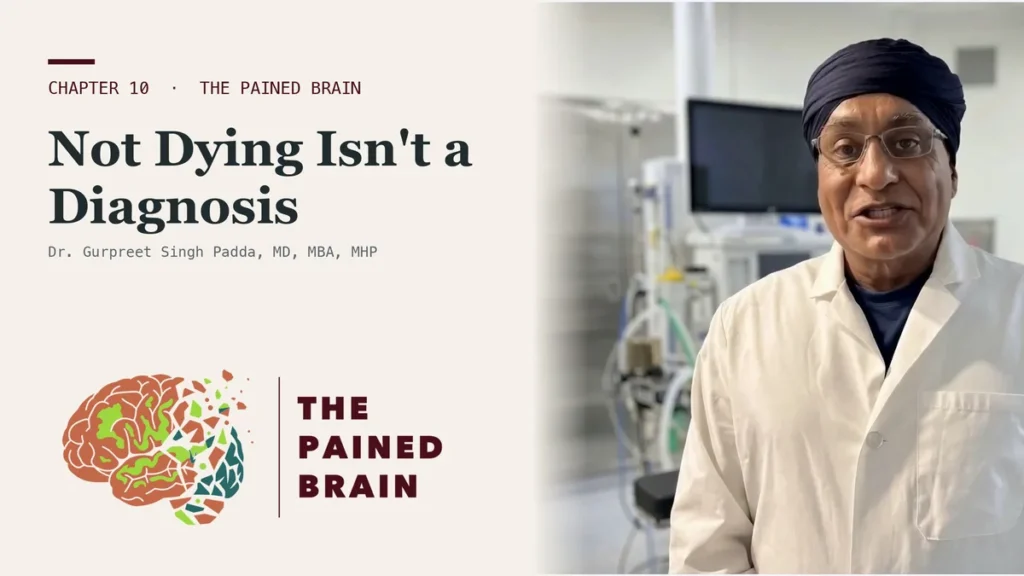
Chapter 10 of The Pained Brain, the video at the top of the page, follows one man through that night. Below is what the video had no room for. That means the exact warning signs, what the visit reliably gives you, what happens in the weeks after, and what a different door looks like. The Pained Brain was written by Dr. Gurpreet Singh Padda, MD, MBA, MHP, with Dr. KrisJay Fucanan, MD.
ER or urgent care for back pain: sort by the red flags
Across 22 studies and 41,320 emergency patients with low back pain, between 2.5 and 5.1 percent in the prospective studies needed urgent treatment. That meant a fracture, a spinal cancer, an infection, or a squeezed spinal cord. Call it three in a hundred. Those people belong in that room, and the room is good at finding them.
One Australian emergency department tracked 1,000 back-pain visits in a row. Of those, 3.3 percent had a serious spinal cause. Another 14.6 percent had a serious cause outside the spine, such as a kidney stone or an aneurysm. The findings that moved the probability most were specific, not vague:
- Numbness in the saddle area (positive likelihood ratio 11.0), trouble passing urine (6.4), or loss of anal tone (6.3). These are signs of cauda equina compression, where the nerves at the base of the spine are squeezed. Surgeons operate on it within hours.
- Fever with back pain. This is the strongest single flag for any serious cause.
- Intravenous drug use (6.9) or a history of tuberculosis (9.8). Both raise the chance of a spinal infection.
The hardest one to catch is an abscess (a pocket of pus) in the spinal canal. Among 457 confirmed cases, 71 percent had already been seen for a related complaint in the month before. Only 10 percent had the textbook trio of back pain, fever and nerve signs. If you were sent home and you are getting worse, with fever or new weakness, go back.
Cauda equina shows up in 0.27 percent of back pain seen in hospital. Only 19 percent of suspected cases turn out to be real. Finding them is the job, and it is the right job.
What the visit gives the other ninety-seven
Low back pain drove 52.8 million American emergency visits from 2016 through 2022. The average stay was 236.6 minutes, and 39.4 percent got an X-ray. The doctor giving that care spends 26.9 percent of the shift with patients and 34.1 percent at the computer. The history that finds a cause does not fit in those minutes.
More testing has not bought more answers. Look at 164 million adult visits for chest pain, belly pain and headache. The share who left with a diagnosis that named a cause fell from 72 to 63 percent over seventeen years, even as testing rose. Back pain was not in that sample. But the pattern matches what patients carry home: a code for where it hurts. And given a case with no red flags at all, most ER doctors surveyed said they would tell the patient to limit activity. That is the one piece of advice the guidelines warn against. Rest weakens the muscles that hold the spine steady. It also feeds the fear that keeps a sensitized nervous system turned up. That is the mechanism in the chapter on the pain amplifier. Timing is biology too. Pain control is weakest in the small hours, as why pain peaks at night explains.
The week after, and the trip back
One New York emergency department followed 556 patients. A week after discharge, 70 percent still could not function normally. At three months, 48 percent still could not. In a later cohort, pain at the one-week call raised the odds of trouble at three months 2.42-fold. The first week is when the path can still be changed.
People come back. In one hospital, 14 percent came back within a year for the same complaint. Those sent home with an opioid came back more often, 68 against 55 percent. Across 21 departments in one health system, 30-day returns ran 32 percent after an opioid. After an anti-inflammatory alone, they ran 19 percent. Both studies are observational (they only watched patients), and the patients given opioids probably hurt more to begin with. The system problem is plainer. Of Canadian ER doctors surveyed, 96 percent said their department had no working path for chronic pain. And 70 percent did not know where to send those patients. Unequal care makes it worse, since Black patients in American emergency departments are 40 percent less likely to get pain medicine for acute pain.
The first prescription and the year that follows
Good opioid stewardship never meant zero. It is the lowest dose that keeps a person functioning while something real is treated. What the ER adds is luck of the draw. In the same hospital, some doctors prescribe an opioid at 7.3 percent of visits and others at 24.1 percent. Their patients look the same across 300 diagnoses. Take Medicare patients who had never used opioids. Drawing the high prescriber raised long-term use a year later from 1.16 to 1.51 percent. That is one extra long-term user for every 48 patients.
How long the first script runs matters more than the first pill. Among 1.29 million patients new to opioids, 6.0 percent were still taking them at a year. That rose to 13.5 percent when the first round ran eight days or more, and 29.9 percent at 31 days. And for acute back pain, adding oxycodone to naproxen improved function at one week by 1.3 points on a 24-point scale. That is indistinguishable from zero. Opioids also slow the bowel, a separate harm covered in the pain pill that paralyzes the gut.
The door that should open the same day
A different visit asks different questions: which structure, which mechanism, which terrain. Structure is proved, not guessed. Does a facet joint cause the back pain? Controlled diagnostic blocks under imaging answer that, and the rigor sets the result. Radiofrequency ablation worked for 26 percent of people picked after one block. It worked for 56 percent when two blocks had each given complete relief. How a medial branch block proves the facet joint covers that test. Terrain is measured, starting with a fasting insulin that no ER order set includes.
Timing changes the year. Look at 265 people seen after an ER back-pain visit. Starting physical therapy within 30 days, not later, went with less than half the twelve-month cost. It went with half the surgery rate and 55 percent lower odds of long-term opioid use. In acute sciatica, an early image-guided transforaminal steroid injection cut leg pain, and those patients used fewer opioids. That is a bridge delivered early. The honest null belongs beside it. One hospital added a rapid-access clinic and saw no drop in admissions. Part of the reason: only 41 percent of referred patients showed up.
The door works when it opens the same day and a doctor behind it has time to ask. In our practice that means the history back to before the pain, the exam, and blood work including fasting insulin. Where a structure is suspected, it means the diagnostic block that proves it. That is done awake without sedation, and most patients drive themselves home within two to four hours. The limits of the emergency room for severe pain are the reason that door exists.
What to ask after an emergency visit
- Does my discharge diagnosis name a cause or only a location?
- Which red flags were checked, and were any positive?
- If I left with an opioid, how many days was it for, and what is the plan when it runs out?
- Who sees me in a week if the pain is still here?
- Has anyone tried to identify which structure is generating this?
For the full study-by-study record, including what each paper cannot show, open the Chapter 10 Deep Dive and take it to your next visit. One headache truly is an emergency, and that same room often gets it wrong; the cluster headache chapter is next.
Frequently asked questions
Should I go to the ER or urgent care for back pain?
Go to the emergency room for back pain with saddle numbness, new trouble urinating, leg weakness, fever, a recent fall with osteoporosis, a history of cancer or intravenous drug use. Without those signs, about ninety-seven in a hundred people will hear they are not dying. Then they go home with a symptom label. A same-day pain visit can start the work of finding a cause. See how same-day and urgent pain visits work here.
What are the cauda equina red flags?
The warning signs are numbness in the saddle area between the legs, new trouble passing urine, loss of bowel control and weakness in both legs. In one ER series, saddle numbness raised the likelihood of serious spinal disease elevenfold. Cauda equina syndrome is rare, and most suspected cases are not confirmed. But every suspected case needs urgent imaging. Compare it with the leg pain of spinal stenosis, which is not an emergency.
Why did the ER only X-ray my back?
An X-ray can rule out some fractures, which is what the ER is looking for. It cannot show a painful facet joint, an inflamed nerve root or a sensitized nervous system. Imaging for ER back pain keeps rising. Diagnoses that name a cause have not risen with it. Learn what imaging can and cannot show about the source of pain.
Does an opioid from the ER help acute back pain?
One randomized trial gave all its ER back-pain patients naproxen. Adding oxycodone improved function at one week by an amount indistinguishable from zero. A longer first prescription is linked with a higher chance of still taking opioids a year later. Short, planned use for a clear reason is a different decision, and any change should be made with your physician. Here is how pain medication can end up making pain worse.
What happens at a same-day pain evaluation?
It starts with a full history and exam. Then comes blood work that looks at the metabolic terrain, including fasting insulin. Imaging is read against the exam. Where a specific structure is suspected, an image-guided diagnostic block can confirm it. A procedure is offered only when clinical need supports it. Walk through what a first interventional pain appointment involves.
Back Pain That Needs an Answer, Not a Waiting Room
If a red flag is present, go to the emergency room now. If not, a same-day visit that asks which structure, which mechanism and which terrain is the faster road to a plan.
Request an appointment, or call or text us.
Sources
- Galliker, G., Scherer, D. E., Trippolini, M. A., Rasmussen-Barr, E., LoMartire, R., & Wertli, M. M. (2020). Low Back Pain in the Emergency Department: Prevalence of Serious Spinal Pathologies and Diagnostic Accuracy of Red Flags. The American Journal of Medicine, 133(1), 60-72.e14. https://doi.org/10.1016/j.amjmed.2019.06.005
- Shaw, B., Kinsella, R., Henschke, N., Walby, A., & Cowan, S. (2020). Back pain “red flags”: which are most predictive of serious pathology in the Emergency Department? European Spine Journal, 29(8), 1870–1878. https://doi.org/10.1007/s00586-020-06452-1
- Durant, E. J., Copos, S., Folck, B. F., Anderson, M., Ghiya, M. S., Hofmann, E. R., Vuong, P., Shan, J., & Kene, M. (2025). Diagnostic Delays Are Common, and Classic Presentations Are Rare in Spinal Epidural Abscess. The Western Journal of Emergency Medicine, 26(3), 692–699. https://doi.org/10.5811/westjem.24985
- Fellner, A., & Kim, H. S. (2025). Usual Care for Low Back Pain at United States Emergency Departments, 2016-2022. Annals of Emergency Medicine, 86(6), 639–645. https://doi.org/10.1016/j.annemergmed.2025.06.005
- Friedman, B. W., O’Mahony, S., Mulvey, L., Davitt, M., Choi, H., Xia, S., Esses, D., Bijur, P. E., & Gallagher, E. J. (2012). One-week and 3-month outcomes after an emergency department visit for undifferentiated musculoskeletal low back pain. Annals of Emergency Medicine, 59(2), 128-133.e3. https://doi.org/10.1016/j.annemergmed.2011.09.012
- Barnett, M. L., Olenski, A. R., & Jena, A. B. (2017). Opioid-Prescribing Patterns of Emergency Physicians and Risk of Long-Term Use. The New England Journal of Medicine, 376(7), 663–673. https://doi.org/10.1056/NEJMsa1610524
- Shah, A., Hayes, C. J., & Martin, B. C. (2017). Characteristics of Initial Prescription Episodes and Likelihood of Long-Term Opioid Use – United States, 2006-2015. MMWR. Morbidity and Mortality Weekly Report, 66(10), 265–269. https://doi.org/10.15585/mmwr.mm6610a1
- Friedman, B. W., Dym, A. A., Davitt, M., Holden, L., Solorzano, C., Esses, D., Bijur, P. E., & Gallagher, E. J. (2015). Naproxen With Cyclobenzaprine, Oxycodone/Acetaminophen, or Placebo for Treating Acute Low Back Pain: A Randomized Clinical Trial. JAMA, 314(15), 1572–80. https://doi.org/10.1001/jama.2015.13043
- Schneider, B. J., Doan, L., Maes, M. K., Martinez, K. R., Gonzalez Cota, A., & Bogduk, N. (2020). Systematic Review of the Effectiveness of Lumbar Medial Branch Thermal Radiofrequency Neurotomy, Stratified for Diagnostic Methods and Procedural Technique. Pain Medicine, 21(6), 1122–1141. https://doi.org/10.1093/pm/pnz349
- Magel, J., Kim, J., Fritz, J. M., & Freburger, J. K. (2020). Time Between an Emergency Department Visit and Initiation of Physical Therapist Intervention: Health Care Utilization and Costs. Physical Therapy, 100(10), 1782–1792. https://doi.org/10.1093/ptj/pzaa100
Dr. Gurpreet Singh Padda, MD, MBA, MHP