The cortisone shot side effects that matter most come from repeated doses. They include faster cartilage thinning in the knee and a sharp blood sugar spike in people with diabetes. They include adrenal suppression, and more fractures after epidural steroid in older adults. Relief fades to about zero by 26 weeks. Platelet-rich plasma offers a longer-lasting effect, not a bigger one.
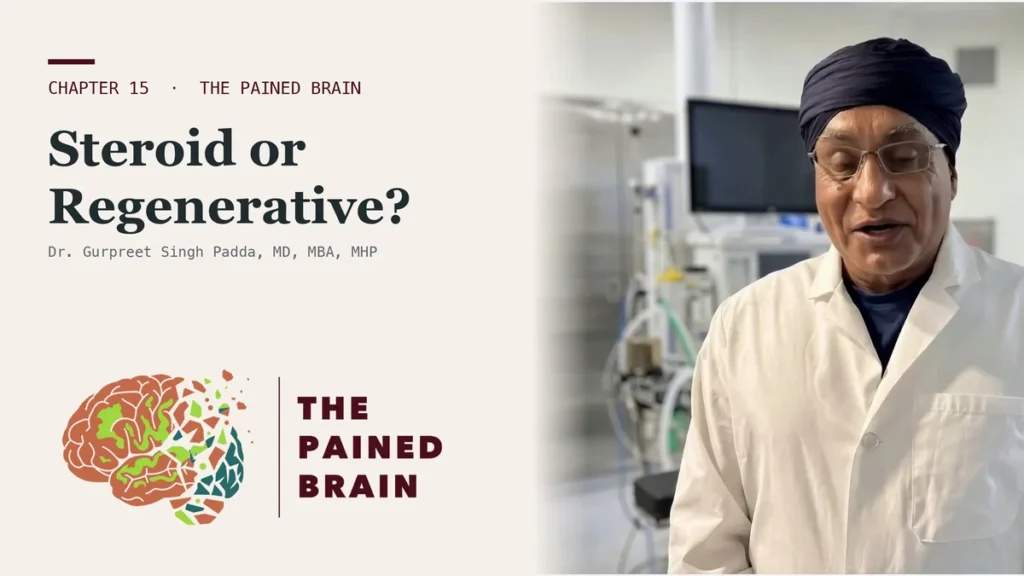
A cortisone shot in a painful knee usually works, and that is the trap. Relief comes fast, fades, and gets repeated while the gaps between shots quietly shrink. The cortisone shot side effects that matter most are not the sore spot after the needle. They are what repeated doses do to cartilage, blood sugar, bone and the adrenal glands. The video above is Chapter 15 of The Pained Brain, by Dr. Gurpreet Singh Padda, MD, MBA, MHP, and Dr. KrisJay Fucanan, MD. It sets that account beside the other path. That path is an injection meant to rebuild, not silence, paired with the metabolic work that gives pain less reason to return.
How long a cortisone shot actually lasts
Across 27 randomized trials in knee arthritis, steroid shots eased pain in the first weeks. Then the effect shrank until it was about zero at 26 weeks. The orthopedic surgeons’ guideline says the effect lasted only up to three months. It lowered its advice a level because of the risk of speeding up arthritis. The rheumatologists still strongly recommend the shot. Neither guideline sets a number limit on repeats.
Cortisone shot side effects on cartilage, blood sugar and bone
The one trial that measured cartilage directly gave 140 patients triamcinolone or saline every twelve weeks for two years. Steroid knees lost 0.21 millimeters of cartilage against 0.10 with saline. And their pain was no better. In a large study, each shot raised the real risk of a knee replacement by 9.4 percent at nine years. But the other side’s evidence is strong too. One study compared steroid with hyaluronic acid, so both groups had knees bad enough to inject. There, the rate ratio for joint-space narrowing was 1.00. Sicker knees get injected. Part of the harm in the large study belongs to the knee, not the drug. At the hip, fast-destroying disease followed 5.4 percent of shots. The risk was low after a single dose of 40 milligrams or less. It was higher after 80 or more and after repeated shots.
The rest of the body pays too. In people with type 2 diabetes, one fast-release knee shot raised peak blood sugar by a median of 169.1 mg/dL over three days. And 93 percent went above 250. An epidural dose of 40 mg suppressed (slowed) the adrenal system for 19.7 days, against 8.0 days for 20 mg. Pain relief was the same. Among older Medicare patients with sciatica, epidural steroid was linked to a fracture hazard of 1.39, and 1.54 at the spine. One Medicare contractor caps epidural steroid at four sessions per spine region in twelve months. It calls a pre-planned series unreasonable.
PRP vs cortisone injection: start with the failures
Platelet-rich plasma is your own blood, spun to concentrate platelets and the growth factors they carry. It is then injected into a joint or tendon. A doctor who quotes only its good trials is selling something. And some of these failures are trials any regenerative doctor would have wanted to win. In a blinded knee trial, 288 patients got three shots of a commercial product. At twelve months, pain fell 2.1 points against 1.8 for saline. That difference could have been zero. A single Achilles shot did nothing against a fake needle. At the hip, no shot of any kind, steroid or plasma, beat saline.
Dose explains the failures. Across 18 placebo-controlled knee trials, products with at least a million platelets per microliter beat placebo on pain by about two points. That held at three, six and twelve months, above the level patients notice. Low-platelet products never got there. And the failed 288-patient trial used a low-platelet product.
Longer, not larger: how the timelines cross
In a small blinded knee trial, steroid clearly won at six weeks. By six and nine months, pooled trials favor plasma. The six-month gap was worth 9.51 points on the osteoarthritis index. Tennis elbow shows the same crossing. Success at one year was 73 percent with plasma against 49 percent with steroid, and plasma was still ahead at two years. The reviewers who have followed this longest put it plainly: platelets offer a longer-lasting effect, not a bigger one. The side effects are those of a needle, mostly pain and swelling where the shot goes in.
Why the spine lags behind the knee
Inside the disc, bone marrow concentrate did no better than a fake procedure. A phase 3 industry trial of injected cells missed its main goal. The small joints of the back do better, but only a little. Pooled across facet and sacroiliac trials, plasma beat steroid by 1.32 points at three months and 1.70 at six, with limited certainty. A blinded French facet trial found no edge. The latest review of randomized spine trials found lasting mid-term benefit for low back nerve pain and facet pain, and little inside the disc.
Coverage, money and the evidence tier
Platelet-rich plasma for joints and tendons is usually not covered, and that is a statement about money. One Medicare contractor says it will not cover it because guidelines do not endorse it and commercial plans do not cover it. A commercial insurer says it will not cover it because it is unproven. So the reasoning runs in a circle. Meanwhile, two European societies judged plasma fitting in 84 of 216 knee scenarios. That was mainly after failed conservative (nonsurgical) care, in joints that are not end-stage. And the pain doctors’ 2025 low back guideline graded epidural plasma at Level III. That is modest, graded evidence, which is not the same as none. The gap itself drives behavior. The three-month drug is paid for. The slower one is paid out of pocket. So the covered option gets repeated. How fee-for-service payment shapes repeat injections follows that incentive further.
The terrain decides whether the seed grows
A regenerative shot is a seed, and the joint is a field. Take 120 patients treated with plasma for Achilles or knee-cap tendon problems. Those with diabetes or prediabetes had 2.41 times the odds of missing a real improvement. Each unit of hemoglobin A1c raised the odds of a poor result 1.16-fold. In knees, body mass index and X-ray grade predicted failure. The platelets were not the problem, since growth-factor levels did not differ by body mass. The tissue they land in was. In one small study, inflammation signals that rise with body mass went with weaker responses.
Terrain work is the treatment the shot makes possible. Cartilage and muscle respond to load. In a 273-patient trial, a year of exercise-based physical therapy beat a steroid shot by 22.70 points on the osteoarthritis index. In an 18-month trial, diet-based weight loss lowered the squeezing force in the knee. It also lowered interleukin-6, an inflammation signal in the blood, compared with exercise alone. Diet plus exercise cut body weight 11.4 percent and brought the biggest drop in pain. The insulin that sits under both is its own story. Where knee arthritis pain actually comes from is the place to start on the joint itself.
What to ask before the next knee injection
Pain is not something to live with because the first three shots wore off. The natural course of knee pain is kinder than that phrase. Followed for six years, 35 percent of people with knee pain had a mild, stable course, and 12 percent improved. Before another steroid shot, ask how many you have had and what the plan is for month six. If plasma is offered, ask the platelet count and whether the joint is too far gone. Ask for fasting insulin and hemoglobin A1c as numbers. Work any medicine change through your doctor. Then watch the gaps between shots. In one uncontrolled series of 368 knees given plasma as needed, the gap between doses grew from 5.42 months to 9.58. Removing damaged tendon tissue covers a step that can come before biology. Pain in older adults who cannot say where it hurts comes next. Every trial here, failures included, is in the Deep Dive to Chapter 15, with what each shows and does not show.
Frequently asked questions
What are the side effects of a cortisone shot?
In the short term, expect possible soreness at the site. In people with diabetes, expect a sharp blood sugar rise lasting days. One trial found peak glucose rose a median of 169.1 mg/dL. With repeated doses, one two-year trial found faster cartilage thinning. Adrenal suppression (slowing of the adrenal glands) grows with dose. Epidural steroid is linked to more fractures in older adults. And a shot within three months of knee replacement raises the odds of infection. Why each injection tends to buy less time than the one before is explained here.
How many cortisone shots can you get in your knee?
No single number fits every knee. The rheumatology guideline sets no number limit. The orthopedic guideline notes the benefit lasts up to three months. For the spine, one Medicare contractor limits epidural steroid to four sessions per region in twelve months. The better question is what each stretch of relief is used for. Shrinking gaps between shots mean nothing is being built in between. Genicular nerve ablation is another option for arthritic knee pain.
Is PRP better than a cortisone injection?
It depends on the time point and the product. Steroid wins in the first six weeks. Pooled trials favor plasma at six and nine months in knee arthritis. In tennis elbow, one-year success was 73 percent with plasma against 49 percent with steroid. High-platelet products beat placebo, and low-platelet products did not. At the hip, no shot beat saline. A summary of recent PRP clinical studies is collected here.
Is PRP covered by insurance?
Usually not. Medicare contractors and many commercial plans list platelet-rich plasma for joints and tendons as not covered. So it is usually paid out of pocket. Not covering it is a payment choice, not a finding that the treatment fails. Professional groups grade it as modest evidence with set uses. Those uses are mainly knees that are not end-stage, after conservative (nonsurgical) care. Placement matters too, because the plasma has to reach the structure. Why a blind needle often misses its target is covered here.
Does blood sugar affect PRP results?
It seems to. In 120 patients treated for Achilles or knee-cap tendon problems, those with diabetes or prediabetes had about two and a half times the odds of missing a real improvement. Higher hemoglobin A1c on its own predicted a poorer result. Platelets from heavier patients carried similar growth factors. That points to the tissue, not the shot. How weight-loss drugs affect knee joint pain is discussed here.
Build Something During the Relief
If your shots wear off faster each time, we look at the joint, the dose and the metabolic terrain underneath before planning the next step.
Request an appointment, or call or text us.
Sources
- Jüni, P., Hari, R., Rutjes, A. W., Fischer, R., Silletta, M. G., Reichenbach, S., & da Costa, B. R. (2015). Intra-articular corticosteroid for knee osteoarthritis. Cochrane Database of Systematic Reviews, 2015(10), CD005328. https://doi.org/10.1002/14651858.CD005328.pub3
- McAlindon, T. E., LaValley, M. P., Harvey, W. F., Price, L. L., Driban, J. B., Zhang, M., & Ward, R. J. (2017). Effect of Intra-articular Triamcinolone vs Saline on Knee Cartilage Volume and Pain in Patients With Knee Osteoarthritis: A Randomized Clinical Trial. JAMA, 317(19), 1967–1975. https://doi.org/10.1001/jama.2017.5283
- Bucci, J., Chen, X., LaValley, M., Nevitt, M., Torner, J., Lewis, C. E., & Felson, D. T. (2022). Progression of Knee Osteoarthritis With Use of Intraarticular Glucocorticoids Versus Hyaluronic Acid. Arthritis & Rheumatology, 74(2), 223–226. https://doi.org/10.1002/art.42031
- Spitzer, A. I., Rodbard, H. W., Iqbal, S. U., Nakazawa, M., DiGiorgi, M., & Winston, R. (2024). Extended-Release Versus Immediate-Release Triamcinolone Acetonide in Patients Who Have Knee Osteoarthritis and Type 2 Diabetes Mellitus. The Journal of Arthroplasty, 39(9 Suppl 2), S218-S223.e1. https://doi.org/10.1016/j.arth.2024.05.055
- Bennell, K. L., Paterson, K. L., Metcalf, B. R., Duong, V., Eyles, J., Kasza, J., Wang, Y., Cicuttini, F., Buchbinder, R., Forbes, A., Harris, A., Yu, S. P., Connell, D., Linklater, J., Wang, B. H., Oo, W. M., & Hunter, D. J. (2021). Effect of intra-articular platelet-rich plasma vs placebo injection on pain and medial tibial cartilage volume in patients with knee osteoarthritis: The RESTORE randomized clinical trial. JAMA, 326(20), 2021–2030. https://doi.org/10.1001/jama.2021.19415
- Bensa, A., Previtali, D., Sangiorgio, A., Boffa, A., Salerno, M., & Filardo, G. (2025). PRP injections for the treatment of knee osteoarthritis: The improvement is clinically significant and influenced by platelet concentration: A meta-analysis of randomized controlled trials. The American Journal of Sports Medicine, 53(3), 745–754. https://doi.org/10.1177/03635465241246524
- Peerbooms, J. C., Sluimer, J., Bruijn, D. J., & Gosens, T. (2010). Positive effect of an autologous platelet concentrate in lateral epicondylitis in a double-blind randomized controlled trial: Platelet-rich plasma versus corticosteroid injection with a 1-year follow-up. The American Journal of Sports Medicine, 38(2), 255–262. https://doi.org/10.1177/0363546509355445
- Filardo, G., Previtali, D., Napoli, F., Candrian, C., Zaffagnini, S., & Grassi, A. (2021). PRP Injections for the Treatment of Knee Osteoarthritis: A Meta-Analysis of Randomized Controlled Trials. Cartilage, 13(1_suppl), 364S-375S. https://doi.org/10.1177/1947603520931170
- Kon, E., de Girolamo, L., Laver, L., Andriolo, L., Andia, I., Bastos, R., Beaufils, P., Biant, L., Bøe, B., Boffa, A., Cugat, R., Di Martino, A., Erggelet, C., Iosifidis, M., Kocaoglu, B., Magalon, J., Marinescu, R., Nehrer, S., Niemeyer, P., … Filardo, G. (2024). Platelet-rich plasma injections for the management of knee osteoarthritis: The ESSKA-ICRS consensus. Recommendations using the RAND/UCLA appropriateness method for different clinical scenarios. Knee Surgery, Sports Traumatology, Arthroscopy, 32(11), 2938–2949. https://doi.org/10.1002/ksa.12320
- Abate, M., Paganelli, R., Pellegrino, R., Di Iorio, A., & Salini, V. (2024). Platelet Rich Plasma Therapy in Achilles and Patellar Tendinopathies: Outcomes in Subjects with Diabetes (A Retrospective Case-Control Study). Journal of Clinical Medicine, 13(18), 5443 (article number from DOI; PubMed record lists volume 13, issue 18). https://doi.org/10.3390/jcm13185443
Dr. Gurpreet Singh Padda, MD, MBA, MHP