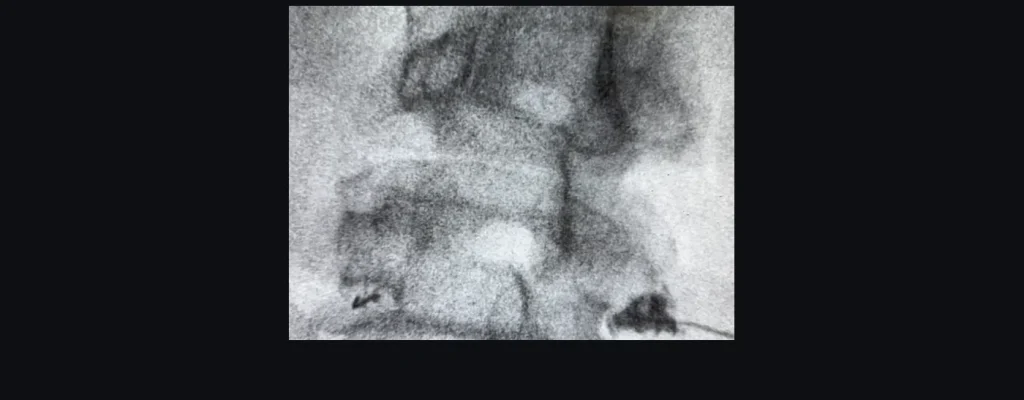
Epidural lysis of adhesions for epidural fibrosis after back surgery targets one exact problem: scar tissue after surgery (epidural fibrosis). That scar can tether a nerve root and block medicine from spreading where it needs to go. Why do you still hurt months after “successful” imaging? Because the assembly line often stops at the operation report, not the pain mechanism. And epidural fibrosis is a leading culprit.
How is epidural fibrosis diagnosed, and why can MRI miss it?
Diagnosis is not a single test. It is a process. First we narrow down the pain generator. Then we pick a procedure that matches it.
Epidural lysis of adhesions for epidural fibrosis after back surgery makes the most sense when the facts line up. Your story, exam, and targeted tests should all point to epidural fibrosis and a tethered nerve root as a plausible cause. That does not mean “MRI must be positive.” It means we know how the imaging performs.
One of the most important points: MRI can miss low-grade epidural fibrosis. One prospective series followed 61 patients with failed back surgery syndrome. Six had grade 1 fibrosis on epiduroscopy (a tiny camera passed into the spinal canal), while none showed fibrosis on MRI. The authors concluded that epiduroscopic imaging appears more sensitive than MRI for finding grade I epidural fibrosis.1 That is not a reason to ignore MRI. It is a reason to stop using “negative MRI” as a hard stop.
Because of this gap, patients with failed back surgery syndrome can still have adhesions that matter even when MRI looks vague. The failure is not in the first six weeks. It is at month four, when the assembly line offers two exits and neither one holds a diagnosis.
How do we decide who is a candidate for lysis of adhesions?
We judge who is a candidate with one blunt question. Do epidural fibrosis and tethering look like plausible drivers of your pain, not just a side finding?
Epidural fibrosis is a known contributor to lasting pain after spine surgery. The more surgeries you have had, and the bigger they were, the more fibrosis there tends to be.1 Published estimates of how often it is the main pain generator vary widely. So we treat it as one plausible mechanism to test, not a settled majority cause. That supports the premise. It does not mean every person with pain after surgery should get adhesiolysis.
Who do we tend to consider? Patients with lasting or returning radicular symptoms (nerve pain that shoots down the leg) after prior surgery. Their pain patterns should match, and testing should support nerve involvement. Say you already tried a well-targeted epidural steroid injection or other nerve root treatments. If the medicine did not spread or the relief was small, adhesiolysis ties more clearly to the mechanism.
Who should we be careful with? Patients whose main problem is mostly outside the epidural space. Examples are mainly facet-mediated pain or sacroiliac-mediated pain. Another is a new compressive lesion that needs a different path. Another is widespread central sensitization with little peripheral match. In those cases, adhesiolysis may add risk without treating the main signal generator.
Whether it helps in your case depends on mapping your pain generator. That mapping is also where we bring in metabolic pain management and other drivers, because chronic pain does not exist in isolation.
Does epidural lysis of adhesions work, and what are the risks?
Let’s talk about the numbers without pretending they settle everything. One multicenter retrospective study looked at 115 patients treated for failed back surgery syndrome (n = 104) or spinal stenosis (n = 11). Of them, 48.7% (95% CI 39.3%–58.1%) had a positive outcome. That was defined as at least 50% pain relief lasting at least one month.2 That is not a universal success rate. But it is a real response rate in the right patients.
Patients often want certainty about the added drugs. In that same study, the use of hyaluronidase did not correlate with outcomes in univariable analysis (odds ratio 1.2, 95% CI 0.6 to 2.5, P = 0.65).2 In plain terms, that data did not show it reliably improves outcomes.
Now the risk talk. Reported complication rates vary between studies, because each study counts them in its own way. So a single pooled number would mislead you. But you should treat the procedure as medical, not cosmetic.
What the evidence does not support is ad-style claims of guaranteed lasting relief. If your case does not match the patients studied, you cannot assume the same outcomes.
Also know this: at least one payer medical policy does not consider lysis of epidural adhesions medically necessary. That does not mean it never helps. It means payers often judge by how strong and consistent the evidence is. And not every payer uses the same bar for access.
Frequently asked questions
Is epidural lysis of adhesions worth it if my MRI did not show severe scar?
Yes, it can still be worth discussing if your symptoms and past injection response fit epidural fibrosis. MRI is about five times less likely to detect high-grade epidural fibrosis than endoscopic assessment. So an MRI that does not show severe scar does not rule it out. See also epiduroplasty and epidural lysis of adhesions.
How is epidural fibrosis after surgery diagnosed before epidural lysis of adhesions?
Diagnosis is usually clinical and procedural, not just imaging. We look at your failed back surgery syndrome timeline and your nerve-root symptom patterns. We look at past treatments like epidural steroid injection. We look at diagnostic block results when we have them.
What are the risks of epidural lysis of adhesions?
Complications are uncommon but not rare. One 2025 summary reported that about 9 in 100 people had complications. Your risk depends on your anatomy, medicines, and past surgery details. That is why patient selection and informed consent matter. See also epidural steroid injection.
Does hyaluronidase improve outcomes for epidural lysis of adhesions?
In one multicenter retrospective study, hyaluronidase (an enzyme added to the mix) did not correlate with outcomes in univariable analysis. That means the evidence for routine benefit from hyaluronidase is not strong. See also selective nerve root block.
How long does pain relief last after epidural lysis of adhesions?
In the multicenter study by Hsu and colleagues (2014), a positive outcome meant at least 50% pain relief lasting at least one month. Of the 115 patients, 48.7% met it. How long relief lasts varies by person. Some patients need a broader chronic pain treatment plan to address central sensitization, not just the pain signal. See also why leg pain persists after back surgery.
To discuss your own case, request an appointment through the appointment request form, call (314) 481-5000, or text (314) 886-5902. You can review the full range of pain treatments, read about the pain management doctors in St. Louis, or find both offices on the locations page.
Sources
- Guner D, Asik I, Ozgencil GE, Peker E, Erden MI. “The Correlation of Epidural Fibrosis with Epiduroscopic and Radiologic Imaging for Chronic Pain after Back Surgery.” Pain Physician, 2021;24(8):E1219–E1226. Prospective trial, 61 patients with failed back surgery syndrome. PMID 34793648
- Hsu E, Atanelov L, Plunkett AR, Chai N, Chen Y, Cohen SP. “Epidural lysis of adhesions for failed back surgery and spinal stenosis: factors associated with treatment outcome.” Anesthesia & Analgesia, 2014;118(1):215–224. Multicenter retrospective study, 115 patients. doi:10.1213/ANE.0000000000000042
Dr. Gurpreet Singh Padda, MD, MBA, MHP


