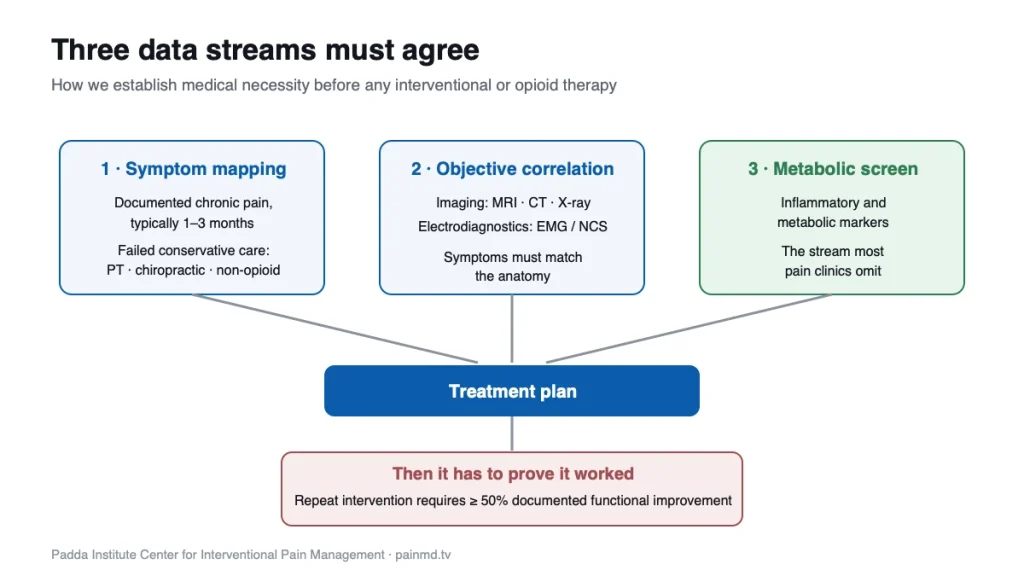
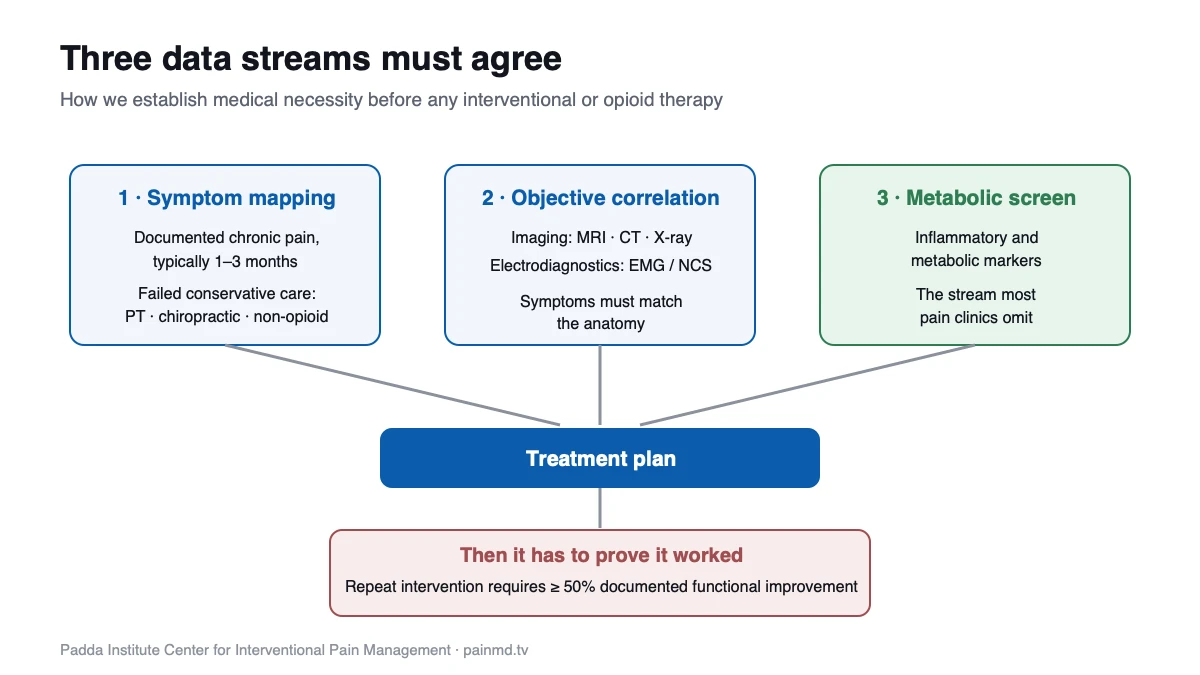
We establish medical necessity with three separate lines of proof that must agree before we treat. One: documented pain that did not get better with conservative (non-surgical) care. Two: scans and nerve tests that match your symptoms. Three: blood work for metabolism and inflammation.
“Medical necessity” is one of those phrases that can mean everything or nothing. Here it means something specific you can test. Three separate lines of proof have to agree before we treat.
Stream one: what counts as failed conservative care?
We require documented chronic pain, usually lasting at least one to three months, that has failed to improve with conservative care. That means physical therapy, chiropractic care and non-narcotic drug trials have been tried and written down, not just mentioned.
This is the step most often skipped elsewhere. Skipping it is how patients end up on more and more medication for a problem nobody has pinned down.
Stream two: do your scans and nerve tests match your pain?
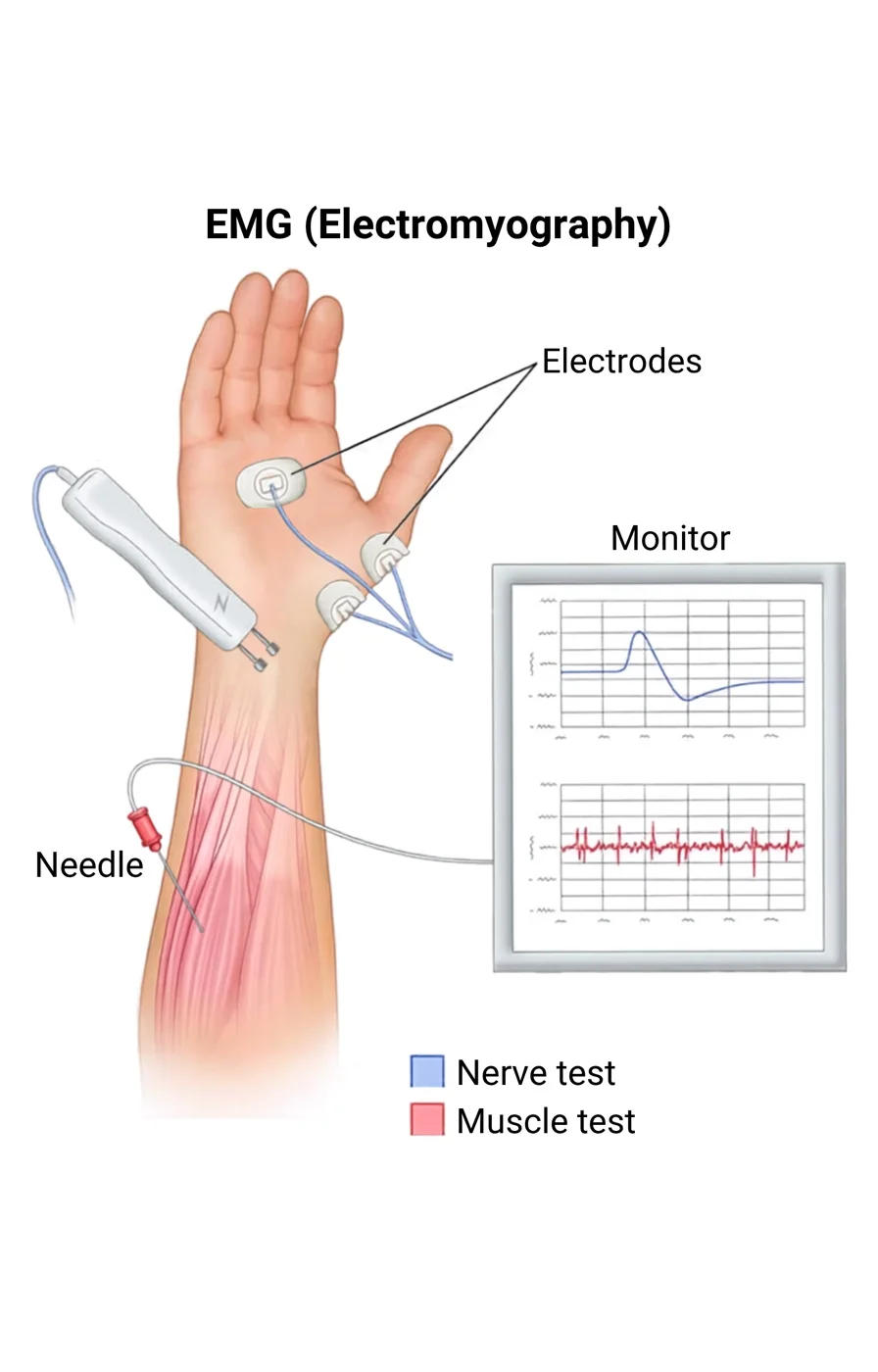
What you report has to line up with what the tests show. We use imaging (MRI, CT, X-ray) and electrodiagnostic testing (EMG/NCS) to tell nerve damage in the limbs apart from a pinched nerve root at the spine. It also confirms that what you describe matches what the anatomy shows.
When the two do not agree, that mismatch is itself a key finding. It sends the workup in a new direction. We do not ignore it.
Stream three: is metabolic inflammation driving your pain?
Most pain practices skip this one entirely. Chronic pain is often an outgrowth of systemic metabolic inflammation, so we require metabolic health screening as part of proving necessity.
We treat pain as a nerve event and also as a body-wide one. The inner terrain has to be steadied. Two patients with the same scans can hurt in very different ways because their metabolic terrain differs. See how inflammation and diet drive chronic pain.
How do you know if a pain procedure worked?
Proving necessity at the start is not enough. Pain procedures both find the problem and treat it. If you ask for a repeat procedure, we require proof of at least 50% functional improvement. Without that proof we stop the therapy. We do not run an assembly line of endless injections.
We review medications every four months. If function has not improved, we taper the medication. We do a full look back at your care every six months. Details for referring doctors and pharmacy partners are in our opioid stewardship guide.
Frequently asked questions
Why do I need imaging or nerve testing before treatment?
Because what you report needs to line up with what the scans and nerve tests show. Imaging and nerve testing tell nerve damage in the limbs apart from a pinched nerve root at the spine. They confirm the target before any procedure.
Why does a pain clinic order metabolic blood work?
Because chronic pain is often an outgrowth of body-wide metabolic inflammation. Blood markers for metabolism and inflammation reveal drivers that scans cannot show. Treating them is often what makes the structural treatment hold. Individual results vary.
To see how metabolic inflammation keeps pain going after an injury heals, read Why Medications, Procedures, and Surgery May Not Fix Chronic Pain.
What happens if a procedure does not help?
We require proof of at least 50% functional improvement before we repeat a procedure. Without it, we stop that therapy and take a fresh look. We do not repeat it forever. Do not stop or change any prescribed medication on your own.
What qualifies as medically necessary pain treatment?
Here, three separate lines of proof have to agree. First, documented chronic pain, usually lasting at least one to three months, that did not get better with physical therapy, chiropractic care and non-narcotic medication. Second, imaging or nerve testing that matches what you describe. Third, blood work for metabolism and inflammation. All three must agree before treatment begins.
How is medical necessity documented?
Every step is written down, not just mentioned. Conservative care has to be tried and recorded. Scans and nerve studies are checked against your symptoms. Once treatment starts, a repeat procedure needs at least 50% documented functional improvement. Medication gets a formal review every four months. A full look back at your care happens every six months.
What if my scans do not match my symptoms?
That mismatch matters, and we do not ignore it. When what you describe does not line up with the scans and nerve tests, the mismatch itself is a key finding. It points the workup toward the real source. For example, is it nerve damage in the limbs or pain coming from the spine? We sort that out before any procedure is planned.
Where are you located and how do I make an appointment?
Padda Institute Center for Interventional Pain Management, 4477 Woodson Rd, Suite 100, St. Louis, MO 63134. Book at painmd.tv/appointment/ or call (314) 481-5000.
The office, hours and directions are on our Locations page.
How can I tell whether a clinic is matching the procedure to the right structure?
Ask what confirmed the target. A matched plan names the structure, such as a facet joint, a nerve root or the sacroiliac joint, and shows three things that agree: an exam pattern that fits, imaging that fits, and a diagnostic block that took the pain away. If the answer is “your MRI shows arthritis” with no block or nerve test behind it, the procedure is aimed at a picture, not at your pain. Learn more: how a medial branch block confirms facet joint pain.
Key takeaways
- Three separate lines of proof must agree before treatment: symptom history, imaging, and metabolic blood work.
- Proof that conservative care failed is a requirement, not a formality.
- Metabolic and inflammation testing is part of proving necessity, not an add-on.
- A repeat procedure requires at least 50% documented functional improvement.
This article is educational and is not a substitute for evaluation, diagnosis, or treatment by a physician. Individual results vary. Do not start, stop, or change any medication without consulting your physician.
Find the source of your pain — not just the signal
Padda Institute Center for Interventional Pain Management builds a customized, root-cause plan for each patient. Interventional care and metabolic medicine, under one roof in St. Louis.
Or call or text us — 4477 Woodson Rd, Suite 100, St. Louis, MO 63134.
Msg & data rates may apply. Reply STOP to opt out, HELP for help. Text is not a secure channel — please don’t send medical or personal health information by text, and don’t use text for emergencies.
Medically reviewed by Dr. Gurpreet Singh Padda, MD, MBA, MHP — Board Certified in Anesthesiology, Pain Medicine, Interventional Pain Management, Addiction Medicine, and Obesity Medicine. Last reviewed July 2026.
Dr. Gurpreet Singh Padda, MD, MBA, MHP