Stop a cluster headache attack with treatments that act in minutes. Use 100 percent oxygen at 12 liters a minute by face mask, a 6 mg sumatriptan shot, or a sphenopalatine ganglion block through the nostril. A painkiller tablet fails because it is still dissolving when the attack ends.
The attack arrives behind one eye, usually at the same hour of the night. The eye waters, the nostril runs, and the person paces because lying still is impossible. Forty-five minutes later it is gone, until tomorrow. Anyone searching for how to stop a cluster headache has usually already tried a painkiller that did nothing, because the tablet was still dissolving when the attack ended.
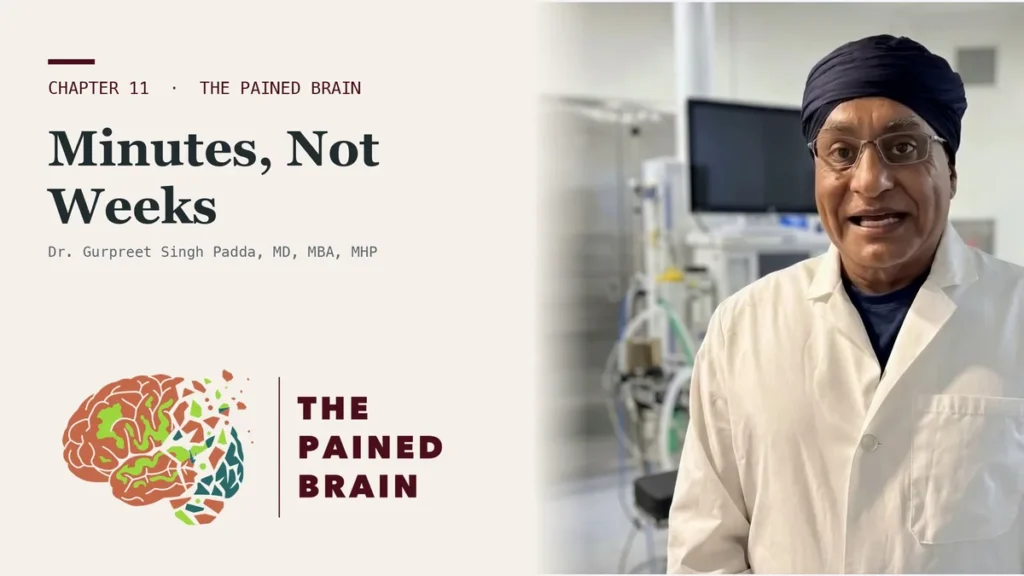
Chapter 11 of The Pained Brain, the video above, calls this the most painful headache in medicine. It argues this is a problem of minutes, not weeks. This page adds the evidence behind each option, graded honestly. It also lays out the plan for the whole bout, not just one attack. The book’s authors are Dr. Gurpreet Singh Padda, MD, MBA, MHP, and Dr. KrisJay Fucanan, MD.
The attack and the clock that sets it
Cluster headache is rare. About 124 per 100,000 people get it in their lifetime. Attacks last 15 to 180 minutes, can come up to eight times a day, and stay on one side. Among 1,604 people who met the diagnostic criteria, the average attack scored 9.7 out of 10. And 72.1 percent gave it the top score. The same people rated labor at 7.2.
Two systems in the body run it. The timing comes from the hypothalamus, the brain’s master clock. A PET scan study of triggered attacks showed it lighting up on the side of the pain, and only during the pain. The pain travels through the trigeminal nerve and the parasympathetic wiring that passes through the sphenopalatine ganglion. That is a small knot of nerve tissue behind the nose. That relay is why the eye tears and the nose runs. It is also where one of the fastest treatments aims. The clock half of this story is in why pain is worst in the small hours, and the same body-clock machinery runs through the gut’s own jet lag.
Why the diagnosis takes a decade
Pooled across 22 studies and 8,654 patients, the average time from first attack to correct diagnosis is 10.43 years. Older patient groups push that average up. In one British series, the delay fell from 22.3 years for onset in the 1950s to 2.6 years for onset in the 1990s. In a Danish series it fell below one year after 2010. Onset before age 20 still carries a delay of 13.8 years.
The wrong turns follow a pattern. In the Netherlands, 34 percent had seen a dentist first and 33 percent an ear, nose and throat surgeon. Women are more often labeled as migraine patients. They more often have nausea and less often the red eye. Yet half of all cluster patients are sensitive to light or sound. So those signs cannot tell the two apart.
A three-question screen asks about intensity, duration and the tearing and nasal signs. It catches cluster headache with 84 percent sensitivity and 89 percent specificity in its test group. The system does not ask it. In one survey, 92.9 percent of emergency doctors said they put these patients in the lowest-priority zone. Only 15 percent of family and emergency doctors felt well informed.
How to stop a cluster headache attack
- High-flow oxygen. In a randomized crossover trial, 100 percent oxygen at 12 liters a minute by face mask for 15 minutes ended or eased 78 percent of treated attacks, against 20 percent for air. Only 76 of 109 randomized patients had attacks counted. The figure is per attack, not per patient.
- Injected sumatriptan. A 6 mg shot left 48 percent pain-free at 15 minutes, against 17 percent on placebo. That is a number needed to treat of 3.3. The reviewers concluded that pills are not right for an attack this short.
Opioids are on no recommended list, and patients know why. Among 2,193 people surveyed, oxygen was completely or very effective for 54 percent and opioids for 6 percent. Yet among 7,589 newly diagnosed patients in insurance claims, opioids were the most common prescription type in the next year, at 41 percent. Of those given opioids, 53.3 percent were in the emergency department or hospital within the year. That compares with 26.8 percent for those given a proper treatment without one. Sicker patients may get more opioids, so that is not proof of cause. The emergency room pattern is familiar from the mismatch chapter before this one.
The money problem is access. Of 566 patients who finally got oxygen, 36 percent had it within a month of diagnosis. And 13 percent waited two to five years, because a doctor did not believe in it or an insurer would not pay. The average wait for a new neurology visit in the United States is 49.7 days. A six-week bout is over by then.
The ganglion behind the nose
The sphenopalatine ganglion sits just behind the middle turbinate (a ridge inside the nose), a few millimeters under the nasal lining. Sluder described it in 1908 as a source of one-sided face pain with tearing and congestion. Because it is so shallow, it can be bathed in numbing medicine through the nostril with a soft catheter. No needle goes through the skin. It usually starts working within 10 to 30 minutes. In a series of 489 such blocks in children and young adults with migraine, done under X-ray guidance, there were no immediate complications. Each took less than 10 minutes. In a chronic migraine trial, the common effects were tearing in 30 percent and a bad taste in 26 percent. All were short-lived.
Here is the evidence level, stated once. In cluster headache itself, the controlled study is small. Of 15 patients, 9 had attacks triggered with nitroglycerin. Numbing medicine on the ganglion ended the pain in all of them: in 37.0 minutes with lidocaine against 59.3 with saline. A systematic review gives the block a Grade B based on that study. No sham-controlled trial of the office block in natural attacks has been run. The anatomy has been tested another way. An implanted stimulator on the same ganglion relieved 67.1 percent of attacks within 15 minutes, against 7.4 percent for sham, in 28 patients. The block is done awake, without sedation, and patients drive themselves home. SPG and stellate ganglion blocks for cluster headache and migraine covers the procedures in more detail.
Ending the bout: the bridge
Stopping one attack is the first job. Ending the run of attacks has stronger trials behind it. A single steroid shot around the occipital nerve at the back of the head left 11 of 13 patients attack-free for the next week. None of 10 on placebo were. Three shots brought 20 of 21 patients under two attacks a day, against 12 of 22. Pooled, the relative risk of pain freedom at one month is 4.86. A short course of prednisone pills cut first-week attacks from 9.5 to 7.1.
These cover the gap while verapamil, the standard preventive, kicks in. That takes about 1.7 weeks in episodic cluster and 5 weeks in chronic. The dose that works can upset heart rhythm. In one audit, 19 percent of patients with an electrocardiogram on file had an abnormal heart rhythm (arrhythmia). And 41 percent of those treated had no electrocardiogram at all. Dose changes and monitoring belong with your physician.
Episodic and chronic cluster respond differently to newer drugs. An anti-CGRP antibody cut weekly attacks by 8.7 against 5.2 on placebo in episodic cluster. It missed its target in chronic cluster. When everything fails, an implanted occipital nerve stimulator helps 57.3 percent in pooled series. The terrain matters too, because sleep timing and light feed the brain’s clock. A small, unrepeated pilot of evening melatonin helped 5 of 10 patients, against none on placebo.
What to bring to your next appointment
- Can we go through the three screening questions for cluster headache?
- What is my plan for an attack that works within fifteen minutes?
- Can the home oxygen paperwork start today?
- What is the transitional treatment for this bout while a preventive takes hold?
- If I am on verapamil, when is my next electrocardiogram?
Every trial cited here, with sample sizes and limits, is laid out in the Deep Dive to Chapter 11. Why the system pays least for the fast, low-risk options is the subject of the chapter on misaligned incentives.
Frequently asked questions
What is the fastest way to stop a cluster headache?
High-flow oxygen by face mask and injected sumatriptan have the strongest trial evidence. Both can end an attack within about fifteen minutes. Tablets are too slow for attacks that often last under an hour. A sphenopalatine ganglion block through the nose is another fast option given in a clinic. Its evidence in cluster headache is thinner. See how cluster headache is treated in our clinic.
How can I tell cluster headache from migraine?
Cluster attacks always stay on one side. They last 15 minutes to three hours and come back up to eight times a day. They bring tearing, a runny or blocked nostril on the same side, and restlessness. Migraine sufferers usually want to lie still. Nausea and light sensitivity occur in about half of cluster patients, so they do not rule cluster out. Learn the nerve reflex behind the watering eye and blocked nostril.
What is a sphenopalatine ganglion block, and does it hurt?
A thin catheter passed along the nostril places numbing medicine on the lining of the nose. Under that lining sits a nerve relay that carries cluster and migraine pain. There is no needle through the skin and no sedation. Most people notice a bitter taste, a numb throat or a watery eye for a short time. The procedure takes minutes. Read what to expect from a sphenopalatine ganglion block.
Why don’t opioids work for cluster headache?
The attack is usually over before an opioid pill is absorbed. And the pain comes from a nerve reflex that opioids do not switch off. In a survey of more than two thousand patients, only 6 percent rated opioids completely or very effective, against 54 percent for oxygen. Patients given opioids after diagnosis also used emergency and hospital care more often. Our view on medication as a bridge, not a destination.
Can a nerve block end a cluster headache bout?
A steroid shot around the greater occipital nerve at the back of the head is the best-supported way to shorten a bout. In one randomized trial, 11 of 13 patients were attack-free for a week after a single shot, against none on placebo. It covers the weeks a daily preventive needs to start working. See the nerve blocks we perform and what each one targets.
A Bout Has Started. Be Seen This Week, Not in Two Months.
Cluster headache runs on a clock measured in minutes and weeks. We see a patient in an active bout quickly. That way the attack plan and the bridge to prevention start while the bout is still running.
Request an appointment, or call or text us.
Sources
- Burish, M. J., Pearson, S. M., Shapiro, R. E., Zhang, W., & Schor, L. I. (2021). Cluster headache is one of the most intensely painful human conditions: Results from the International Cluster Headache Questionnaire. Headache, 61(1), 117–124. https://doi.org/10.1111/head.14021
- Van Obberghen, E. K., Fabre, R., & Lanteri-Minet, M. (2025). Cluster headache diagnostic delay and its predictors: a systematic review with a meta-analysis. The Journal of Headache and Pain, 26(1), 71. https://doi.org/10.1186/s10194-025-02001-7
- Parakramaweera, R., Evans, R. W., Schor, L. I., Pearson, S. M., Martinez, R., Cammarata, J. S., Amin, A. J., Yoo, S. H., Zhang, W., Yan, Y., & Burish, M. J. (2021). A brief diagnostic screen for cluster headache: Creation and initial validation of the Erwin Test for Cluster Headache. Cephalalgia, 41(13), 1298–1309. https://doi.org/10.1177/03331024211018138
- Cohen, A. S., Burns, B., & Goadsby, P. J. (2009). High-flow oxygen for treatment of cluster headache: a randomized trial. JAMA, 302(22), 2451–2457. https://doi.org/10.1001/jama.2009.1855
- Law, S., Derry, S., & Moore, R. A. (2013). Triptans for acute cluster headache. Cochrane Database of Systematic Reviews, 2013(7), CD008042. https://doi.org/10.1002/14651858.CD008042.pub3
- Pearson, S. M., Burish, M. J., Shapiro, R. E., Yan, Y., & Schor, L. I. (2019). Effectiveness of Oxygen and Other Acute Treatments for Cluster Headache: Results From the Cluster Headache Questionnaire, an International Survey. Headache, 59(2), 235–249. https://doi.org/10.1111/head.13473
- Choong, C. K., Ford, J. H., Nyhuis, A. W., Joshi, S. G., Robinson, R. L., Aurora, S. K., & Martinez, J. M. (2017). Clinical Characteristics and Treatment Patterns Among Patients Diagnosed With Cluster Headache in U.S. Healthcare Claims Data. Headache, 57(9), 1359–1374. https://doi.org/10.1111/head.13127
- Costa, A., Pucci, E., Antonaci, F., Sances, G., Granella, F., Broich, G., & Nappi, G. (2000). The effect of intranasal cocaine and lidocaine on nitroglycerin-induced attacks in cluster headache. Cephalalgia, 20(2), 85–91. https://doi.org/10.1046/j.1468-2982.2000.00026.x
- Ho, K. W. D., Przkora, R., & Kumar, S. (2017). Sphenopalatine ganglion: block, radiofrequency ablation and neurostimulation – a systematic review. The Journal of Headache and Pain, 18(1), 118. https://doi.org/10.1186/s10194-017-0826-y
- Ambrosini, A., Vandenheede, M., Rossi, P., Aloj, F., Sauli, E., Pierelli, F., & Schoenen, J. (2005). Suboccipital injection with a mixture of rapid- and long-acting steroids in cluster headache: a double-blind placebo-controlled study. Pain, 118(1-2), 92–96. https://doi.org/10.1016/j.pain.2005.07.015
Dr. Gurpreet Singh Padda, MD, MBA, MHP