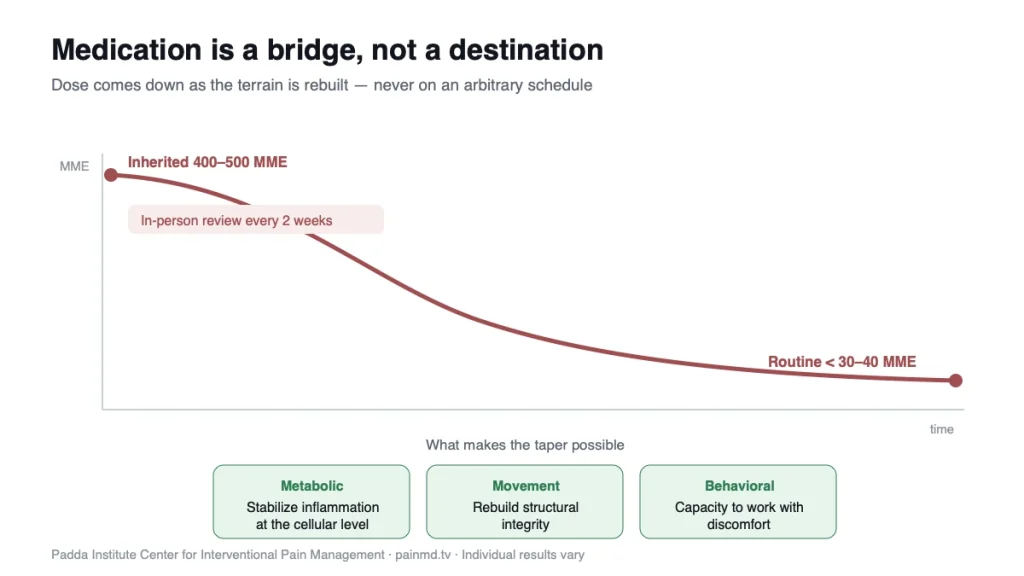
Opioid tapering here is a slow, data-driven step-down, never a random cut on somebody else’s timetable. Doses come down as metabolic, movement and behavioral care rebuild your body’s own power to work with less medicine.
Most patients who come in for a taper have heard the word used as a threat. It is usually framed as something done to them, on somebody else’s timetable, because of somebody else’s guideline. That is not what a taper is for.
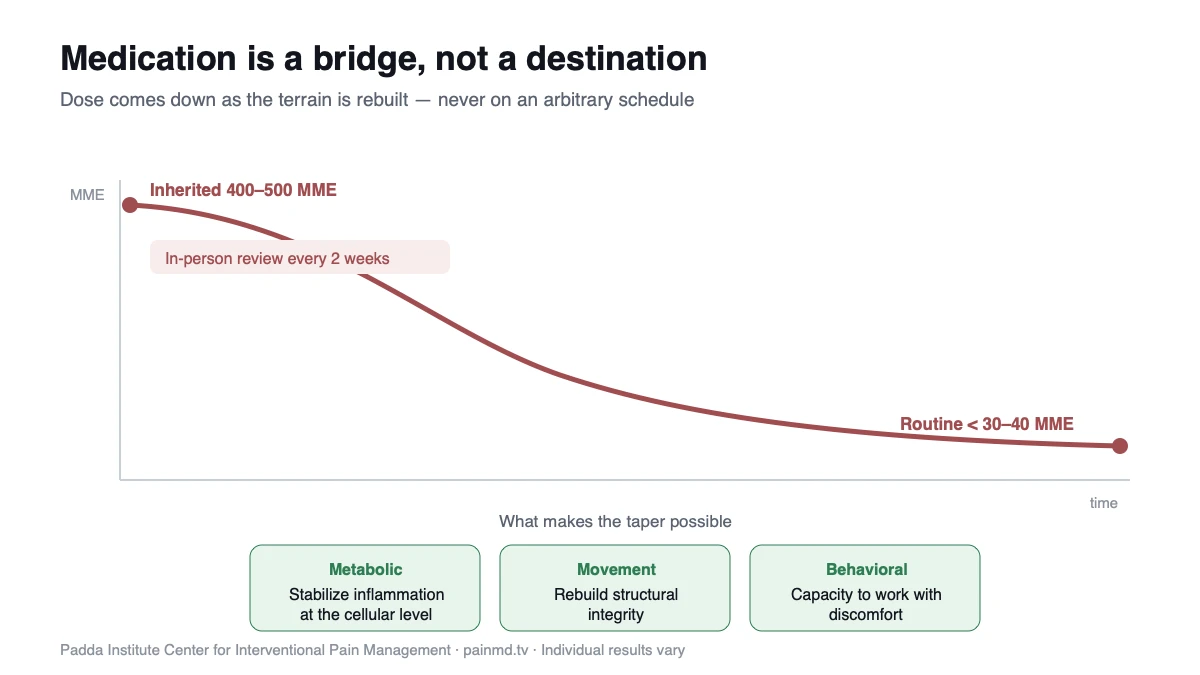
At our center, medication is a bridge, not a destination. The goal is to calm the nervous system, lower body-wide inflammation and restore metabolic health. Then you can function while leaning less on outside chemicals.
Is tapering taking away my support?
We do not view tapering as taking away support. We view it as uncovering your body’s own capacity. Medication masks signals. That includes the very signals we are working to change through structural, metabolic and behavioral care. Lowering the dose is how we find out what the body can now do on its own.
If the terrain underneath has truly improved, the taper shows it. If it has not, the taper tells us that too, and we adjust.
Data-driven and gradual, never arbitrary
We set each taper from three things: how stable you are, your progress in physical therapy and movement, and your metabolic markers. Slow cuts let the nervous system adjust safely. That keeps withdrawal low and blocks the rebound that fast changes cause.
Many patients come to us from primary care at 400–500 milligram equivalents (MME). Those doses come down on purpose. They usually reach a routine level within one to three months. Not overnight, and not on a fixed calendar that ignores how your body is doing.
What makes an opioid taper work?
A taper depends on you showing up for three pillars:
- Metabolic and nutritional optimization — calming inflammation inside the cells. See how visceral fat pumps out pain signals.
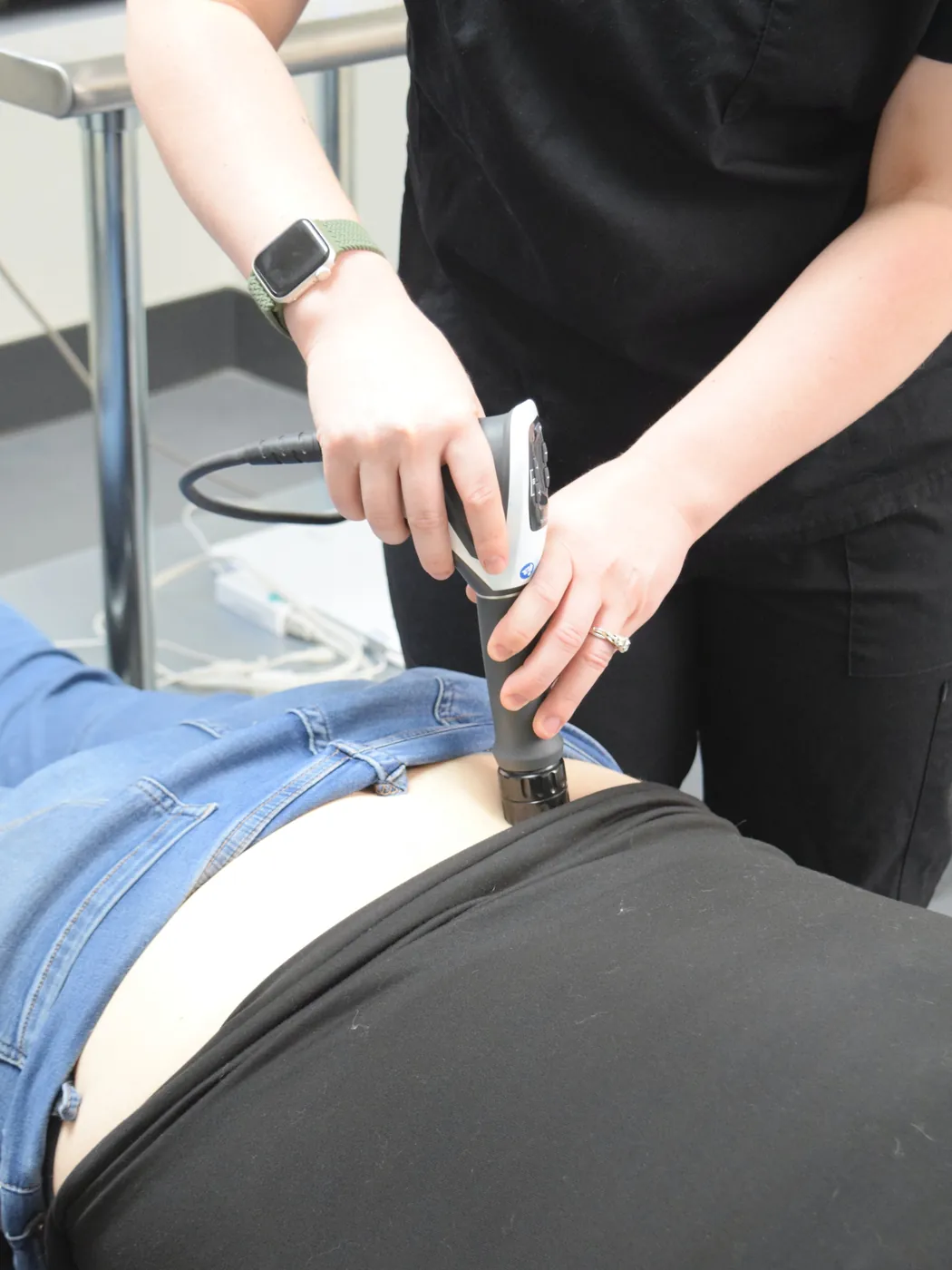
- Movement and physical therapy — rebuilding strength and structure so the body can hold itself up.
- Behavioral health and resilience — learning to work through discomfort instead of falling back on a drug crutch.
These are requirements, not suggestions. Care that is medication alone does not meet our criteria for medical necessity.
Can the tapering timeline change?
We run steady cognitive and psychometric screening (tests of thinking and mood) the whole way through. If your body shows the taper needs to slow, we slow it. Patients on long-term controlled substances are seen in person every two weeks. So changes happen fast, not at the next quarterly review.
Rebuilding the body’s own pain-control system is part of the plan. See why sleep governs your natural pain control and why long-acting opioids can make pain worse.
Frequently asked questions
Will I be cut off from my medication?
No. Tapering here is slow and based on your clinical data, not a random deadline. If your body shows the timeline should change, we change it. Never stop or change a prescribed medication on your own. Do it with your physician.
Why Abrupt Opioid Tapering Is Also Harm explains why stopping suddenly is not the safe alternative.
How quickly do you reduce a high dose?
Patients who arrive at 400 to 500 MME usually reach a routine dose over one to three months. We review them in person every two weeks. Speed depends on stability, therapy progress and metabolic markers. Individual results vary.
Why do I have to do physical therapy and metabolic testing to stay on treatment?
Because medication alone does not address why the nervous system is overexcited. Taking part in physical therapy, behavioral health and metabolic care is what makes a taper possible. If you do not take part, the care no longer meets criteria for medical necessity.
How We Establish Medical Necessity Before Treating Pain explains how those criteria are set.
Is there a standard schedule for tapering off opioids?
Not here. There is no fixed calendar that ignores how your body is doing. We set each taper from your clinical stability, your progress in physical therapy and movement, and your metabolic markers. Patients on long-term controlled substances are seen in person every two weeks. So the pace is checked and adjusted often, not once a quarter.
Does a slow taper make withdrawal easier?
Yes. A slow step-down gives the nervous system time to adjust. That keeps withdrawal to a minimum and blocks the rebound that fast changes cause. Cognitive and psychometric screening runs the whole way through. If your body shows the taper needs to slow down, it slows down. Never cut or stop a prescribed opioid on your own.
What does “medication is a bridge, not a destination” mean?
It means opioids carry you while the real repair happens. They are not there forever. Treatment calms the nervous system, lowers body-wide inflammation and restores metabolic health. As that terrain improves, the dose comes down. The taper shows how much your body can now do for itself.
Where are you located and how do I make an appointment?
Padda Institute Center for Interventional Pain Management, 4477 Woodson Rd, Suite 100, St. Louis, MO 63134. Book at painmd.tv/appointment/ or call (314) 481-5000.
Our Locations page has the address, hours and directions.
Key takeaways
- Medication is a bridge. The aim is a body that regulates itself again, not endless prescribing.
- Tapers are set by clinical stability, therapy progress and metabolic markers.
- Slow cuts keep withdrawal low and prevent rebound.
- Doing the metabolic, movement and behavioral work is what makes a taper succeed.
This article is educational and is not a substitute for evaluation, diagnosis, or treatment by a physician. Individual results vary. Do not start, stop, or change any medication without consulting your physician.
Find the source of your pain — not just the signal
Padda Institute Center for Interventional Pain Management builds a customized, root-cause plan for each patient. Interventional care and metabolic medicine, under one roof in St. Louis.
Or call or text us — 4477 Woodson Rd, Suite 100, St. Louis, MO 63134.
Msg & data rates may apply. Reply STOP to opt out, HELP for help. Text is not a secure channel — please don’t send medical or personal health information by text, and don’t use text for emergencies.
Medically reviewed by Dr. Gurpreet Singh Padda, MD, MBA, MHP — Board Certified in Anesthesiology, Pain Medicine, Interventional Pain Management, Addiction Medicine, and Obesity Medicine. Last reviewed July 2026.
Dr. Gurpreet Singh Padda, MD, MBA, MHP