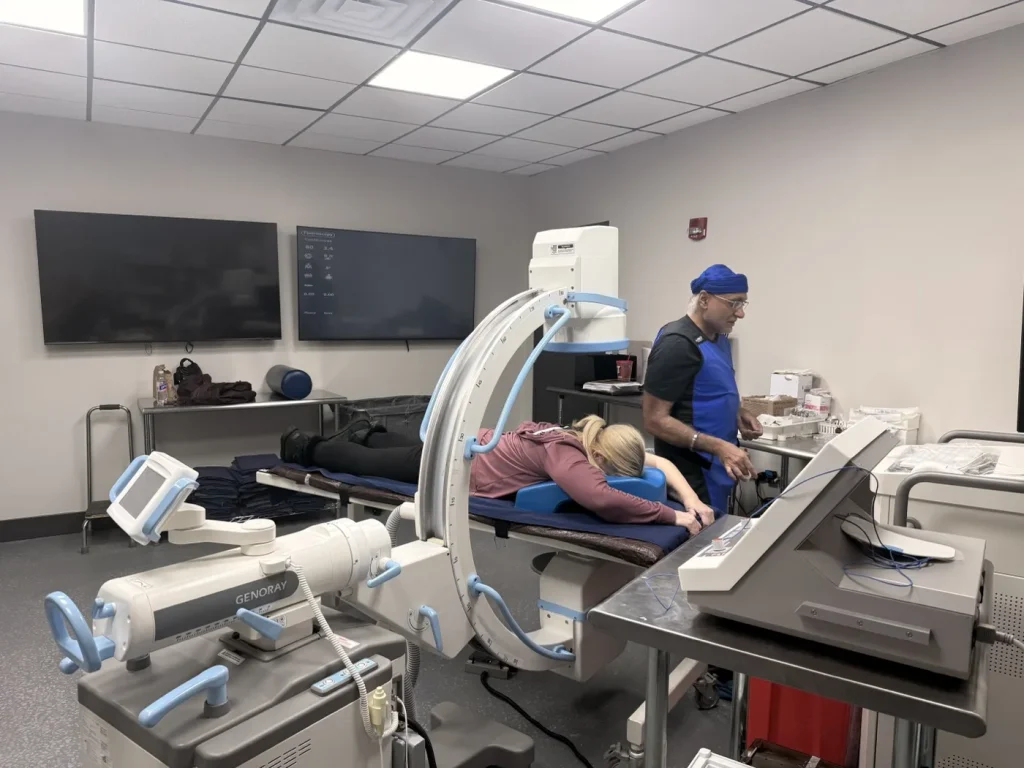
Kyphoplasty inflates a balloon inside the collapsed vertebra (spine bone) before cement goes in. Vertebroplasty injects cement straight into the bone as it sits. That balloon step is the whole difference. It is why only kyphoplasty is said to restore height. Here is what the comparison studies really show. The height gained is measured in millimeters. Much of it is lost again under normal loading. And it has never been shown to be the reason patients feel better.
This page compares the two procedures on height alone. If you are earlier in the process, start with vertebral compression fracture and sudden back pain. It covers how the bone fails, what the placebo-controlled trials found, and whether cement is needed at all.
The mechanical difference
Bone is not a hollow box. A vertebral body is a spongy lattice of bone, and a compression fracture is that lattice buckling under load.
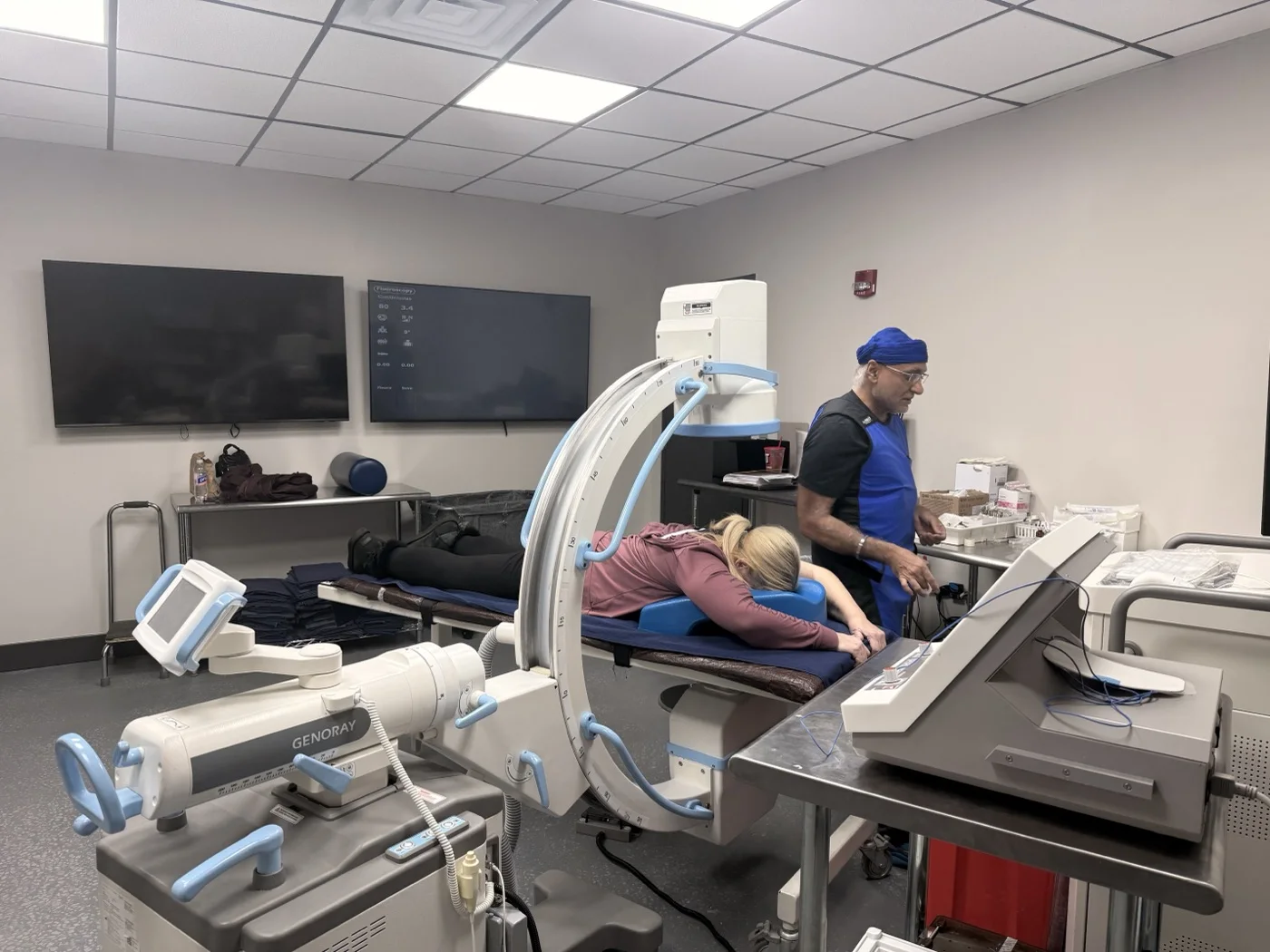
Kyphoplasty passes a balloon into the broken bone and inflates it to make a cavity. The balloon comes out, and the space is filled with polymethyl methacrylate cement. Vertebroplasty skips the balloon. It injects cement under pressure straight into the existing lattice.
Both end with cement in bone. Only one tries to change the shape of the vertebra first. Neither rebuilds bone — cement acts as a splint. It does not turn into bone.
What the height numbers actually show
A comparison review in Current Reviews in Musculoskeletal Medicine put the difference in millimeters, not percentages. Right after the procedure, the kyphoplasty group gained 2.7 mm of height on average, against 0.7 mm for vertebroplasty.1
That is a real difference. And it is smaller than most patients picture when they hear “height restoration.”
The same review gives the more important catch. Those early gains did not hold up under repeated loading. The kyphoplasty samples lost an average of 4.2 mm. The vertebroplasty samples lost 1.1 mm.1 The procedure that gains more height also gives more of it back once the spine goes back to work.
Another figure from the same review is often quoted without that loading context: 97% restoration of original height with kyphoplasty against 30% with vertebroplasty.1 On its own, it suggests a near-complete fix. Read next to the loading data, it describes a measurement taken at the best possible moment.
Height is not the outcome you came for
Height is easy to photograph. Pain is the reason anyone is in the room.
No trial has shown that the millimeters gained are what bring relief. Both procedures aim to reduce tiny movements across the break. That steadying is what best fits what patients report. Whether cement also affects nerve endings inside the bone is still a theory, not a proven fact.
This matters when a procedure is sold on height alone. If height is given as the reason to choose kyphoplasty, ask what result that height is supposed to change.
What happens after the cement
A vertebral compression fracture is a sign that bone is failing everywhere, not just in one spot. Compression fractures carry roughly a five-fold higher risk of more fractures, nearby or far away.2
Neither procedure changes that path. A matched analysis in Cureus found that within one year, 55.7% of kyphoplasty patients and 51.9% of vertebroplasty patients had another thoracic or lumbar fracture.3 Both numbers are high, and they are close to each other.
That is the most useful comparison on this page. The choice between balloon and no balloon moves height by millimeters. It does not really change what happens to the rest of the spine over the next year. What changes that is treating the bone disease — and cement is not a treatment for osteoporosis.
Patient selection decides more than technique
A new fracture with swelling inside the bone on MRI acts differently from an old, healed deformity. The height question only matters while the fracture is still active. A vertebra that healed months ago will not re-expand.
We also look at why the bone failed. Osteoporosis, poorly controlled diabetes, vitamin D levels and poor nutrition are not side notes on a fracture workup. They are why the fracture happened, and why the next one will.
The most common sound answer to “which of these two should I have” is that the fracture does not yet need either. Many heal on their own over 6 to 12 weeks.
Where this fits in the rest of your care
At Padda Institute Center for Interventional Pain Management, we look at a fracture as part of a whole system, not a single spot. Pain that lasts after a vertebra is stabilized often comes from somewhere else. It may be the facet joints, an irritated nerve root, or an overactive nervous system that no longer needs input from the body to keep firing.
That is why the workup may lead to a facet joint injection or a diagnostic nerve block instead of more cement. It is also why scans alone do not settle the question. Dr. Padda covers that reasoning in what imaging can and cannot show about pain.
The full range of options is listed under pain treatments. The clinical team is introduced on the pain management doctors in St. Louis page.
Dr. Padda discusses vertebral compression fractures and what cement actually does in this video on the practice’s channel: Vertebral Compression Fracture: Why a Cough Can Break a Spine.
Frequently asked questions
Does kyphoplasty restore more height than vertebroplasty?
Yes, but by millimeters, not by a transformation — about 2.7 mm against 0.7 mm right after the procedure. Much of that gain is lost again under repeated loading. The procedures and when they are used are described on the kyphoplasty page.
Does vertebroplasty restore any height at all?
It is not built to. Vertebroplasty steadies the vertebra in its current shape. The small measured gains are a side effect of cement filling the lattice. See the vertebroplasty page for when it fits.
Does restoring height reduce pain?
That has not been proven. When they work, both procedures are thought to work by reducing tiny movements across the break. The evidence on relief is covered in detail in vertebral compression fracture and sudden back pain.
Will either procedure stop me from fracturing again?
No. Roughly half of patients in a matched one-year analysis had another thoracic or lumbar fracture, no matter which procedure they had. Lowering that risk means treating the bone disease underneath, not the single vertebra.
What if my back still hurts after the cement?
Lasting pain usually points to a different pain source, such as the facet joints or an irritated nerve root. Those are tested directly with a facet joint injection or a nerve block, not guessed from scans.
How do I get evaluated in St. Louis?
Padda Institute Center for Interventional Pain Management is at 4477 Woodson Road, Suite 100, St. Louis, MO 63134, next to St. Louis Lambert International Airport. A second location is at 12174 Natural Bridge Rd, St. Louis, MO 63044. Call (314) 481-5000 or text (314) 886-5902, Monday through Friday, 8:00 AM to 5:00 PM. Bring your scans, or request an appointment.
Sources
- McCall T, Cole C, Dailey A. Vertebroplasty and kyphoplasty: a comparative review of efficacy and adverse events. Current Reviews in Musculoskeletal Medicine. 2008. PMC2684146
- Munakomi S, Stretanski MF, Das JM. Vertebral Augmentation. StatPearls. NBK547726
- Belt NG, Lee A, Sanghvi P, Mistovich RJ, Belding J. Comparative Long-Term Outcomes of Vertebroplasty Versus Kyphoplasty for Osteoporotic Vertebral Compression Fractures: A Propensity-Matched Analysis. Cureus. 2025. PMC12688411
Dr. Gurpreet Singh Padda, MD, MBA, MHP


